Eysenck Theory of Personality | Introvert | Extrovert | Psychoticism | Neuroticism | Hindi | Urdu
Keywords
Summary
153 words
Critical Evaluation
Value of the Information & Strength of the Argument
The video provides a accessible introduction to Eysenck’s theory, useful for beginners. It clearly distinguishes the three dimensions and explains their biological bases, particularly the role of the autonomic nervous system. However, the argumentation is largely descriptive rather than critical; the presenter does not evaluate evidence or discuss controversies. The explanation of nervous system arousal is oversimplified and some translations are confusing. The value lies in its clarity and structure, but it does not offer new insights or rigorous analysis.
Scientific Rigor, Source Quality, Title Accuracy
The scientific rigor is weak: no sources are cited, empirical studies are not mentioned, and the theory is presented as established fact without critical appraisal. Terminology is sometimes misused (e.g., confusing sympathetic and parasympathetic systems). The title/content mismatch regarding language is notable, and the lack of citations undermines reliability. The content is generally consistent with Eysenck’s published theory, but the presentation lacks nuance and precision.
160 words
Title / Content Match
The title claims Hindi/Urdu as the language, but the actual spoken language is Arabic, which is a significant mismatch. Content otherwise matches the stated topic.
Quality & Reliability
5/10
The video presents a basic and generally accurate overview of Eysenck's PEN model, but it lacks citations, simplifies complex concepts, and contains a few inaccuracies in terminology. The presentation is didactic but not rigorous.
Key Moments
Markers derived by PSI from the transcript: the creator did not define chapters.
- Introduction to the lecture and definition of personality.
- Background on Eysenck's work at the Maudsley Hospital.
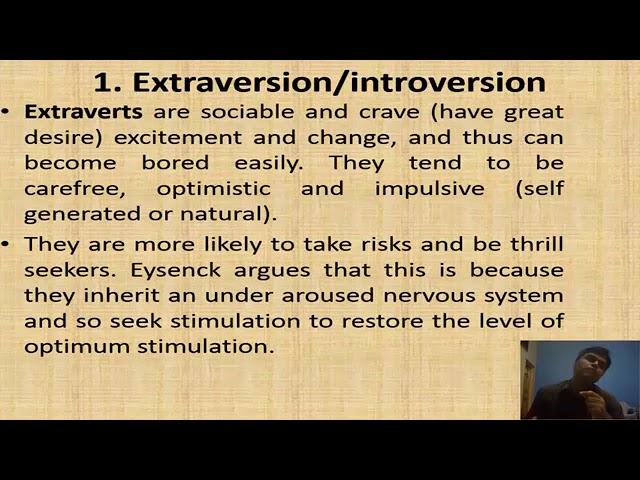
- Explanation of introversion and extraversion, including nervous system arousal.
- Discussion of neuroticism and the role of the sympathetic nervous system.
- Introduction of psychoticism as the third dimension.
- Summary and concluding remarks.
Contribution & Novelties
The video offers a simplified, didactic summary of Eysenck’s PEN model, useful for quick learning but with no original contribution. It highlights the biological basis of personality traits, which may help beginners understand the theory’s foundations.
Pour aller plus loin :
- Hans Eysenck biography — Provides context on the theorist and his work.
- Extraversion and introversion — Details definitions and related research.
- Neuroticism — Explains the trait and its psychological underpinnings.
- Psychoticism — Describes the third dimension in the PEN model.
81 words
Radar Profile
The radar profile shows moderate scores across quantity, quality, and reliability, with a low technical level. This indicates a basic introductory lecture that is accessible but not deeply rigorous or original.