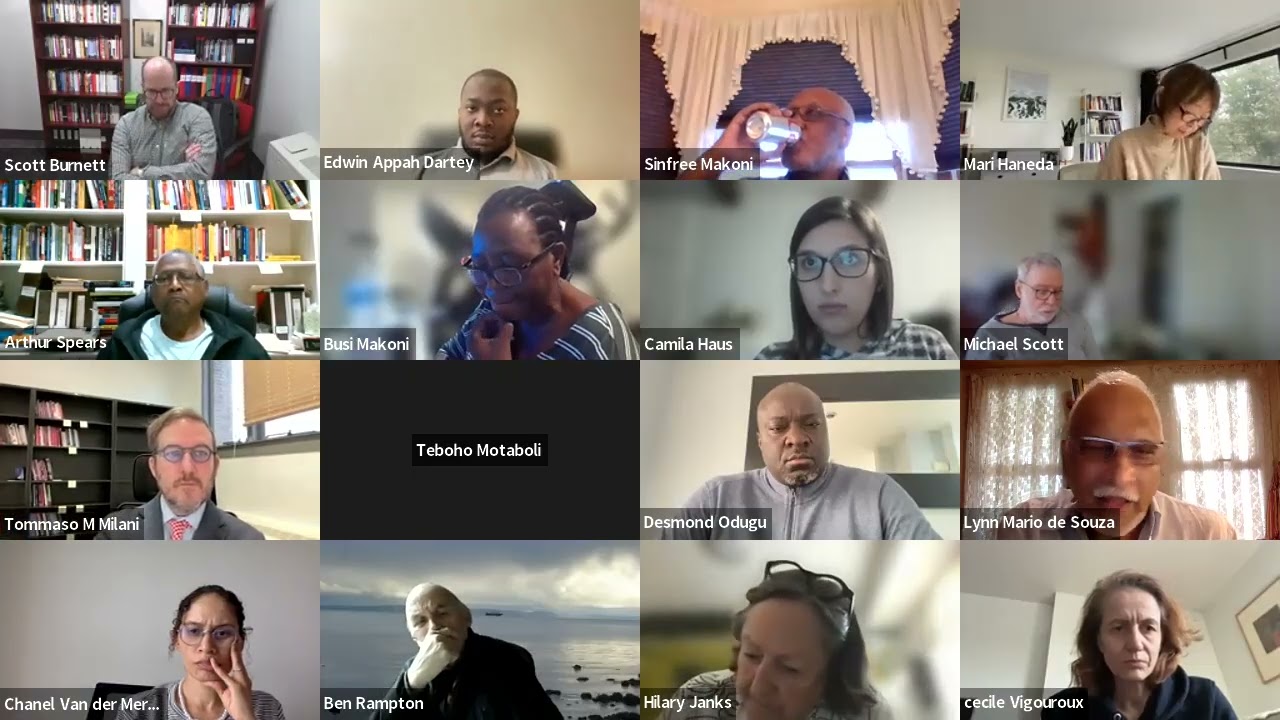
African Studies Global Virtual Forum: Decoloniality & Southern Epistemologies - Lynn Mario de Souza
Keywords
Summary
168 words
Critical Evaluation
Value of the Information & Strength of the Argument
The value of this content lies in its incisive critique of the monolingual and Eurocentric foundations of linguistics, offering a compelling alternative grounded in southern epistemologies. De Souza’s argumentation is coherent, moving from biographical experience to theoretical frameworks, then to concrete examples from Brazil and Quilombola thought. He effectively connects abstract concepts to real-world linguistic policies and power asymmetries, making a strong case for decolonizing linguistics. However, the discussion is largely theoretical and relies on the authority of the speaker and cited thinkers rather than empirical evidence, which limits its argumentative strength for practitioners demanding data-driven analysis.
Scientific Rigor, Source Quality, Title Accuracy
The scientific rigor is moderate: the speaker cites recognized scholars like Khubchandani and Spivak, and introduces Antonio Bispo’s oral philosophy, but no systematic literature review or empirical evidence is presented. The sources are credible but not exhaustively verified, and the format is an open-ended conversation rather than a closed scholarly presentation. The title precisely reflects the video’s content, though it omits the conversational and exploratory nuance. The adequacy between title and content is high, as the video indeed focuses on decoloniality and southern epistemologies in linguistics.
198 words
Title / Content Match
The title accurately describes the content: a virtual forum on decoloniality and southern epistemologies in linguistics.
Quality & Reliability
7/10
Presentation by a senior professor in applied linguistics, with references to established scholars. However, the format is an informal conversation, lacking empirical data or systematic review.
Key Moments
Markers derived by PSI from the transcript: the creator did not define chapters.
- Introduction of the speaker and topic by the host.
- De Souza begins his talk, critiquing monolingual presuppositions in linguistics.
- Discussion of Khubchandani's work on pluralingualism and the concept of a pluralingual ethos.
- Introduction of Antonio Bispo's concepts of confluence and transfluence in a Quilombola perspective.
- Makoni asks about the impact of De Souza's work and De Souza reflects on his academic position in Brazil.
Cited Sources
- Khubchandani, L. - works on pluralingualism and language in India — De Souza cites Khubchandani to critique the universalization of European language models and introduce concepts like synergy and serendipity.
- Spivak, G.C. - 'Can the Subaltern Speak?' — De Souza refers to Spivak's idea of abandoning privilege as a prerequisite for decolonial engagement.
- Bispo, A. - oral philosophy on confluence and transfluence — De Souza presents Bispo's Quilombola thought to illustrate a cosmological perspective on cultural and linguistic entanglement.
Concurring Sources
- Decoloniality - Wikipedia — Supports the video's emphasis on decolonial perspectives and the critique of Eurocentric knowledge systems.
- Plurilingualism - Wikipedia — Aligns with the video's argument that multilingualism is the norm and individual repertoires are hybrid.
Contribution & Novelties
The video offers an original contribution by synthesizing decolonial theory, pluralingualism, and southern epistemologies, particularly through the concepts of ‘marking the unmarked’ and ‘bringing the body back’ in linguistic analysis. De Souza’s engagement with Antonio Bispo’s transfluence adds a novel, non-Western framework for understanding cultural mixing. The dialogue also highlights pragmatic strategies for decolonizing academic practice within hegemonic institutions.
Pour aller plus loin :
- Decoloniality — Overview of decolonial theory and its key thinkers.
- Plurilingualism — Related concept to pluralingualism, emphasizing individual repertoires.
- Gayatri Spivak — Background on a key postcolonial scholar cited in the talk.
96 words
Radar Profile
The radar profile shows balanced, moderately high scores for information quality and reliability, with lower scores for quantity and technical depth. This indicates a focused, well-argued conceptual talk rather than a data-driven or encyclopedic lecture.