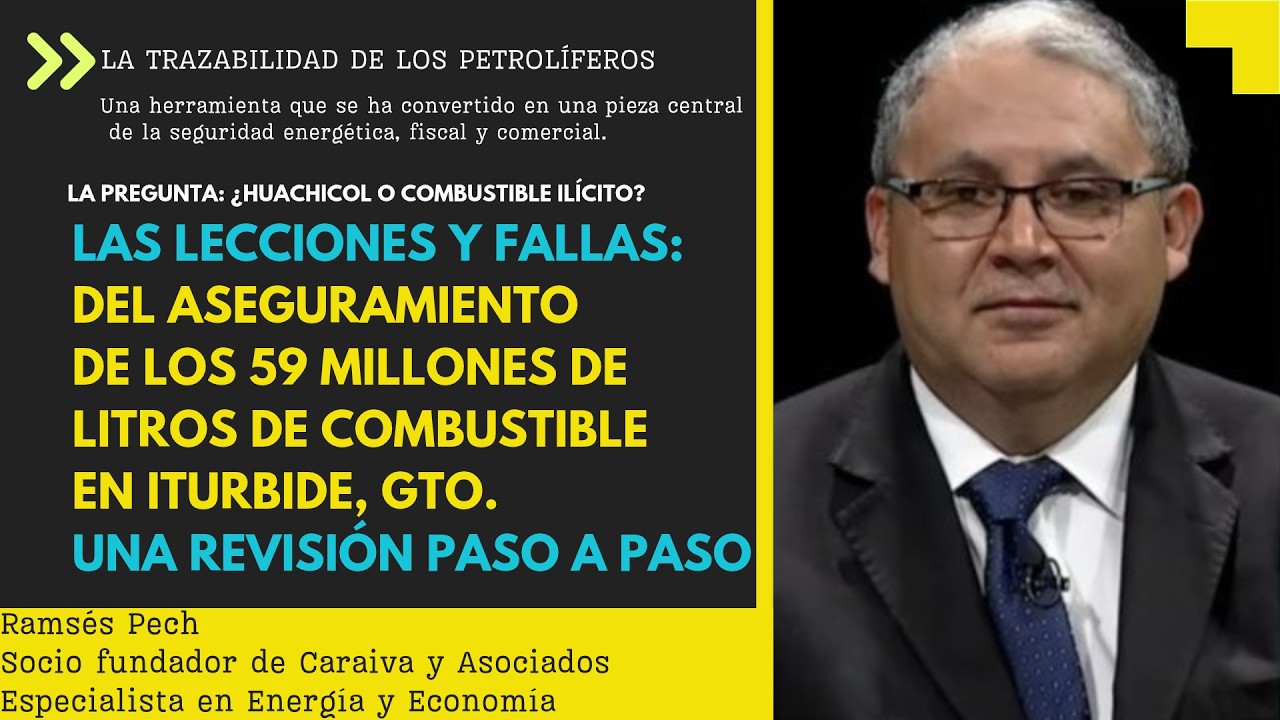
59 millones de litros de combustible: evidencia vacíos legales y malos procedimientos
59 Million Liters of Fuel: Evidence of Legal Loopholes and Malpractice
Keywords
Summary
206 words
Critical Evaluation
Value of the Information & Strength of the Argument
The video provides valuable insights into the procedural and legal complexities of fuel regulation in Mexico. It highlights the critical role of traceability and the importance of distinguishing between physical presence and documentary legitimacy. The argumentation is coherent, starting from a specific case and expanding to general principles. Pech builds a logical case for why the investigation was flawed, using analogies (like the package in a warehouse) to make abstract concepts accessible. He supports his claims with references to standard investigative procedures and institutional roles, though he acknowledges reliance on public information. The recommendations are practical and constructive, though they remain expert opinion rather than empirically validated solutions. Overall, the argument is persuasive within its stated scope, but the lack of access to official documents limits the conclusiveness of some assertions.
Scientific Rigor, Source Quality, Title Accuracy
The video’s rigor is moderate: Pech explicitly states that the analysis draws from journalistic notes, official statements, and public references, and clarifies that the FGR investigation file is confidential. He does not provide specific sources with URLs, which limits verifiability. The reasoning is internally consistent, and he distinguishes between facts and inferences. The title matches the content well, as the video indeed highlights legal gaps and procedural errors. However, the lack of direct evidence and the speculative nature of some criticisms prevent a high reliability rating. The presentation is clear and structured with visual aids, enhancing understandability.
243 words
Title / Content Match
The title accurately captures the video's core argument about legal gaps and flawed procedures in a fuel seizure case.
Quality & Reliability
7/10
The analysis is based on publicly available news reports and official communications, but lacks direct access to the investigation file, limiting full verification. The reasoning is logical and well-structured, but some claims are speculative and the recommendations, while sensible, are not empirically tested.
Key Moments
Markers derived by PSI from the transcript: the creator did not define chapters.
- Introduction of the case: a tanker truck with 33,000 liters was stopped without proper documentation.
- Explanation of CFDI (digital tax invoice) and its role in proving legal origin of fuel.
- Critique that documentary verification was not completed before the seizure, highlighting the failure point.
- Discussion of the consequences of premature labeling as 'huachicol' and the importance of precise language.
- Presentation of recommendations for a unified data platform and better coordination between institutions.
Contribution & Novelties
The video offers a structured, expert perspective on a specific recent case, emphasizing the procedural flaws in Mexican fuel regulation. It brings attention to the gap between physical presence and documentary proof, and argues for a more rigorous, data-driven investigative approach. Its novelty lies in prescriptive recommendations for institutional coordination, though it is not an original study.
Pour aller plus loin :
- Fuel theft in Mexico — Background on the huachicol phenomenon and related issues.
- CFDI (Comprobante Fiscal Digital por Internet) — The electronic invoice system in Mexico, crucial for fuel traceability; no URL provided due to uncertainty.
- Trazabilidad (Supply chain traceability) — General concept applicable to fuel logistics; consider exploring ISO standards; no URL provided for reliability concerns.
119 words
Radar Profile
The radar profile shows balanced scores with slightly higher quantitative and qualitative information, but lower technical depth and global reliability. This reflects a well-argued opinion piece grounded in public data but lacking verified sources and deep technical modeling.