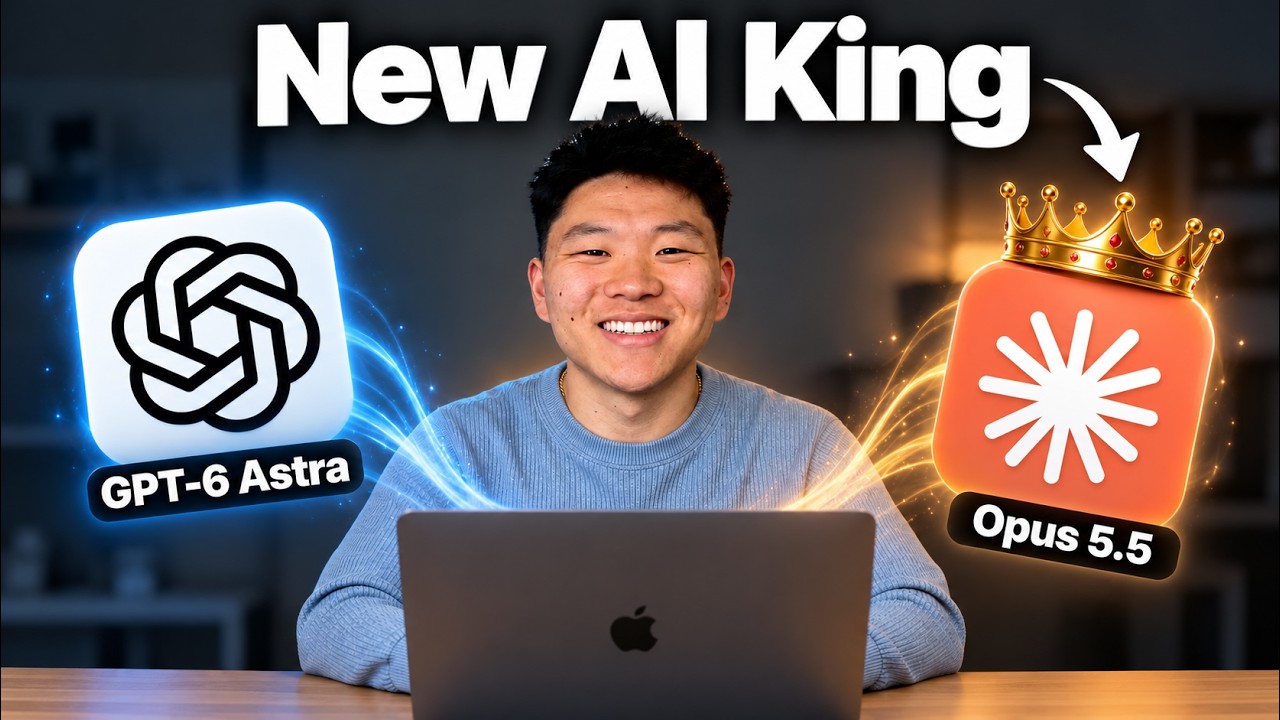
I Tested Opus 5.5 vs. GPT-6 Astra on 12 Real Use Cases
Keywords
Summary
150 words
Critical Evaluation
Value of the Information & Strength of the Argument
The value of this video lies in its practical, hands-on evaluation of two leading AI models. By performing real tasks and showing actual outputs, the creator provides tangible evidence of model strengths and weaknesses, including measurable metrics like time and cost. This is far more informative than benchmark scores alone. The argumentation is built on direct experience; however, it is inherently subjective—taste plays a large role in design judgments, and the sample size is limited to 12 tasks. The creator is transparent about his preferences and even acknowledges a mistake in a previous video, which strengthens his credibility. The cost analysis is particularly useful, revealing that despite Astra being 2.5x more expensive per API call, actual task costs vary widely, sometimes being cheaper than Opus. The main weakness is the lack of statistical rigor and generalizability, but as an expert opinion grounded in demonstrated outputs, the argumentation is solid and insightful.
Scientific Rigor, Source Quality, Title Accuracy
The video does not cite formal academic sources, relying instead on the creator’s own experiments and official API pricing listed on An AI and Anthropic’s websites. He provides links to his own tools and courses, which are promotional but not central to the evaluation. The title accurately promises a head-to-head comparison on 12 use cases, and the content delivers exactly that. The methodology is transparent—he uses consistent prompts, shows both outputs, and shares time and cost data. However, the evaluation criteria for output quality are subjective and not quantified, which limits scientific rigor. The video is a practitioner’s review rather than a controlled study, and while the information is valuable, it should not be taken as definitive proof of model superiority. The creator also acknowledges a past mistake, indicating a degree of honesty and self-correction that enhances trustworthiness.
304 words
Title / Content Match
The title accurately reflects the video's content: a systematic comparison of the two models on 12 practical use cases.
Quality & Reliability
8/10
The video provides a detailed hands-on comparison of two AI models across 12 real-world tasks, with transparent cost and time data. The creator's expertise in AI automation adds credibility, though conclusions are subjective and based on personal preference.
Chapters
Cited Sources
- Scrollcraft Website Design Skill — Free skill used for website design tasks in the comparison.
- AI OS Course — Free course mentioned as a resource for adopting AI systems.
- Glaido - Voice to Text — Tool for voice-to-text conversion, used as a productivity aid.
- Hostinger VPS — VPS hosting service recommended for running AI agents like Claude.
Contribution & Novelties
The video contributes a unique, applied perspective on AI model comparison, focusing on real-world deliverables rather than abstract benchmarks. It introduces a cost-per-task analysis that is rarely found in such comparisons, helping viewers understand economic implications. The creator’s hands-on approach with detailed walkthroughs provides a template for evaluating AI models in practical settings.
Pour aller plus loin :
- Artificial intelligence — Background on the field of AI.
- Large language model — Core architecture underlying both models.
- Intelligent agent — Concept relevant to autonomous task execution.
- Claude (language model) — Overview of Anthropic’s Claude series.
- Generative pre-trained transformer — Technical basis for OpenAI’s GPT models.
104 words
Radar Profile
The radar profile shows high scores in information quantity and technical level, reflecting the video's thorough coverage and use of professional terminology. The quality and reliability scores are moderate, consistent with the subjective nature of the evaluation and the lack of external validation. This indicates a dense but opinion-driven content.