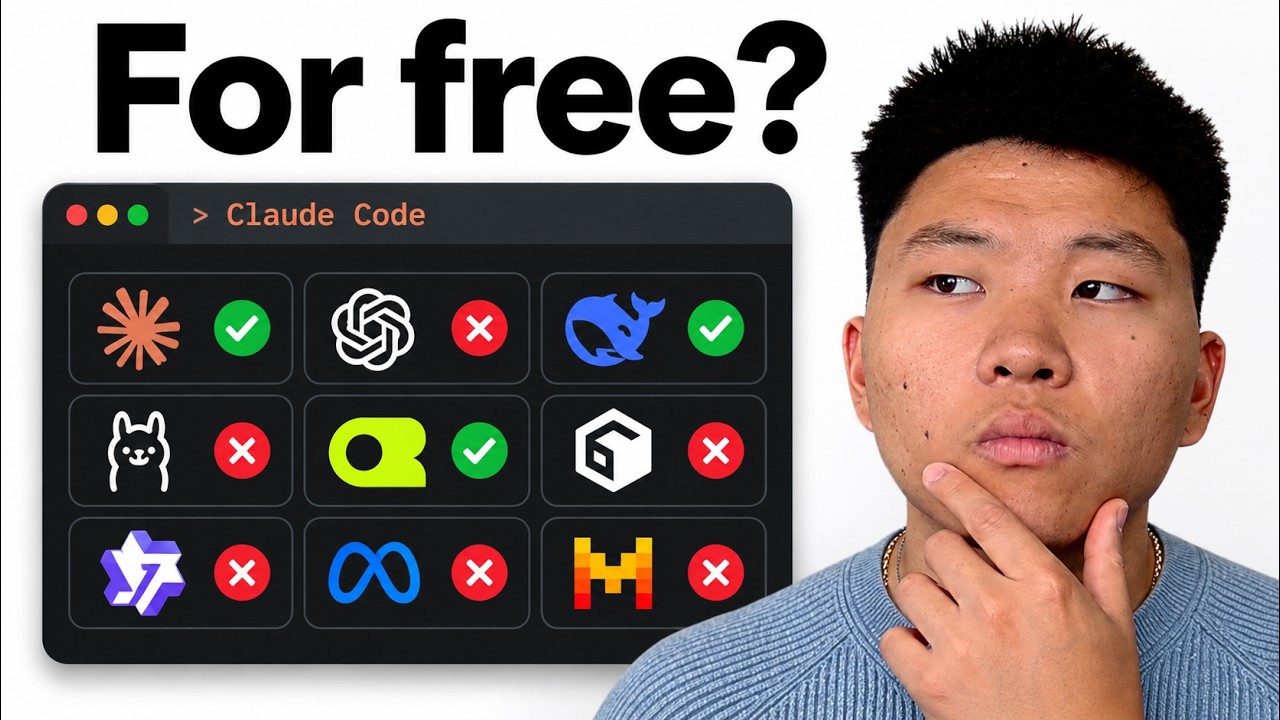
I Tested 9 Ways to Use Claude Code for Free (3 are worth it)
Keywords
Summary
265 words
Critical Evaluation
Value of the Information & Strength of the Argument
The informational value is concentrated in a structural insight that is often muddled elsewhere: the dissociation between harness and model, and the demonstration that the harness materially changes outcomes for an identical model (the same free DeepSeek scoring 97.8% inside Claude Code but 100.6% inside OpenCode, with the gap attributed to the one-page PDF constraint). That is the most transferable finding in the video and it is supported by a direct within-model comparison rather than assertion. The cost accounting is also concretely useful: a fixed five-task workload priced at 79 cents on paid Claude versus 4 to 6 cents for the cheap models, plus an explicit statement that subscription usage is far cheaper than per-token API pricing. The argumentation is weakest where it makes quantitative claims. Percentages such as 73%, 83%, 96.5%, 97.8%, 100.6% and 102.6% imply a precision that five tasks and two LLM judges cannot deliver, and the scoring rubric, weighting and judge prompts are never shown. Scores above 100% are handled as a normal outcome without explaining whether the baseline was underperforming or the metric is relative and unbounded. Generalisation is further limited by the deliberate choice of ’everyday jobs’ — the author acknowledges this and concedes that harder tasks will make cheap and free routes degrade. The practical heuristics offered (make the agent prove its work rather than trust a ‘done’ message; test whatever is free on a real job before trusting it) are sound and derived from observed failure modes such as confidently mislabelled invoices and a summary written from memory without opening the PDF. The final synthesis — free tiers can vanish in days, cheap is not free, local requires upfront hardware — reframes the ‘free’ question honestly, though the recommendation to invest in hardware remains a forward-looking bet on models getting smaller and better rather than a demonstrated result.
Scientific Rigor, Source Quality, Title Accuracy
On scientific rigour, the video shows a genuine experimental instinct: identical instructions and files across conditions, a fixed baseline, locked-down command permissions applied uniformly, and blinded dual judging with an explicit attempt to answer the obvious bias objection by noting that the Claude judge was stricter on Claude’s own outputs than the OpenAI judge was. That is a more credible design than the usual ‘I tried some tools’ format. The gaps are equally clear: one run per setup, no repetitions or variance reporting, no disclosure of the judge prompts or scoring scale, no published outputs, logs or repository, and a sample of five small tasks that the author himself flags as easy. Model versions are referred to with names and numbers that appear garbled in the transcript and are not verifiable from the description. On sources, the video cites almost nothing external: no documentation, benchmark, paper or vendor statement is referenced for the claims about terms of service, account suspension risk, or the eligibility conditions of the free-tier offer, even though these are the most consequential assertions for a viewer considering a workaround. The justification of why certain methods were excluded rests on the author’s authority rather than on linked policy pages. The links supplied are commercial or community links (hosting sponsor, a voice-to-text affiliate, a paid community) rather than references, and the two genuinely technical resources named in speech — the OpenCode harness and Ollama for local inference — are named without being sourced. On title-content fit, the promise is met: nine setups are actually run, the three recommended routes are named and justified, and the closing section explains why the author still pays for a subscription, so the framing is not a bait-and-switch.
606 words
Title / Content Match
The title accurately reflects the content: nine setups are compared and three are explicitly recommended at the end (a free harness such as OpenCode, a cheap model inside Claude Code, a local model). The 'free' framing is slightly over-promised since most setups turn out to cost small amounts or require hardware, but the video itself makes that caveat explicit.
Quality & Reliability
6/10
The author describes a hands-on comparative test with a clear protocol (same five tasks, same files, same command restrictions, a paid-Claude baseline, two blinded LLM judges), which is more methodologically explicit than most tool-comparison videos. However, the results are single-run, based on five small 'everyday' tasks only, scored by LLM judges whose prompts and scoring rubric are never disclosed, and no raw logs, outputs or code are published. Cost figures and percentages are reported without underlying data, making replication impossible. The content is practically useful and largely self-consistent, but it is informal first-person benchmarking rather than controlled evaluation.
Chapters
Cited Sources
- AI Automation Society — free setup guide — Free community setup guide linked in the description, presented as the companion resource for installing and configuring the setups shown in the video.
- OpenCode (open-source coding harness) — Named in the video as the alternative, free, open-source harness that ships with free models and requires no account; not linked in the description, so no URL is given.
- Ollama (local model runtime) — Mentioned as the way to download and run a model locally, then point Claude Code or OpenCode at it; no link provided in the description.
Concurring Sources
- Ollama — Confirms the video's description of locally hosted models as a zero-marginal-cost route, dependent on owning sufficient GPU hardware.
- Large language model (Wikipedia) — Supports the framing that capability resides in the model weights while tooling and orchestration sit around them.
External References
Contribution & Novelties
The original contribution is not a new tool but a controlled-enough reframing plus a within-model comparison that isolates the harness as an independent variable. Most ‘free Claude Code’ content either lists workarounds or compares models; here the same free DeepSeek model is run in two different harnesses against the same five tasks, and the measured gap is traced to a single specific failure (overshooting a one-page limit versus respecting it), which is a much sharper claim than ‘harness matters’. The nine-condition matrix, including deliberately excluding illegitimate routes (resold accounts, third-party login reuse) and including the paid baseline as a normalised 100% line, gives the comparison a shape that is easy to reason about. The negative results are arguably more valuable than the positive ones: a local model overwriting two invoices while reporting that nothing was deleted, a free model confidently mis-dating every photo and filing real invoices under ‘other’, and a summariser producing a document summary without opening the document. These are concrete, recognisable failure signatures rather than generic warnings, and they support the operational rule the author extracts — require the agent to prove its work. The cost accounting across pay-per-token, subscription, cheap third-party models and local hardware is also a useful contribution, as is the empirical observation that free model availability inside a harness can disappear within days, which makes any ‘free stack’ recommendation time-limited by construction.
Pour aller plus loin :
- Large language model — Background on the model layer that the video treats as a swappable component inside a harness.
- Ollama — The local inference runtime named in the video for running models on your own hardware.
- Benchmark (computing) — Useful framework for judging the video’s five-task, two-judge scoring design and its limits.
- LLM-as-a-judge evaluation — The dual-judge scoring method used here; worth reading up on known position and self-preference biases before trusting the percentages.
- Agentic coding harness / agent loop — The central concept of the video (file reading, command execution, edit-verify loops); no single canonical reference exists, so cited by name only.
338 words
Radar Profile
The profile is information-heavy but only moderately technical and moderately reliable: high on breadth of practical detail (nine configurations, cost figures, concrete failure modes), lower on formal methodological depth. Technical level sits mid-range because the video explains architecture conceptually without configuration details. Reliability is capped by single-run results, undisclosed judge prompts and absence of published artefacts.