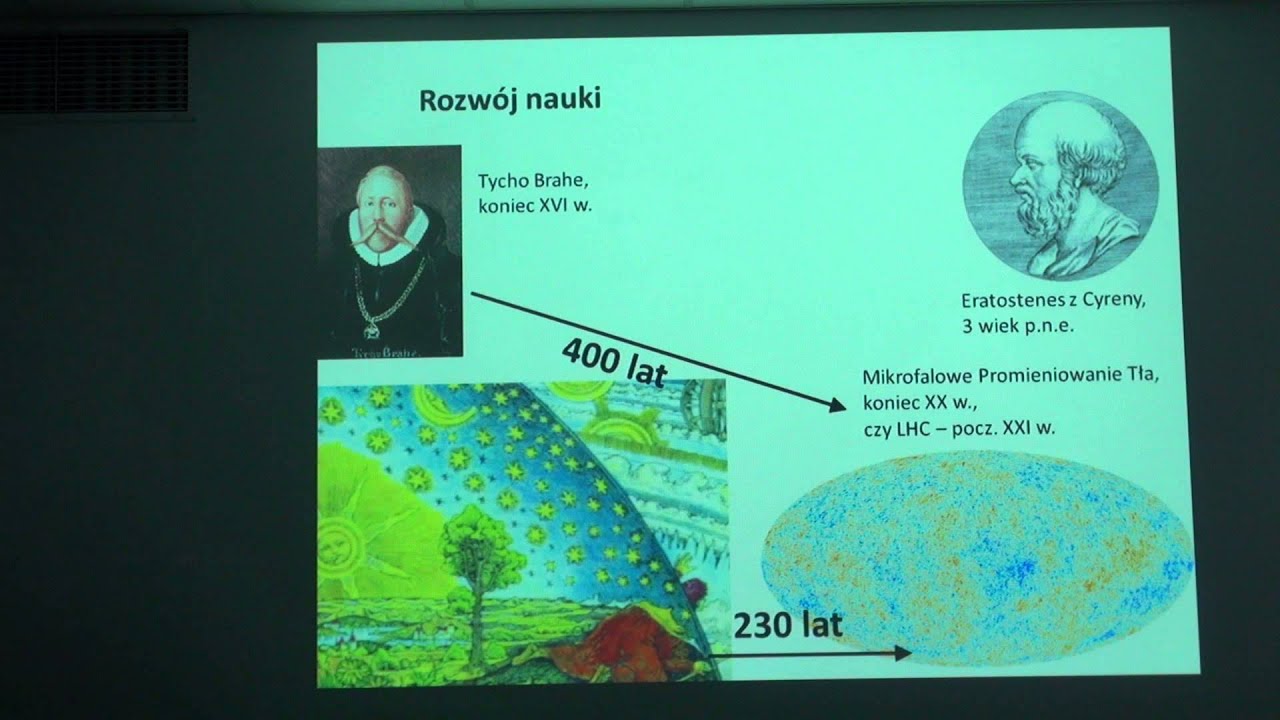
Mikrofalowe promieniowanie tła - kosmiczne "DNA" naszego Wszechświata
Microwave background radiation - cosmic "DNA" of our Universe
Keywords
Summary
191 words
Critical Evaluation
Value of the Information & Strength of the Argument
The lecture provides a high-value synthesis of modern cosmology, connecting historical discoveries with current measurements of the CMB. Sawicki’s argumentation is logical and evidence-based, clearly explaining how the CMB’s temperature, isotropy, and fluctuations lead to constraints on fundamental cosmological parameters. He presents the expansion of the universe as a well-supported fact, and systematically builds the case for the Big Bang model, addressing alternatives (like steady-state theory) and showing why the CMB and nucleosynthesis favor a hot, dense origin. The talk also integrates philosophical reflections on the nature of science and the role of authority, but always grounds the discussion in empirical data. The reasoning is thorough, and the speaker critically evaluates the limitations and open questions in the field.
Scientific Rigor, Source Quality, Title Accuracy
The scientific rigor is strong: the lecture cites key experiments (COBE, WMAP, Planck) and theoretical milestones (Friedmann, Lemaitre, nucleosynthesis) without overstating certainty. The speaker distinguishes established results from hypotheses (e.g., inflation, dark matter). No explicit sources are listed in the description, but the talk draws on standard cosmological literature and public data. The title is well-matched to the content, as the CMB is indeed portrayed as a ‘cosmic DNA’ encoding the universe’s history. However, the description lacks direct links to primary sources, which would have enhanced traceability. The adéquation between title and content is very good, and the content is presented with appropriate scientific caution.
239 words
Title / Content Match
The title accurately reflects the content: it focuses on the cosmic microwave background as a fundamental diagnostic of the universe's origin and evolution.
Quality & Reliability
8/10
The lecture is delivered by a physicist at the Institute of Physics of the Polish Academy of Sciences, covering well-established cosmological knowledge with references to key historical experiments and theories, and is part of a scientific seminar series.
Key Moments
Markers derived by PSI from the transcript: the creator did not define chapters.
- Introduction and presentation of the Hubble Ultra Deep Field image.
- Discovery of cosmic expansion: Hubble's law and the role of standard candles.
- Properties of the cosmic microwave background: blackbody spectrum and anisotropies.
- Big Bang nucleosynthesis and the origin of light elements.
- Future missions (e.g., James Webb) and implications for cosmology.
Cited Sources
- Hubble's law — The relationship between distance and recessional velocity of galaxies, fundamental to the universe's expansion.
- Planck satellite — Provided precise measurements of CMB anisotropies and cosmological parameters.
- Big Bang nucleosynthesis — Theory explaining the observed abundances of light elements during the early universe.
Contribution & Novelties
The lecture’s original contribution lies in its clear pedagogical synthesis of the CMB as a cornerstone of modern cosmology, weaving together historical context, observational evidence, and theoretical implications. It effectively communicates how a single observational dataset can constrain the age, geometry, and composition of the universe, and explains the connection between microphysics (nucleosynthesis) and cosmology. The “cosmic DNA” metaphor, while not new, is effectively used to emphasize the information encoded in the CMB.
Pour aller plus loin :
- Cosmic microwave background — Comprehensive overview of the CMB and its cosmological significance.
- Big Bang nucleosynthesis — Details the production of light elements in the early universe.
- Expansion of the universe — Explanation of the expanding spacetime and Hubble’s law.
- Inflation (cosmology) — The hypothesized exponential expansion phase that addresses several cosmological puzzles.
131 words
Radar Profile
The radar profile shows high scores in reliability and information quantity, with moderate technical level, reflecting a well-structured and comprehensive lecture that is accessible to a broad audience while maintaining scientific depth.