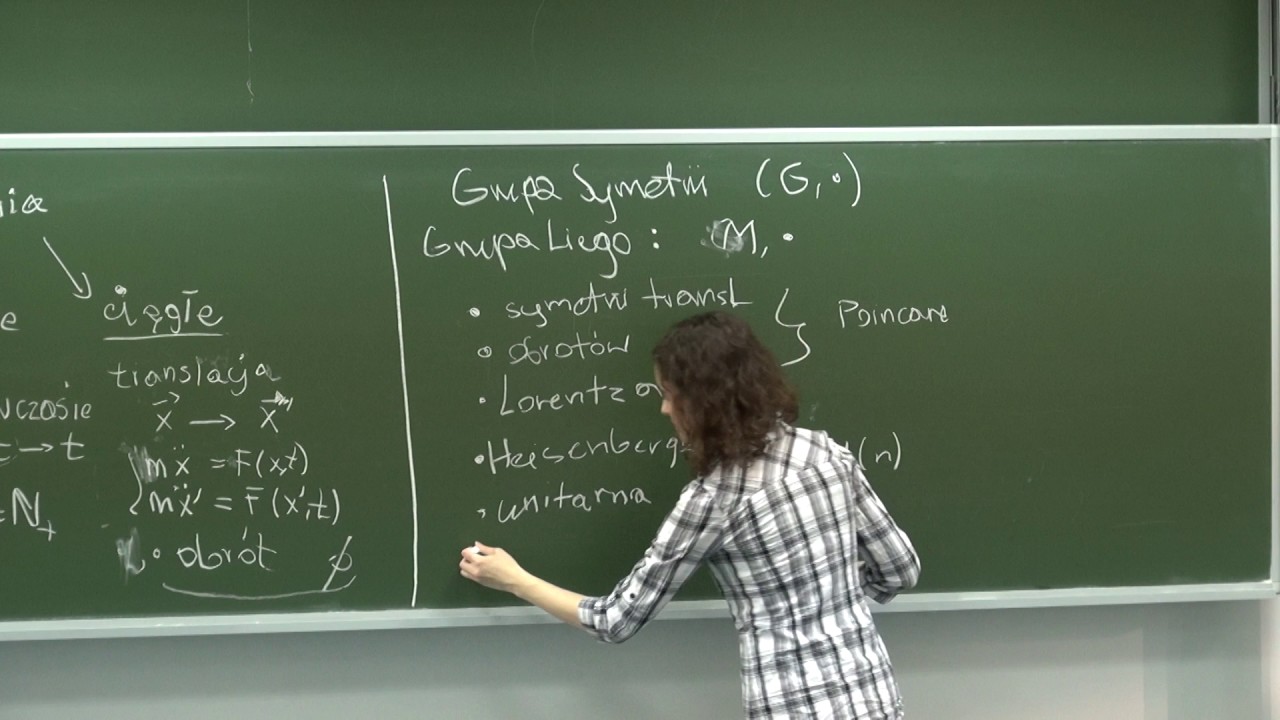
Symetrie ciągłe w fizyce, cz. I
Continuous symmetries in physics, part I
Keywords
Summary
142 words
Critical Evaluation
Value of the Information & Strength of the Argument
The value of the information lies in the clear exposition of foundational concepts of group theory applied to physics. The argumentation is sound: definitions are given precisely, and examples are worked out step by step. The transition from simple translation groups to the more complex Lorentz group is logical and well-paced. The demonstration of why rotations are non-abelian in 3D, and how infinitesimal generators linearize transformations, is particularly instructive. However, some parts, such as the discussion of generators, could benefit from more explicit connections to physical observables (e.g., momentum as translation generator), though the speaker acknowledges postponing that aspect.
Scientific Rigor, Source Quality, Title Accuracy
The scientific rigour is high: the mathematical content is standard and correctly presented, with appropriate notation. No external sources are cited in the video or description, but the material is foundational and verified in many textbooks. The title accurately reflects the content, and there is no mismatch. The absence of citations is typical for a didactic lecture, but it limits the ability to trace specific claims; nevertheless, the concepts are well-established. The presentation is coherent and does not introduce novel or controversial ideas, focusing instead on pedagogical clarity.
202 words
Title / Content Match
Le titre correspond exactement au contenu : il s'agit bien de la première partie d'un exposé sur les symétries continues en physique.
Quality & Reliability
8/10
The lecture is given by a researcher from a reputable Polish Academy of Sciences institute, presenting standard mathematical physics content (group theory, symmetries). The exposition is clear and accurate, though occasional hesitations and simplifications occur.
Key Moments
Markers derived by PSI from the transcript: the creator did not define chapters.
- Definition of symmetry as a transformation leaving physical laws unchanged.
- Distinction between discrete and continuous symmetries with examples.
- Introduction to groups: axioms, abelian groups, and symmetry groups.
- Representations and concept of standard representation.
- Infinitesimal generators and exponentiation for rotations and translations.
- Lorentz group: definition, metric preservation, and transformations.
- Poincaré group as combination of translations and Lorentz transformations, conclusion.
Contribution & Novelties
The lecture provides a clear and structured pedagogical introduction to continuous symmetries, bridging pure mathematics (group theory) and physics. Its originality lies in the step-by-step derivation of generators and representations, with concrete matrix examples for rotations and boosts. This serves as a solid foundation for further study in quantum mechanics and particle physics.
Pour aller plus loin :
- Group theory — Relevant as the core mathematical structure discussed.
- Lie group — Continuous symmetries form Lie groups, directly linked to the talk’s subject.
- Representation theory — Essential for understanding how group elements act on vector spaces, as presented in the video.
- Lorentz group — Focuses on the specific symmetry group of special relativity, discussed in the latter half.
117 words
Radar Profile
The radar profile shows high scores in technical level and information quality, reflecting the advanced and accurate mathematical content. The relatively lower score in information quantity suggests the lecture covers a broad topic but with moderate depth, while the overall high reliability indicates a trustworthy exposition.