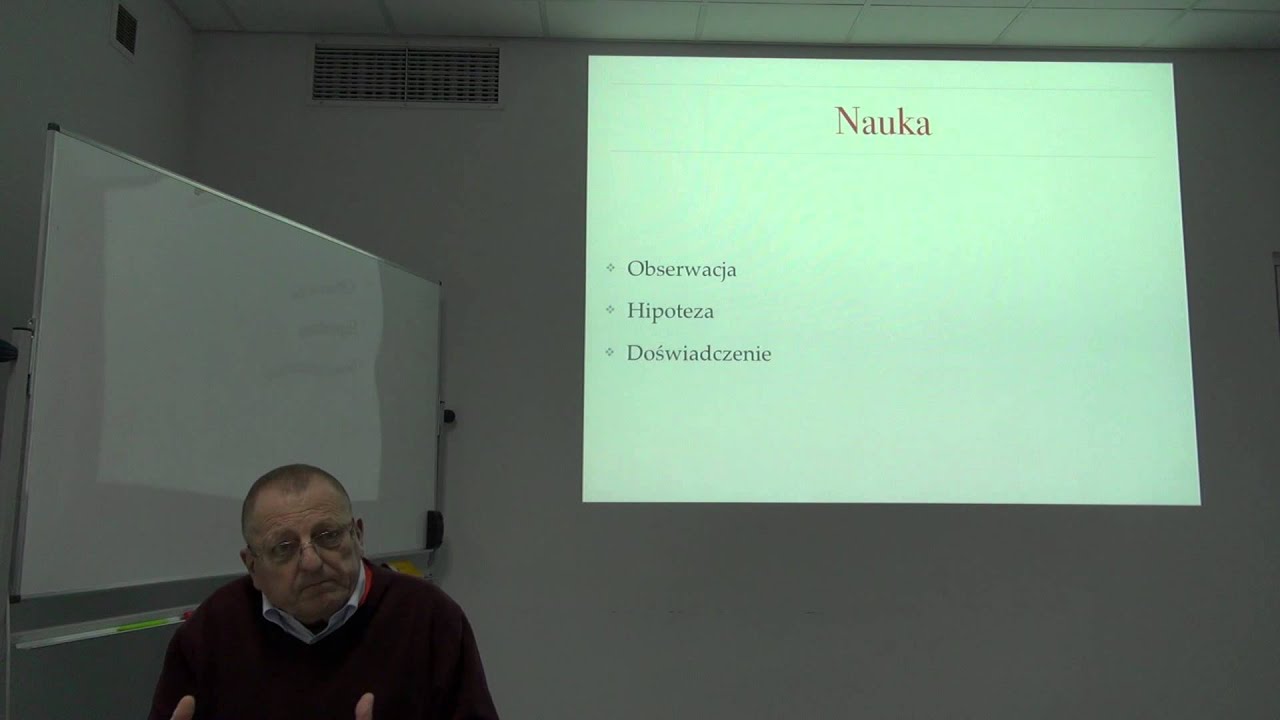
Zmierzyć to znaczy wiedzieć!
To measure is to know!
Keywords
Summary
253 words
Critical Evaluation
Value of the Information & Strength of the Argument
The lecture offers a coherent and persuasive argument for the primacy of measurement in physics, supported by a wide range of historical and conceptual examples. Turski skillfully weaves together references to canonical figures (Kelvin, Clifford, Pauli, Bohr, Einstein, Alvarez) to illustrate how experiment has repeatedly settled debates or exposed errors. The distinction between qualitative and quantitative approaches, and the notion of ‘safe truth’ (Clifford’s concept), provide a philosophical framework that elevates the talk beyond mere anecdote. The argument about computer experiments as a contested epistemic category is particularly insightful, acknowledging both their utility and their limitations, and the Alder–Wainwright discovery is presented as a concrete case of unexpected physical insight. The reasoning is clear and accessible, though the lecturer’s rhetorical style is conversational and at times meanders into asides, which may slightly dilute the line of argument.
Scientific Rigor, Source Quality, Title Accuracy
The lecture is rigorous in its use of historical examples and quotations, albeit largely from memory or without direct citations. Turski references specific books and papers (e.g., Natanson’s ‘Wstęp do fizyki teoretycznej’, Clifford’s ‘The Ethics of Belief’, the Alder–Wainwright 1967 paper) but does not provide exact sources or URLs, which limits verifiability from the video itself. The title accurately encapsulates the central message, but the content is a broad reflection on measurement rather than a focused exposition of a specific experiment. The description gives minimal metadata (lecture title and venue), and there is no supplementary bibliography. Nonetheless, the speaker’s expertise and the coherent integration of established historical facts lend a high degree of credibility to the narrative. The absence of disclosed conflicts of interest and the academic context further support the lecture’s scientific integrity.
286 words
Title / Content Match
The title 'To measure means to know' accurately reflects the central thesis of the lecture, which emphasizes measurement as the foundation of knowledge in physics.
Quality & Reliability
7/10
The lecture is delivered by a professor of physics and presents a well-structured argument about the essential role of measurement in physics, illustrated with historical examples and methodological reflections. However, no concrete external sources or references are provided in the description, and the talk is largely anecdotal and opinion-based rather than presenting new experimental data.
Key Moments
Markers derived by PSI from the transcript: the creator did not define chapters.
- Introduction of the lecture theme with a quote from Natanson's 1890 book on the role of verification by experiment.
- Discussion of Jan Heweliusz as a meticulous observer who made precise measurements without a telescope.
- Quotes from William Clifford and Lord Kelvin emphasizing that only exact experiment provides a basis for knowledge.
- The concept of Gedankenexperiment (thought experiment) introduced by Bohr and Einstein, and its distinction from real experiments.
- Mention of Anton Zeilinger as a modern experimentalist realizing thought experiments in the laboratory.
- Luis Alvarez's application of radioactive-materials-based measurements to probe the inside of the Cheops pyramid, illustrating precision of speaking.
- Discussion of the 'how' vs 'why' distinction in physics, with reference to Descartes and Galileo.
- Comparison of qualitative (Linnaean botany) and quantitative (classical chemistry) sciences, with culinary recipes as an analogy.
- Introduction of computer experiments as a third pillar of physics, and the Alder–Wainwright discovery of long-time tails in correlation functions.
Contribution & Novelties
The lecture provides a compelling synthesis of historical anecdotes and epistemological arguments to underscore the centrality of measurement in physics. Its original contribution lies in framing computer experiments as a distinct epistemological category and in highlighting the Alder–Wainwright effect as a rare case of a genuinely new physical phenomenon discovered via simulation. For viewers unfamiliar with the history of experimental physics, the talk offers a rich narrative that connects standalone facts into a coherent worldview.
Pour aller plus loin :
- Thought experiment — Pertinent to the lecture’s discussion of Gedankenexperimente.
- Alder–Wainwright effect — Directly relates to the computer experiment described.
- Scientific method — Underpins the lecture’s emphasis on measurement and verification.
- Luis Alvarez — Provides background on the scientist and the pyramid experiment.
123 words
Radar Profile
The radar profile shows strong scores in quantity and quality of information, reflecting the lecture's rich content and expert delivery. The technical level is moderately high, indicating accessibility to a general audience with some physics background. The lower reliability score stems from the absence of externally verifiable sources, while the overall high values align with the lecture's authoritative tone and educational value.