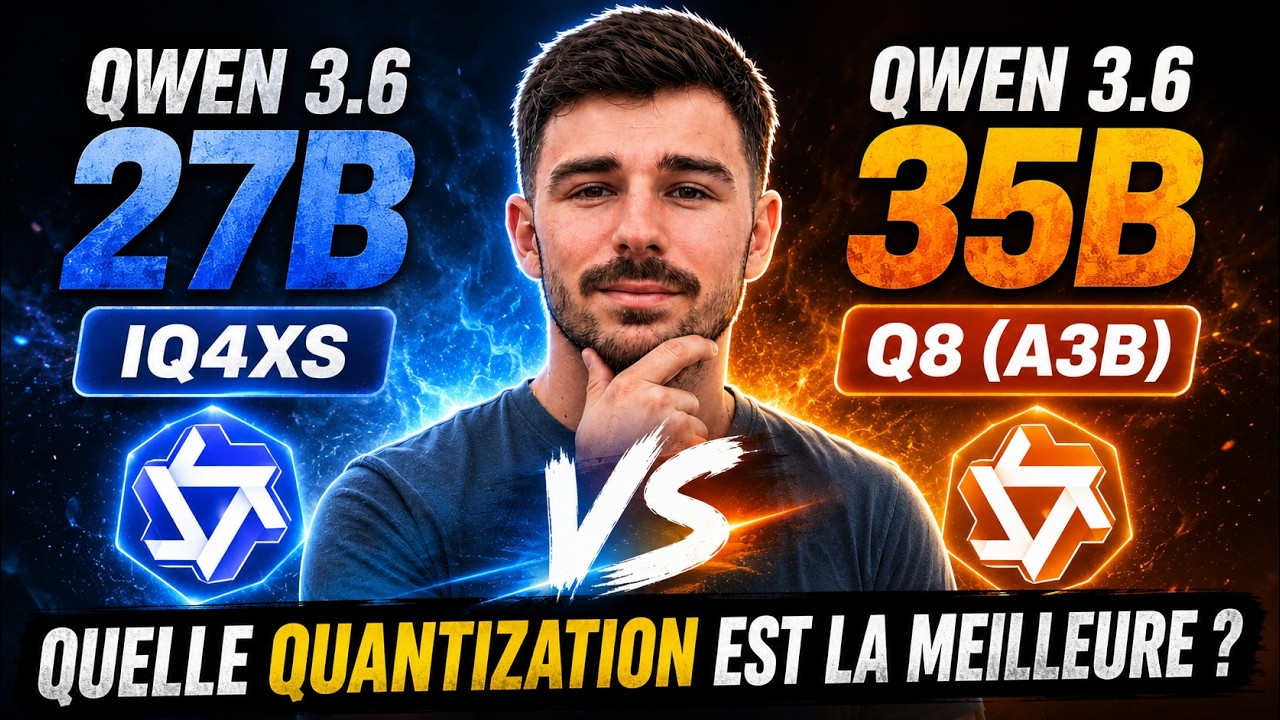
QWEN 3.6 27B IQ4XS vs 35B Q8 : Lequel est le meilleur ?
QWEN 3.6 27B IQ4XS vs 35B Q8: Which one is better?
Title history
- QWEN 3.6 27B IQ4XS vs 35B Q8 : Lequel est le meilleur ? — observed on 20261101-0116 UTC (YouTube)
Keywords
Summary
150 words
Critical Evaluation
Value of the Information & Strength of the Argument
The information value is moderate, as the tests are illustrative of model capabilities but lack quantitative metrics. The argumentation relies on direct observation and side-by-side comparison, which is valid for a practical demonstration. The creator clearly explains the context (VRAM constraints) and the reasoning behind the choice of quantization levels. The conclusions are logically drawn from the observed results, though the subjectivity of the tests limits scientific robustness.
Scientific Rigor, Source Quality, Title Accuracy
The scientific rigor is low; the video presents a personal experiment without citing external research or benchmarks. The quality of sources is limited to the creator’s own interface (jean.nathaninline.com) and references to prior videos. The title matches the content well, as it accurately describes the comparison. No external studies are referenced, and the methodology (two tests, visual inspection) is not standardized. The public comments received 87 likes, but no comments were provided for analysis; therefore, no public trends can be assessed.
164 words
Title / Content Match
The title clearly reflects the content: a direct comparison between two Qwen model variants with different quantization.
Quality & Reliability
6/10
The video presents practical comparisons of two quantized AI models, but the methodology is limited to a couple of subjective tests without formal benchmarks or statistical validation. The results are reproducible but not scientifically rigorous.
Key Moments
Markers derived by PSI from the transcript: the creator did not define chapters.
- Introduction to the comparison and explanation of VRAM constraints.
- First test with 27B model: generation of water simulation HTML.
- First test with 35B model: generation of water simulation HTML.
- Second test with 27B model: generation of Windows 11-like interface.
- Second test with 35B model: comparison of Windows interface.
- Conclusion and recommendation that 27B IQ4XS remains the better choice.
Cited Sources
- Jean Interface (Nathan Inline) — The creator's custom interface used for running the models and testing generations.
Contribution & Novelties
This video provides a practical, real-world comparison of two widely used quantization levels (IQ4_XS and Q8) on the Qwen 3.6 family, addressing a common dilemma for local LLM users with limited VRAM. It demonstrates that even a heavily quantized 27B model can outperform a less quantized 35B model on specific generation tasks, offering useful guidance for model selection. The hands-on approach with HTML generation tests is original and relatable.
Pour aller plus loin :
- Mixture of Experts — The 35B A3B model uses a mixture-of-experts architecture, which is key to its parameter efficiency.
- Quantization (neural networks) — Describes the trade-offs between model size and performance, as discussed in the video. (No reliable specific URL provided.)
- Hugging Face Quantization Documentation — Official documentation on quantization methods used in modern LLMs, relevant to IQ4_XS and Q8 variants.
135 words
Radar Profile
The radar profile shows moderate scores across all dimensions, with a slight dip in technical depth and reliability. The video is practical and informative but lacks rigorous benchmarking, making it more of a hands-on demonstration than a scientific study.