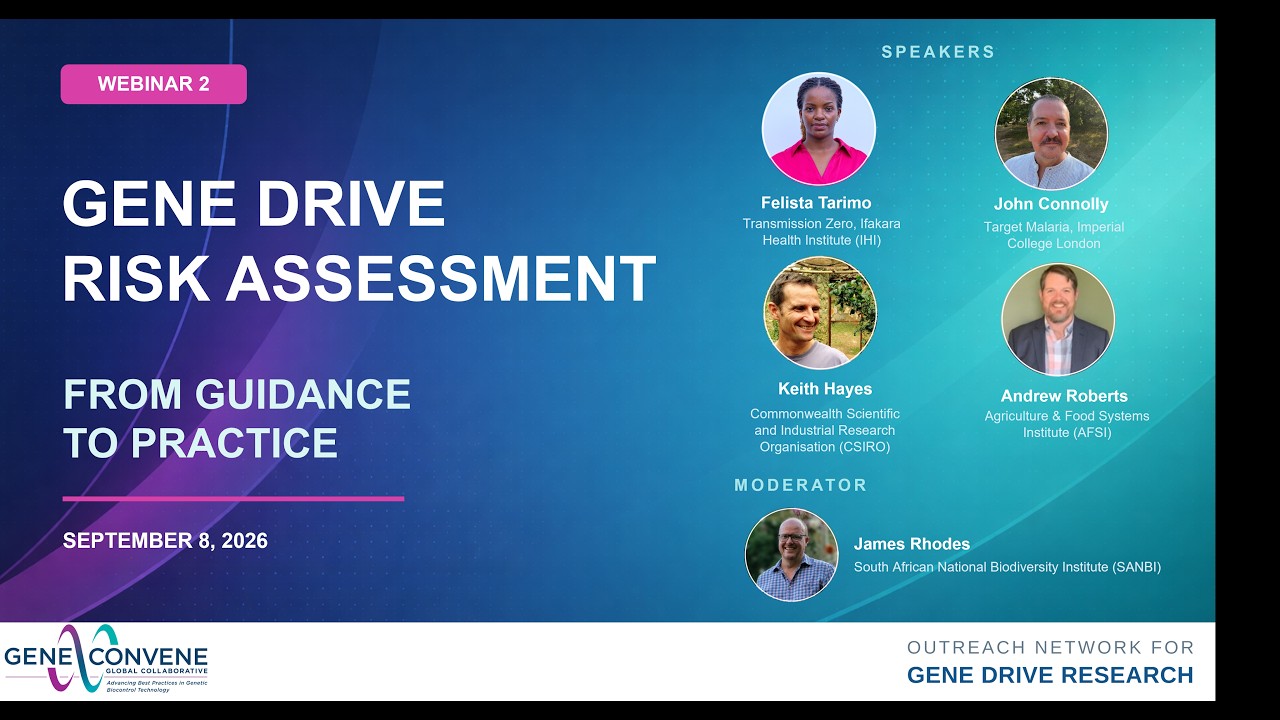
Synthetic Biology for Biodiversity: Gene Drive Risk Assessment
Keywords
Summary
237 words
Critical Evaluation
Value of the Information & Strength of the Argument
The webinar provides valuable insights from practitioners actively engaged in gene drive research and risk assessment. The value lies in its concrete case studies, such as Felista Tarimo’s community engagement work in Tanzania, which illustrates how stakeholder concerns are systematically collected and considered. Keith Hayes strengthens the argument by connecting field practices to the official CBD guidance framework, demonstrating how stakeholder involvement is embedded throughout the risk assessment process, not just as an add-on. The panelists collectively argue that integrating community perspectives improves the legitimacy and relevance of risk assessments, and they provide logical justifications for early and continuous engagement. However, the session is more of a discussion of experiences and frameworks than a rigorous empirical study; arguments are supported by anecdotal evidence and reference documents rather than quantitative data. The moderation and flow of talks were coherent, and the question-and-answer sections allowed for concrete examples of how methodologies are applied.
Scientific Rigor, Source Quality, Title Accuracy
The scientific rigor is high, as the speakers are senior experts from respected institutions and reference the Convention on Biological Diversity’s official guidance materials, which are widely accepted. The quality of sources is primarily institutional and peer-reviewed, although specific citations are not detailed in the presentation slides. The title accurately captures the session’s focus on gene drive risk assessment in the biodiversity context, particularly aligned with CBD COP 17. The content is well-structured and consistently sticks to the announced topic, with a clear progression from community engagement to risk assessment frameworks and data adequacy. There were no comments provided, so public reception was not analyzed.
271 words
Title / Content Match
Title accurately reflects the content, which focuses on the risk assessment of gene drives in the context of biodiversity and synthetic biology, as per the CBD COP 17 context.
Quality & Reliability
8/10
The webinar features four recognized experts from leading institutions (Ifakara Health Institute, CSIRO, Imperial College, and AFSI), providing evidence-based perspectives and referencing official CBD guidance. The content is coherent, practical, and aligned with current scientific frameworks.
Key Moments
Markers derived by PSI from the transcript: the creator did not define chapters.
- Moderator James Rhodes introduces the webinar theme and speakers.
- Felista Tarimo explains the role of stakeholder engagement in framing risk assessment questions.
- Tarimo presents community findings from Ukara Island, including concerns about safety of modified mosquitoes.
- Keith Hayes begins his talk, linking CBD guidance to stakeholder integration in risk analysis.
- Hayes details how stakeholder participation contributes to defining harm endpoints and risk perceptions.
- John Connolly discusses plausible pathways to harm and structured analysis of risk hypotheses.
- Andrew Roberts talks about testing risk hypotheses and defining sufficient data for dossiers.
Contribution & Novelties
The webinar offers practical examples of implementing CBD guidance on gene drive risk assessment, emphasizing the integration of community and scientific concerns. Its original contribution is the case-based demonstration of how stakeholder engagement informs each stage of the risk assessment process, from problem formulation to data gathering. The discussions underline the importance of local knowledge and the need for coherence between engagement and risk teams.
Pour aller plus loin :
- Gene drive — Overview of genetic engineering technique with applications and controversies.
- Cartagena Protocol on Biosafety — International agreement addressing safe transfer and handling of GMOs, directly relevant to the regulatory context.
- Risk assessment — General framework for evaluating risks, central to the webinar’s topic.
115 words
Radar Profile
The radar profile shows relatively balanced scores across information quantity, quality, technicality, and reliability, with a slight dip in technical depth. This reflects a competent yet accessible expert discussion, emphasizing practical applications over advanced technical detail.