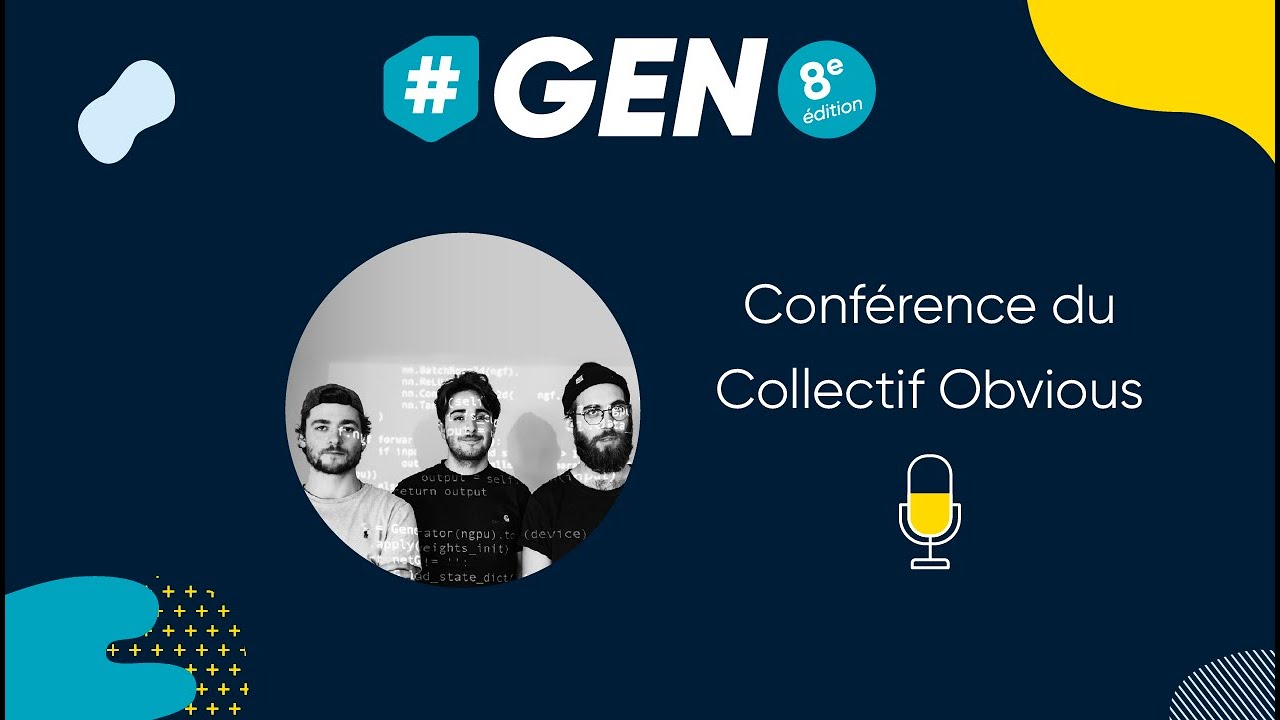
Conférence • Collectif Obvious • L'IA au service de la création artistique #GEN2020
Conference • Collectif Obvious • AI in the service of artistic creation #GEN2020
Keywords
Summary
173 words
Critical Evaluation
Value of the Information & Strength of the Argument
The talk provides valuable insight into the practical and philosophical dimensions of AI-generated art. The speakers effectively argue that AI algorithms can be creative partners, emphasizing the importance of human curation and intentionality. Their argumentation is grounded in concrete examples, such as the Christie’s auction and the traditional craftsmanship collaborations, which illustrate their points persuasively. The narrative is coherent and accessible, though it relies primarily on anecdotal evidence rather than systematic scientific analysis.
Scientific Rigor, Source Quality, Title Accuracy
The scientific rigor is moderate: while the technical explanation of GANs is accurate, the talk does not reference specific research papers or external sources beyond their own work and general knowledge. The sources cited in the description are limited to the video production company and the GEN conference link, which do not substantiate the content. The title adequately matches the content, focusing on AI for artistic creation without exaggeration.
157 words
Title / Content Match
The title accurately reflects the content, which focuses on using AI in artistic creation, with a strong emphasis on the collective's journey and the philosophical questions raised.
Quality & Reliability
7/10
The speakers are artists and a researcher with direct experience in AI art; they explain their creative process and provide accessible explanations of techniques like GANs. However, they do not cite formal sources or independent verification.
Key Moments
Markers derived by PSI from the transcript: the creator did not define chapters.
- Introduction of Hugo and Pierre and the Collectif Obvious.
- Explanation of Generative Adversarial Networks (GANs) with the analogy of student and professor.
- Detailed breakdown of the five-step artistic process.
- Discussion of the Japanese prints series and the use of traditional woodblock printing.
- Presentation of African masks created with Ghanaian artisans.
- Exploration of daguerreotypes and the parallel with the advent of photography.
- Reflections on the semantic confusion around AI and their mission to demystify it.
Cited Sources
- AGA Audiovisuel — Production company responsible for the video recording of the conference.
- GEN 2021 event — Website of the Grand Est Numérique conference series, where this talk was delivered.
Contribution & Novelties
The video offers a unique first-hand account from artists who have successfully commercialized AI-generated art, providing a rare perspective on the intersection of technology, tradition, and creativity. It contributes to the public understanding of AI by framing it as an accessible tool rather than an autonomous creator, and by showing how human decisions (choice of data, curation, medium) are integral to the final artwork. The novelty lies in their explicit emphasis on blending cutting-edge algorithms with ancient craftsmanship (woodblock printing, African mask carving) to challenge the binary opposition between tradition and innovation.
Pour aller plus loin :
- Generative adversarial network — Core technology behind their work; the Wikipedia article explains the architecture and history.
- DeepDream — Early example of AI-generated imagery that popularized the aesthetic and sparked discussion on machine creativity.
- Artificial intelligence art — Overview of the field, including notable works, artists, and the ongoing debate about authorship.
149 words
Radar Profile
The profile is balanced, with strong scores in quality and fiability relative to quantity and technical depth. This reflects a talk that is well-presented and credible, though not extremely dense or heavily technical. The audience gets a clear and inspiring overview without overwhelming detail.