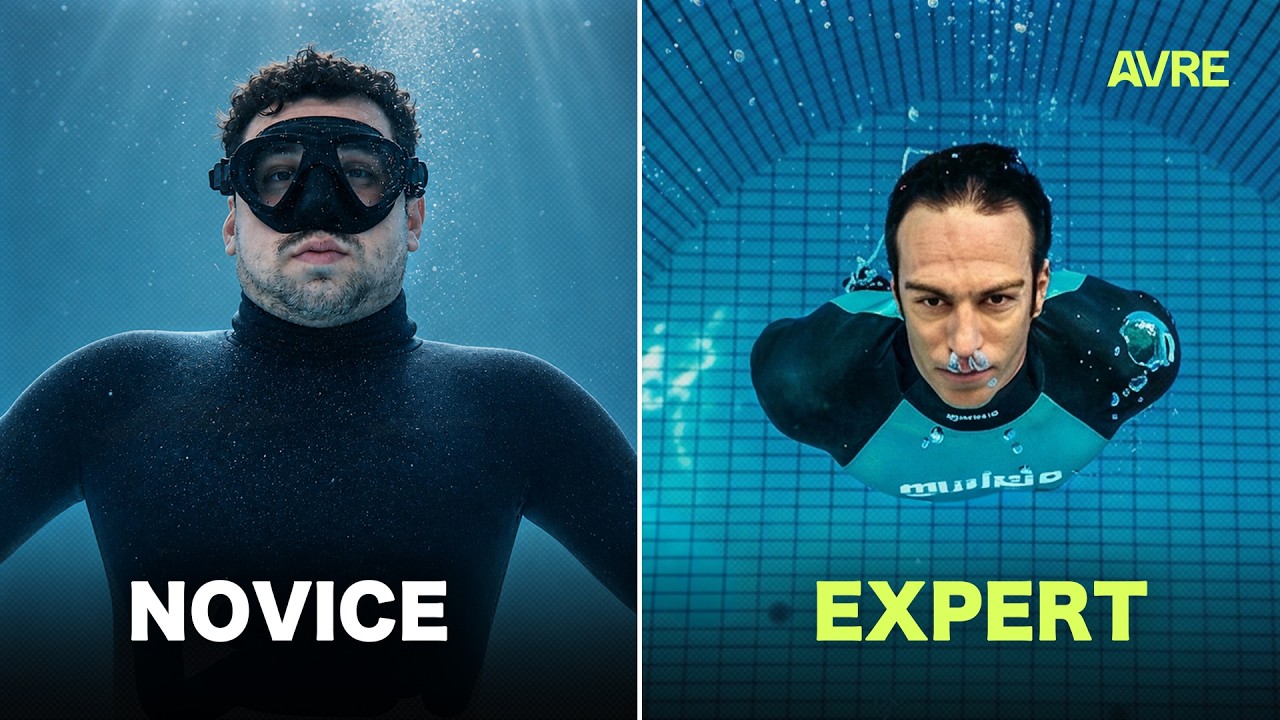
Un champion du monde nous apprend à tenir 3 min en apnée | Novice
A World Champion Teaches Us How to Hold Our Breath for 3 Minutes | Novice
Title history
- Un champion du monde nous apprend à tenir 3 min en apnée | Novice — observed on 20261119-1835 UTC (YouTube)
Keywords
Summary
142 words
Critical Evaluation
Value of the Information & Strength of the Argument
The video’s primary value lies in its practical demonstration that a few hours of targeted coaching can dramatically improve breath-holding performance in a novice. The argumentation is built through a clear progression from cold start to final success, anchored in concrete physiological explanations (role of CO2, diaphragm contractions, hyperventilation risks). The coach’s expertise is showcased not only through his credentials but through his step-by-step adjustments and the ‘check’ protocol used for safety. The narrative is compelling and credible, with the host’s honest account of his own past accident adding a poignant safety message. The reasoning is sound and easy to follow, making the educational content accessible without oversimplifying the dangers.
Scientific Rigor, Source Quality, Title Accuracy
The video does not provide external sources or references in its description, limiting the possibility of independent verification. However, the information delivered is consistent with scientific knowledge on apnea and dive physiology. The title perfectly matches the content: the challenge is exactly as advertised, and the format is clear. The absence of citations is a weakness, but the use of a recognized world champion as an authority and the visually demonstrable results lend self-consistency. The description includes no scientific links, only social media, so no direct source evaluation is possible.
215 words
Title / Content Match
The title accurately reflects the content: a world champion coaches a novice to achieve 3 minutes of apnea in a few hours. The challenge is fully delivered and the format corresponds to the promise.
Quality & Reliability
8/10
The content is presented by a triple world champion in deep apnea, Morgan Bourc'his, whose credentials are clearly stated. The physiological explanations are accurate and consistent with established knowledge on breath-holding and hypercapnia. The video clearly warns about the dangers of unsupervised practice, which demonstrates responsibility. The main limitation is the absence of cited scientific sources or references in the description.
Key Moments
Markers derived by PSI from the transcript: the creator did not define chapters.
- Presentation of the challenge and introduction of coach Morgan Bourc'his.
- First attempt without preparation: 1 minute 9 seconds.
- Breathing and stretching exercises, including abdominal massage.
- Explanation of CO2 role and diaphragmatic contractions.
- Safety warning about hypoxic syncope and the importance of an accompanist.
- Second attempt reaches 2 minutes 40 with active coaching.
- Final attempt: 3 minutes 50, and closing reflections.
Contribution & Novelties
This video provides a concrete, short-term demonstration of how breathing-control techniques can yield rapid improvements in apnea performance, even for a beginner. Its originality lies in the ‘Novice’ challenge format combined with expert coaching, making the physiological concepts (CO2 tolerance, diaphragm acceptance) tangible. The safety advice is reinforced by a personal accident story, adding an affective dimension rarely seen in technical videos.
Pour aller plus loin :
- Static apnea - Wikipedia — This article details the discipline, world records, and physiological basics.
- Hypoxic syncope - Wikipedia — Relevant to the ‘blackout’ phenomenon discussed in the video.
- Freediving - Wikipedia — Covers competition disciplines, techniques, and safety protocols.
- Diaphragm - Wikipedia — Explains the main respiratory muscle and its role in breathing.
121 words
Radar Profile
The radar profile shows a balanced performance across all dimensions, with relatively high scores in fiabilité and qualité_information, reflecting the video's credible coaching and solid scientific grounding. The quantite_information is adequate for the short format, while niveau_technique is moderate, making it broadly accessible. The main weakness is the lack of cited sources, which limits the fiabilité_globale slightly.