ERIA | Crude Steel Production Structures in ASEAN by Ms Miki Yanagi | AJSI Webinar 2026
Keywords
Summary
229 words
Critical Evaluation
Value of the Information & Strength of the Argument
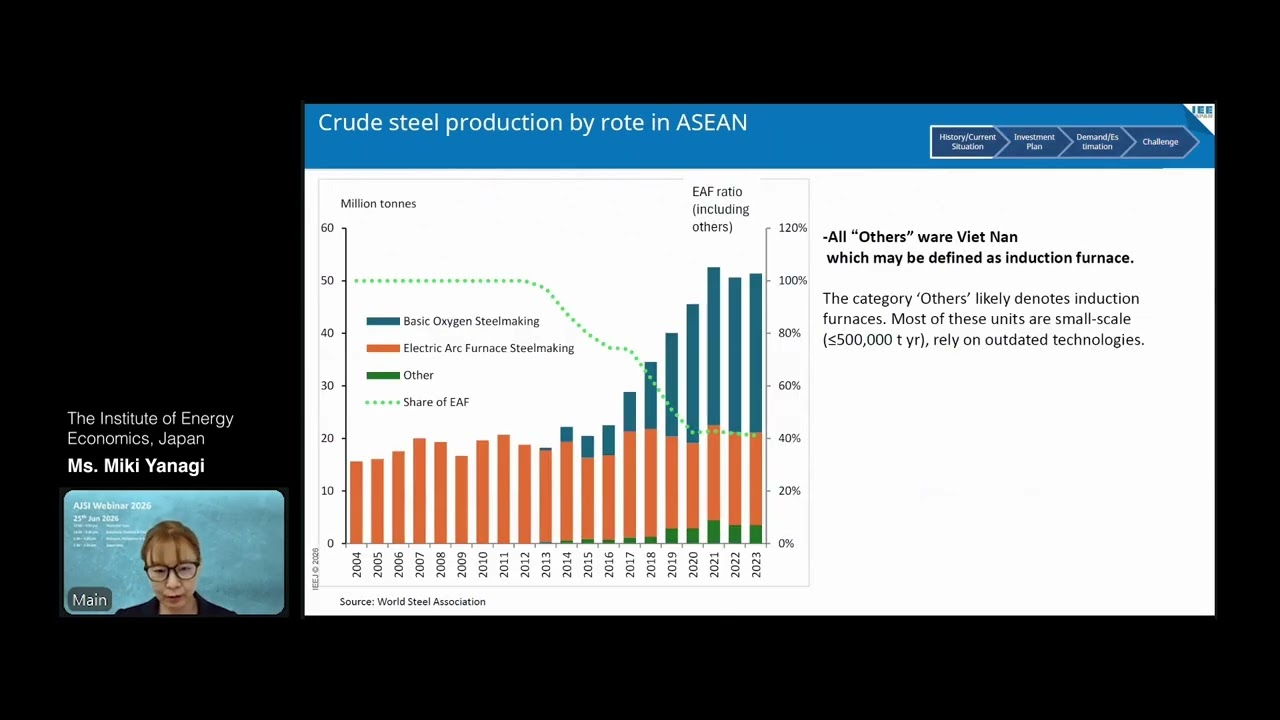
The presentation offers valuable insights into the current and projected structure of ASEAN’s crude steel industry, highlighting the significant shift towards electric arc furnaces and the surge in blast furnace capacity from Chinese investments. The argumentation is logically structured, moving from historical context to methodology, results, and policy implications. The speaker candidly notes that results are tentative and invites feedback, which adds credibility. However, the argumentation is somewhat rushed due to time constraints, and some parts (like the detailed model description) are only briefly touched upon. The use of comparative graphs with IEA projections strengthens the analysis, but the lack of precise citations for some data points reduces the strength of the argument.
Scientific Rigor, Source Quality, Title Accuracy
The presentation references OECD’s recent steel outlook and ERIA’s own modeling framework, but does not provide specific citations or links. The methodology is based on clustering and regression analysis, which is standard, yet the presentation does not explain data sources in detail. The title accurately matches the content, focusing on crude steel production structures and tentative future analysis. While the speaker is clearly knowledgeable, the scientific rigor is moderate due to the preliminary nature of the results and the absence of transparent sourcing. No public comments were available for analysis.
218 words
Title / Content Match
The title accurately reflects the content, a webinar presentation on crude steel production structures in ASEAN with tentative future outlook.
Quality & Reliability
6/10
The presentation provides a preliminary analysis based on ERIA's in-house modeling, referencing OECD reports and internal studies. However, it lacks detailed citations and the results are explicitly tentative, limiting full reliability assessment.
Key Moments
Markers derived by PSI from the transcript: the creator did not define chapters.
- Introduction to ERIA and the 3E+S (Energy, Environment, Economics, Security) framework, comparison of ERIA estimates with IEA.
- Overview of current ASEAN steel production: shift to electric arc furnace (40% share), growth driven by Indonesia and Vietnam.
- Methodology explanation: clustering and regression analysis based on per-capita steel demand and GDP, used for projections.
- Projections for ASEAN-6 crude steel production to 2050 (150 million tons), comparison with OECD 2030 forecast.
- Discussion on blast furnace capacity expansion (150% increase) and concerns about excess capacity, followed by implications and closing.
Cited Sources
- OECD Steel Outlook (referenced) — Mentioned as a recent publication with forecasts for 2030, used as a comparison point for ERIA's own projections.
Contribution & Novelties
This presentation contributes a tentative regional analysis of crude steel production structures for ASEAN, emphasizing the electric arc furnace transition and investment-driven capacity expansion. The originality lies in the clustering-based forecasting methodology tailored to ASEAN economies, and the integration of decarbonization modeling for hard-to-abate sectors.
Pour aller plus loin :
- Electric arc furnace — Relevant to the shift in production technology discussed.
- Carbon capture and storage — Mentioned in relation to clean steel pathways.
- Hydrogen economy — Highlighted as a potential for steel decarbonization.
- Linear programming — The cost-optimization approach used in ERIA’s modeling.
94 words
Radar Profile
The profile shows moderate scores across all dimensions, with slightly higher quantitative and technical levels, indicating a content-rich presentation that could benefit from more rigorous sourcing and clearer argumentation.