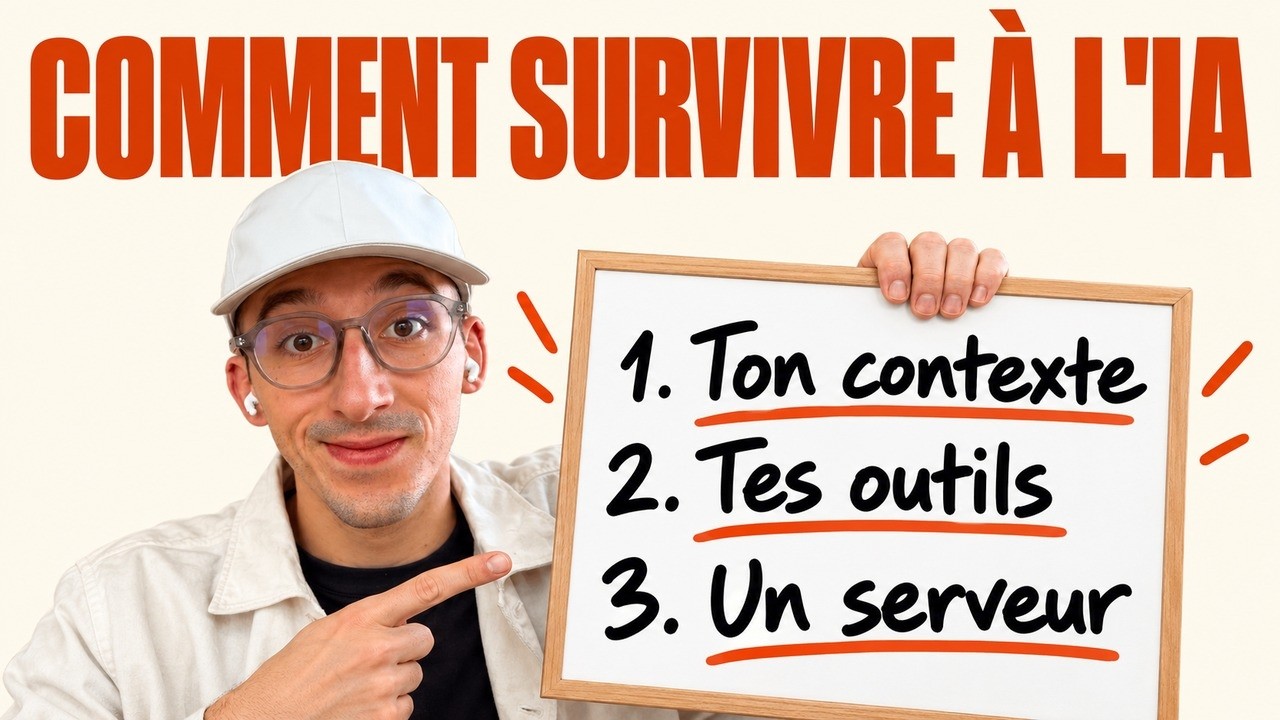
Ton métier va changer dans 2 ans : prépare-toi maintenant (le setup simple)
Your job will change in 2 years: prepare now (the simple setup)
Title history
- Ton métier va changer dans 2 ans : prépare-toi maintenant (le setup simple) — observed on 20261031-2253 UTC (YouTube)
Keywords
Summary
165 words
Critical Evaluation
Value of the Information & Strength of the Argument
The primary value of this content lies in its clear, actionable mental model (the 6 levels of AI usage) and the concrete first steps it proposes, such as creating a local ‘digital brain’ and defining ‘skills’. The argumentation is persuasive and emotionally charged, relying on a mix of fear-based urgency and relatable anecdotes (e.g., a friend manually subtitling on Premiere Pro, another friend replacing ClickFunnels with Claude). The math example calculating saved hours (78 hours/year for a 30-minute task repeated 3 times weekly) is sound and effectively illustrates the time-saving potential. However, the argumentation is primarily built on personal success stories and the author’s own authority rather than on broad empirical evidence. Claims about the ‘Stanford study’ (without citation) and the 6x speed of competitors are presented as facts but remain unverifiable. The logical progression from building context to using agents is coherent, and the emphasis on communication skills as the core of AI usage is a valuable perspective.
Scientific Rigor, Source Quality, Title Accuracy
Scientifically, the video is weak. It references a ‘Stanford study’ without providing the study’s name, authors, or a URL, making it impossible to verify. The author relies heavily on personal testimonials and implies universal truths based on isolated examples. There is a clear conflict of interest, as the video heavily promotes the author’s own paid formations and masterclass (via link shorteners like mlv.sh/fx). Despite this, the advice about setting up a context folder is consistent with modern AI workflow best practices, though simplified. The title adequately represents the content, which indeed focuses on preparing for imminent career changes and a ‘simple setup’ using AI agents. It does not overpromise science, but it does generalize personal success into a broad survival guide.
295 words
Title / Content Match
The title accurately reflects the content: the video focuses on preparing for job changes due to AI and provides a simple setup (digital brain folder, skills, and agents). It matches perfectly.
Quality & Reliability
5/10
The video is highly practical and offers a clear framework, but it relies heavily on anecdotal evidence and personal testimonials. It mentions a Stanford study without providing a citation or URL, making it unverifiable. The content is structured as a motivational career advice video, blending personal experience with generalized claims about AI capabilities, without scientific rigor or external validation.
Chapters
- Comment survivre aux 2 prochaines années d'IA
- Le vrai danger : les gens qui cliquent
- Ton job, là où tu peux agir
- Les 3 camps face à l'IA
- L'étude de Stanford sur les juniors
- Ton concurrent 6 fois plus rapide
- Les 6 niveaux d'utilisation de l'IA
- Arrête de cliquer
- Le calcul de ton temps perdu
- Ma chaîne YouTube automatisée depuis 1 an
- Du concret : ClickFunnels remplacé par Claude
- Ton concurrent ne clique plus, il demande
- La bonne première tâche à automatiser
- Monter d'un niveau : ton dossier Brain
- Les skills
- Rester propriétaire de tes données
- Ce que l'IA ne remplace pas, et ses limites
- Excuse 1 : « j'ai pas le temps »
- Un site web est devenu une commodité
- Excuse 2 : « c'est pas fiable »
- Excuse 3 : « c'est trop technique »
- L'erreur : trop d'outils et de skills
- Il n'y a pas de prompt magique
- Réveille-toi
Cited Sources
- Melvynx's personal blog — Mentioned in the video description as a link to follow Melvynx.
- Discord community — Official Discord server link for discussion, provided in the description.
- AI Formation — Link to a paid AI training course promoted in the description.
- Assistant Formation — Link to an assistant training course mentioned in the description.
- Configuration Agents (Claude Codex) — Link to a guide for setting up agents, mentioned in the description.
- Free masterclass to automate work with AI — The primary free masterclass link promoted in the video description.
- GitHub profile — Link to the author's GitHub profile in the description.
- One-on-one chat — Link for direct communication with the author, provided in the description.
- Twitter profile — Link to the author's Twitter account in the description.
Contribution & Novelties
The video’s original contribution lies in its accessible, graded ‘6 levels of AI usage’ framework, which helps non-technical professionals identify where they currently stand. It consolidates known AI workflow concepts (context building, agents, skills) into a simple, actionable plan focused on a local ‘digital brain’ folder. The author demystifies the hype by stating there is no ‘magic prompt’ and correctly stresses the importance of creating personal workflows. His perspective on staying ‘sovereign’ over your data by keeping context files locally on your machine is a relevant and creative counterpoint to cloud-only AI setups.
Pour aller plus loin :
- Prompt Engineering — Directly relevant to the author’s point that communication is the core skill in AI adoption, deeper insights into structuring inputs.
- Intelligent Agent — Expands on the ’level 5’ concept of autonomous agents working 24/7, providing the theoretical computer science background.
- Retrieval-Augmented Generation — Relates to the ‘dossier Brain’ concept, explaining how AI models can use external private data to generate more accurate, context-aware outputs.
- Markdown — The file format recommended for the digital brain folder, useful for understanding why it’s a lightweight and portable alternative to Word documents.
189 words
Radar Profile
The radar profile indicates a moderate overall performance across all dimensions. The video scores well on information quantity (7/10) due to its dense content and multiple examples, but suffers from lower reliability (5/10) because of the lack of verifiable primary sources and reliance on personal anecdotes. The balanced profile reflects a content that is practically useful but scientifically unsubstantiated.