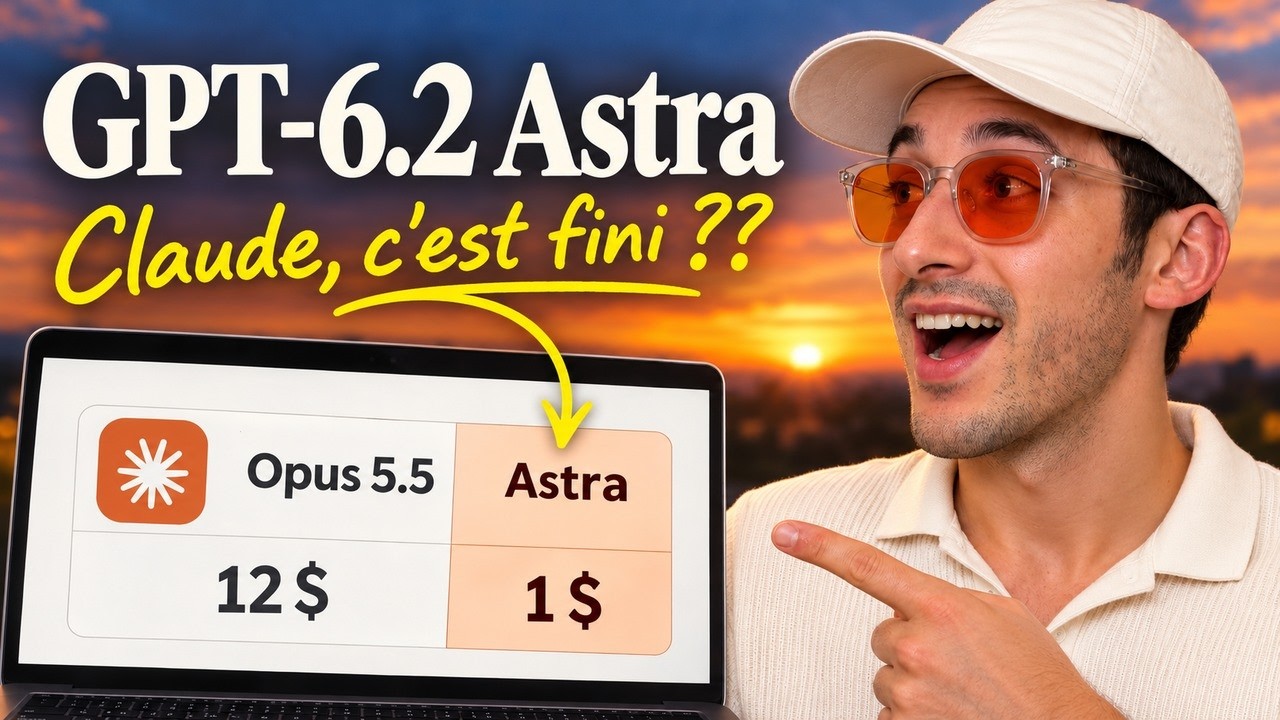
GPT-6.2 Astra et Sol : les nouveaux modèles d'OpenAI testés
GPT-6.2 Astra and Sol: OpenAI's new models tested
Title history
- GPT-6.2 Astra et Sol : les nouveaux modèles d'OpenAI testés — observed on 20261118-0817 UTC (YouTube)
Keywords
Summary
163 words
Critical Evaluation
Value of the Information & Strength of the Argument
The video provides valuable empirical data on the new models’ performance and costs, which is useful for practitioners. The argumentation is based on personal tests, which are transparent but limited. The creator clearly states his biases and acknowledges that his tests are not exhaustive. He supports his claims with concrete numbers and visual demonstrations, strengthening his credibility. However, the evaluation criteria are subjective, especially regarding ’taste’ and ‘style,’ which are not measurable quantitatively. The reasoning is logical and systematic, but the sample size is small, and no statistical analysis is offered.
Scientific Rigor, Source Quality, Title Accuracy
The video does not cite formal sources; it relies on the creator’s own tests and mentions benchmarks from LMArena or similar, but without specific citations. The description contains only links to the creator’s own content, not to external references. The title is appropriate and accurately represents the content. The video’s rigor is limited by the lack of peer-reviewed sources and the subjective nature of the evaluation. The creator does not provide methodological details, making replication difficult. However, he transparently shows his tests and results, which provides some reproducibility.
194 words
Title / Content Match
The title accurately reflects the content: the video tests the new GPT-6.2 Astra and Sol models and compares them with competing models like Claude Opus and Fable.
Quality & Reliability
6/10
The evaluation is based on hands-on tests with concrete costs and times, but it is subjective, based on personal taste, and limited in sample size. The author openly admits bias towards Anthropic's models. Benchmark data is referenced but not independently verified.
Chapters
- GPT-6.2 Astra et Sol sont sortis
- Les benchmarks : moins bon que Fable 5.2
- Le coût par intelligence
- Plus rapide : 11 minutes contre 41
- 41 000 tokens contre 274 000
- En code, Anthropic reste devant
- L'annonce d'OpenAI : super efficient
- Fichiers, 3D et créativité
- Mes nouveaux tests sans system prompt
- Le coût de mes tests
- Test 1 : le crash de voiture
- Test 2 : la lampe et l'interrupteur
- Test 3 : le Time Zone Checker
- Test 4 : la génération vidéo
- Les prix : 37 $ contre 4 $
- Mon verdict : efficace contre goût
- Ce qu'en disent Théo et les autres
- One shot contre vrai travail
- Je garde mon abonnement Claude
Cited Sources
- MLV Blog — Creator's blog link from description.
- Discord — Discord invitation link from description.
- Formation AI — AI training course link from description.
- Formation Assistant — Assistant training course link from description.
- Configuration Agents — Agent configuration link from description.
- Free AI Brain Kit — Free kit link from description.
- GitHub — Creator's GitHub link from description.
- One-on-One — Direct discussion scheduling link from description.
- Twitter — Creator's Twitter link from description.
Contribution & Novelties
The video contributes practical, real-world testing data for two new AI models, highlighting cost and performance differences directly relevant for developers. It offers a subjective but detailed comparison, revealing trade-offs between efficiency and aesthetic output. The creator’s hands-on approach provides concrete numbers that are often absent in official announcements.
Pour aller plus loin :
- Large language model — Background on the technology behind these models.
- Artificial intelligence — General context on AI development and applications.
- Generative artificial intelligence — Focus on generative models and their evaluation.
86 words
Radar Profile
The profile indicates high information quantity but moderate reliability and technical depth, suggesting a content-rich video that is accessible but not highly rigorous.