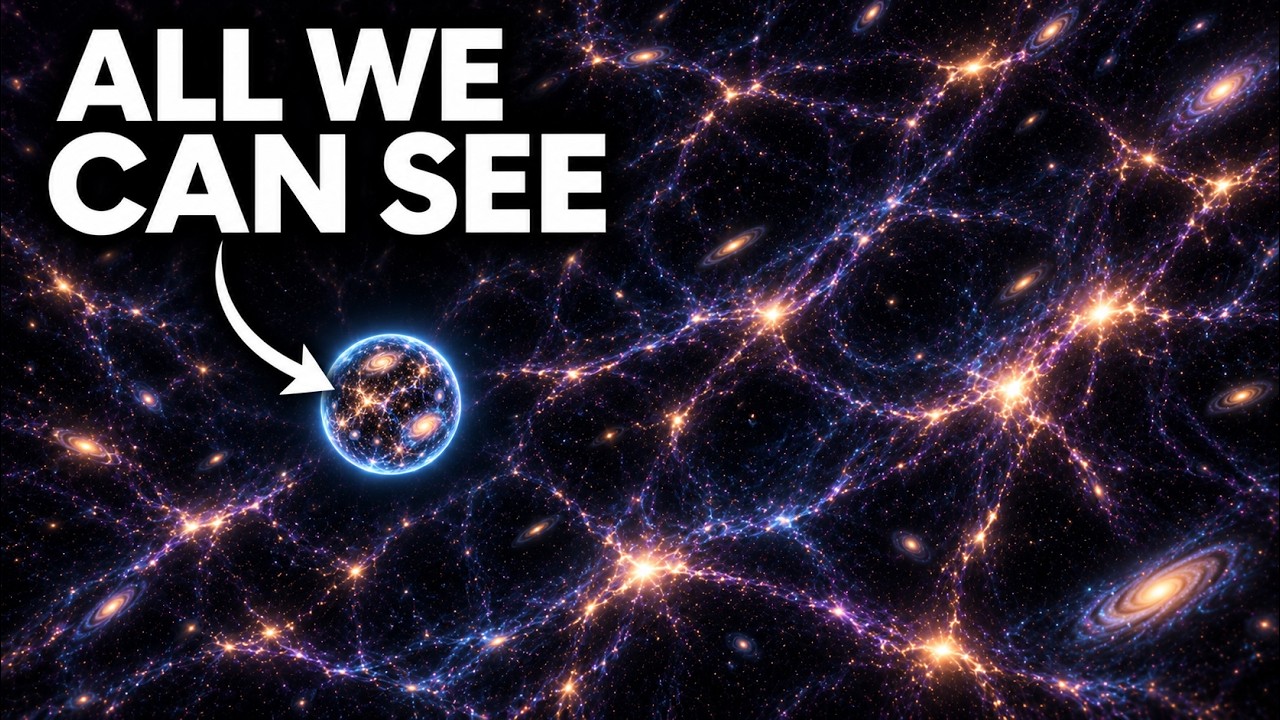
What Exists Beyond the Universe We Can See?
Keywords
Summary
204 words
Critical Evaluation
Value of the Information & Strength of the Argument
The value of this episode lies in its careful, step-by-step explanation of concepts that are frequently misrepresented elsewhere: the difference between the observable universe and the entire universe, the distinction between a particle horizon and a physical boundary, and the apparent contradiction between a 13.8-billion-year cosmic age and a 92-billion-light-year observable diameter. The argumentation is solid: each claim is grounded in established cosmology (general relativity, the Friedmann-Lemaître expanding models, CMB measurements), and the narrator explicitly flags what is known, what is inferred, and what is simply unknown — notably the possibility of an infinite universe. The reasoning linking the scale factor to the travel time of ancient light is pedagogically effective, and the episode successfully avoids the common trap of presenting the observable horizon as a physical edge of existence. The slow, deliberate pace serves the explanatory clarity without compromising scientific accuracy.
Scientific Rigor, Source Quality, Title Accuracy
The scientific rigor is high: the content matches the current cosmological consensus, and the description links to institutional references — NASA, ESA, the Nobel Foundation, the Planck collaboration’s peer-reviewed results, arXiv preprints on cosmic topology and eternal inflation, and the Vera Rubin Observatory — all appropriate, high-quality sources for the topics covered. The episode correctly distinguishes established results from open questions, particularly regarding the global topology and geometry of the universe. The title matches the content precisely: the episode is entirely built around the question of what may exist beyond our observable horizon, and it treats that question with appropriate nuance. A brief promotional segment for the channel’s own Spotify feed appears at the start, without disrupting the scientific narrative.
277 words
Title / Content Match
The title faithfully reflects the content: the entire episode is built around the question of what may exist beyond our observable horizon, treating it with appropriate nuance and without unwarranted speculation.
Quality & Reliability
8/10
The episode presents well-established cosmology (Lambda-CDM model, cosmic microwave background, particle horizon, Hubble sphere, event horizon) with accurate explanations and clear distinctions between established results, inferences, and open questions. The description links to reputable institutional sources (NASA, ESA, Nobel Foundation, Planck collaboration, arXiv preprints, Vera Rubin Observatory). No speculative claims are presented as fact, and the pedagogical reasoning is sound.
Key Moments
Markers derived by PSI from the transcript: the creator did not define chapters.
- Intro, greeting, and channel self-promotion for the Spotify feed.
- The Milky Way's 100 to 400 billion stars and the cosmic web of galaxies.
- Definition of the observable universe: the region from which light has had time to reach us.
- The particle horizon: a boundary of information, not a physical wall.
- The cosmological principle: Earth is not at the centre of the entire universe.
- The observable universe: 92 billion light-years in diameter despite a 13.8-billion-year age.
- Resolving the paradox: space expands during the photon's journey, illustrated with the scale factor.
- Historical context: Lemaître (1927) and Hubble (1929) establish cosmic expansion.
- Different distance measures in cosmology and the oldest light: the cosmic microwave background.
- Distinction between particle horizon, Hubble sphere and cosmological event horizon.
Cited Sources
- NASA — How Big Is Space? We Asked a NASA Expert — Referenced as general background on the scale of the universe.
- NASA Science — Universe Overview: The Big Bang and Cosmic Inflation — Supports the presentation of the Big Bang and cosmic inflation.
- European Space Agency — Planck and the Cosmic Microwave Background — Supports the discussion of the cosmic microwave background as the oldest light.
- NASA Science — Wilkinson Microwave Anisotropy Probe Overview — Background on CMB measurements used in cosmology.
- NASA Science — Large-Scale Structures: The Cosmic Web — Supports the description of the cosmic web of galaxies.
- NASA Science — What Is Dark Energy? — Supports the mention of dark energy and accelerated expansion.
- Nobel Prize — The Nobel Prize in Physics 2011: Accelerating Expansion of the Universe — Supports the section on the accelerating expansion of the universe.
- Astronomy & Astrophysics — Planck 2015 Results: Background Geometry and Topology of the Universe — Peer-reviewed reference for the global geometry and topology discussion.
- The Status of Cosmic Topology After Planck Data — Preprint on cosmic topology, directly relevant to what may lie beyond the observable universe.
- Alan Guth — Eternal Inflation and Its Implications — Reference for the possibility of an eternally inflating, far larger universe.
Concurring Sources
- NASA Science — Universe Overview: The Big Bang and Cosmic Inflation — Concurs with the episode's description of cosmic expansion and the early universe.
- Nobel Prize — The Nobel Prize in Physics 2011 — Concurs with the episode's claims about the accelerating expansion of the universe.
- European Space Agency — Planck and the Cosmic Microwave Background — Concurs with the episode's description of the CMB as the oldest detectable light.
External References
Contribution & Novelties
The contribution of this episode is not new scientific content but a pedagogical presentation of established cosmology in a format adapted to relaxation and sleep. Its originality lies in the careful ordering of concepts: the observable universe, the particle horizon, the Hubble sphere and the event horizon are clearly separated, and the apparent paradox of the 13.8-billion-year age versus the 92-billion-light-year diameter is explained through an accessible description of the scale factor and expanding space. The episode also correctly distinguishes what is known (the observable universe’s extent), what is inferred (space likely continues beyond the horizon) and what is unknown (the global topology of the universe).
Pour aller plus loin :
- Observable universe — Overview of the definition, extent and limitations of the observable cosmos.
- Particle horizon — Detailed discussion of the cosmological horizon concept central to the episode.
- Cosmic microwave background — The oldest light in the universe and its role in constraining cosmological models.
- Dark energy — The accelerated expansion phenomenon that shapes the future event horizon.
- Shape of the universe — The question of global geometry and topology, at the edge of the episode’s scope.
188 words
Radar Profile
The radar profile shows a strong peak in information quality and reliability, with a moderate technical level and a solid quantity of content — typical of a well-documented science communication production. The high quality and reliability scores dominate, while the technical level is deliberately kept accessible, reflecting the episode's both educational and calming purpose.