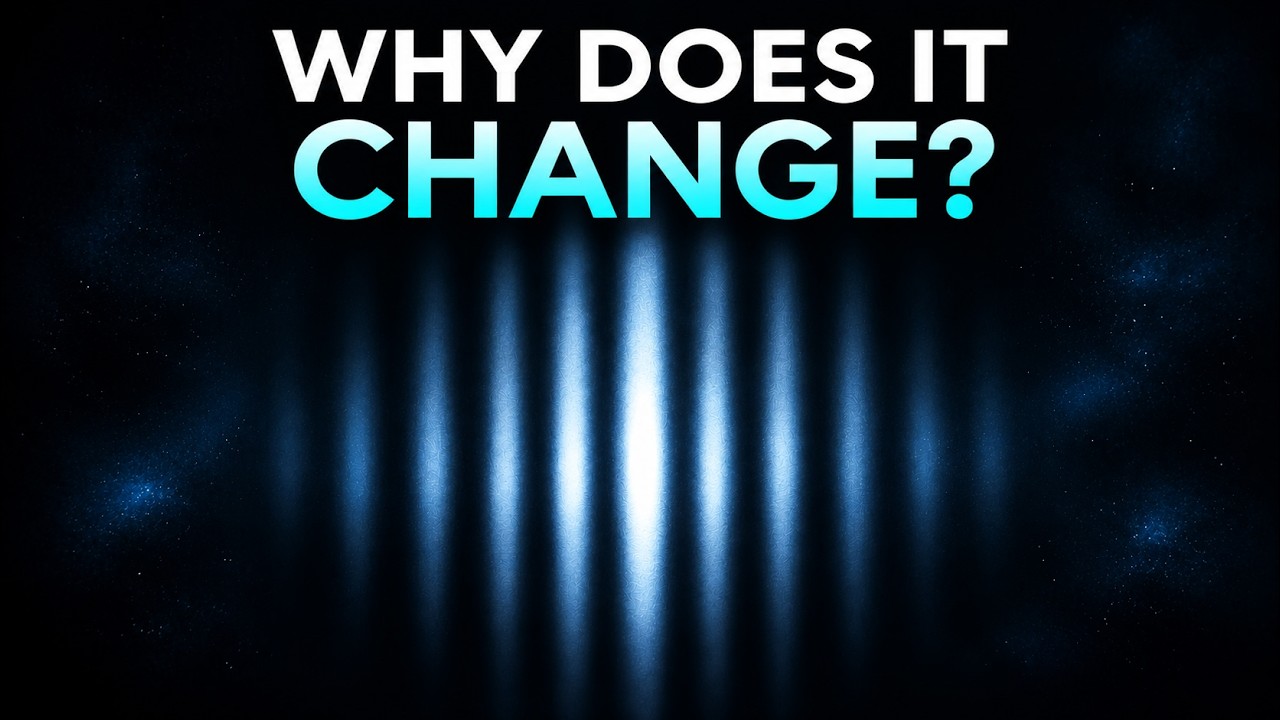
Why Does Quantum Physics Behave Differently When Nobody Is Watching?
Title history
- Why Does Quantum Physics Behave Differently When Nobody Is Watching? — observed on 20261120-0344 UTC (YouTube)
Keywords
Summary
121 words
Critical Evaluation
Value of the Information & Strength of the Argument
The video provides high-value information by accurately explaining quantum mechanical concepts without oversimplification. It systematically builds from classical wave interference to quantum probability amplitudes, addressing common misconceptions. The argumentation is solid, using concrete experiments like Tonomura’s electron buildup and the quantum eraser to support claims. It distinguishes between measurement and consciousness, and explains decoherence as the mechanism behind the apparent observer effect. The content is well-structured and logically flows from fundamentals to subtleties, making complex topics comprehensible.
Scientific Rigor, Source Quality, Title Accuracy
The scientific rigor is strong: the video cites original papers and authoritative references, including the American Journal of Physics, Nature, Physical Review, and Stanford Encyclopedia of Philosophy. The sources are relevant and directly support the discussed experiments and interpretations. The title accurately reflects the central theme, though it slightly sensationalizes the ’nobody is watching’ aspect, which the video effectively demystifies. The content properly attributes findings and avoids overclaiming, maintaining a balanced discussion of interpretations.
166 words
Title / Content Match
The title aptly captures the central question addressed, and the content thoroughly explains why the observed behavior is not due to consciousness but to measurement interactions.
Quality & Reliability
8/10
The video provides a thorough and accurate explanation of quantum mechanical phenomena, referencing key experiments and papers, and correctly dispels common misconceptions about the observer effect.
Key Moments
Markers derived by PSI from the transcript: the creator did not define chapters.
- Introduction and welcome message, promotion of Spotify version.
- Introduction to the double-slit experiment and its setup.
- Explanation of wave interference, superposition, and single-electron buildup experiment.
- Discussion of which-path measurement, the observer effect, and the role of decoherence.
- Exploration of quantum erasers, delayed-choice experiments, and interpretations of quantum mechanics.
Cited Sources
- American Journal of Physics — Demonstration of Single-Electron Buildup of an Interference Pattern (1989) — Referenced in description for the single-electron interference buildup experiment.
- Nature — Dephasing in Electron Interference by a Which-Path Detector (1998) — Reference for how which-path measurement destroys interference.
- Physical Review A — Quantum Eraser: A Proposed Photon Correlation Experiment Concerning Observation and Delayed Choice in Quantum Mechanics (1982) — Original proposal of the quantum eraser experiment.
- Physical Review Letters — Delayed Choice Quantum Eraser (2000) — Reference for delayed-choice quantum eraser experiment.
- Reviews of Modern Physics — Decoherence, Einselection, and the Quantum Origins of the Classical (2003) — Seminal review on decoherence and its role in quantum-to-classical transition.
- Nature — Wave-Particle Duality of C60 Molecules (1999) — Demonstration of interference with large molecules, supporting generality.
- Science Advances — Experimental Test of Local Observer Independence (2019) — Test of observer independence in quantum mechanics.
- Nobel Prize — The Nobel Prize in Physics 2022: Experiments with Entangled Photons and Bell Inequalities — Reference for advances in quantum information and entanglement.
- Stanford Encyclopedia of Philosophy — Copenhagen Interpretation of Quantum Mechanics — Philosophical overview of the Copenhagen interpretation.
- Stanford Encyclopedia of Philosophy — Many-Worlds Interpretation of Quantum Mechanics — Philosophical overview of the many-worlds interpretation.
- Stanford Encyclopedia of Philosophy — Philosophical Issues in Quantum Theory: The Measurement Problem and Decoherence — Discussion of measurement problem and decoherence.
External References
Contribution & Novelties
The video’s novelty lies in its engaging, soothing presentation of foundational quantum concepts, making them accessible to a broad audience while maintaining accuracy. It synthesizes multiple sources into a coherent narrative, clarifying common misconceptions about the observer effect and emphasizing the physical nature of measurement. The inclusion of historical context and experimental details adds depth.
Pour aller plus loin :
- Stanford Encyclopedia of Philosophy - Copenhagen Interpretation — Comprehensive philosophical analysis of the standard interpretation.
- Physical Review Letters - Delayed Choice Quantum Eraser — Original paper on the experiment, demonstrating the role of timing in quantum erasure.
- Reviews of Modern Physics - Decoherence, Einselection, and the Quantum Origins of the Classical — Seminal review explaining decoherence as the mechanism behind wavefunction collapse phenomenology.
123 words
Radar Profile
The radar profile indicates a high quantity of information and strong reliability, with moderate technical depth. This suggests a well-researched educational video that balances detail with accessibility.