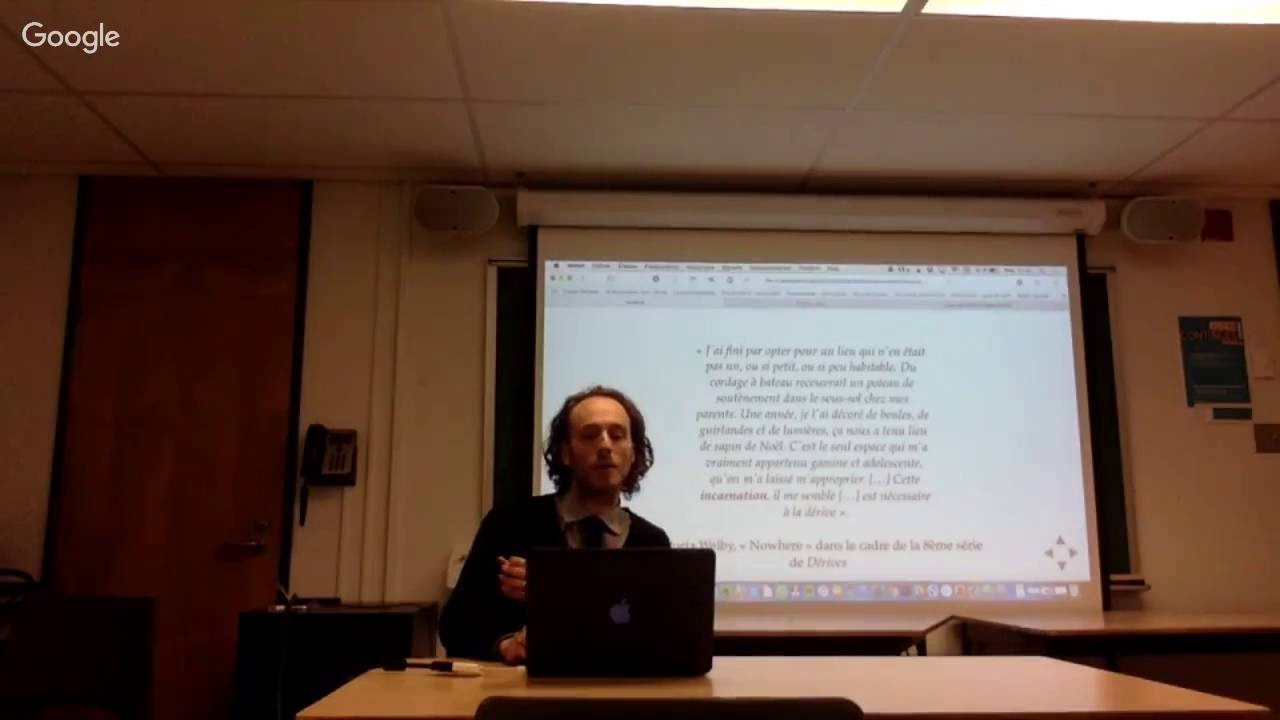
Littérature et culture numérique, colloque étudiant Part2bis
Literature and Digital Culture, Student Colloquium Part2bis
Keywords
Summary
211 words
Critical Evaluation
Value of the Information & Strength of the Argument
The informational value lies in the original synthesis of literary theory and digital media, applying the Situationist concept of drift to contemporary digital literature. The argumentation is coherent: the speaker defines terms, uses concrete examples (the collaborative hypermedia work), and draws connections between theorists (Guy Debord, Bertrand Gervais, Baudelaire, Preciado). The reasoning is logical and progressive, though sometimes dense and rapid. The main weakness is the lack of detailed textual evidence from the analyzed works, making it hard to fully assess the claims.
Scientific Rigor, Source Quality, Title Accuracy
The scientific rigor is moderate: the speaker cites established thinkers (Debord, Gervais, Baudelaire, Preciado) but does not provide precise references or explain the methodology for selecting and interpreting the digital work. The title accurately reflects the content, and the presentation is a well-structured academic talk, but the lack of verifiable sources in the video description and the informal Q&A format limit its reliability. No comments were available for analysis.
167 words
Title / Content Match
The title accurately announces the subject: a student colloquium on digital literature and digital culture, with a specific presentation on drift and space.
Quality & Reliability
7/10
The presentation draws on recognized theoretical references (Guy Debord, Bertrand Gervais, etc.) and offers a structured analysis, but the student colloquium format limits depth and source verification.
Key Moments
Markers derived by PSI from the transcript: the creator did not define chapters.
- Introduction to the notion of drift in Situationist thought.
- Definition of dérive and its connection to urban space.
- Case study of a collaborative hypermedia literary work and its multiple meanings of drift.
- Discussion of the 'line' as a figure from Bertrand Gervais's geocriticism.
- Comparison with Baudelaire's flânerie and the role of the body in space.
- Conclusion on digital drift as a technique for navigating hyperlinks and producing new paths.
Cited Sources
- Guy Debord — Reference for the Situationist concept of dérive.
- Geocriticism — Reference to Bertrand Gervais's geocritical approach to space.
- Charles Baudelaire — Comparison with flânerie in 19th-century Paris.
- Paul B. Preciado — Reference for the body as a spatial instrument.
Contribution & Novelties
The presentation offers an original insight by linking the Situationist dérive with the spatial metaphors of digital literature, showing that digital space transforms both the act of writing and reading. The concept of the ’line’ from geocriticism is creatively applied to navigate between physical and virtual spaces. This helps theorize how hyperlinks function as contemporary ‘drift lines’.
Pour aller plus loin :
- Dérive — Concept central of the talk.
- Psychogeography — Related to situationist experiments.
- Digital literature — Overview of the field.
82 words
Radar Profile
The radar profile shows a high technical level and moderate information quantity, indicating a specialized but content-rich presentation. Quality and reliability are balanced, suggesting a thoughtful synthesis of references.