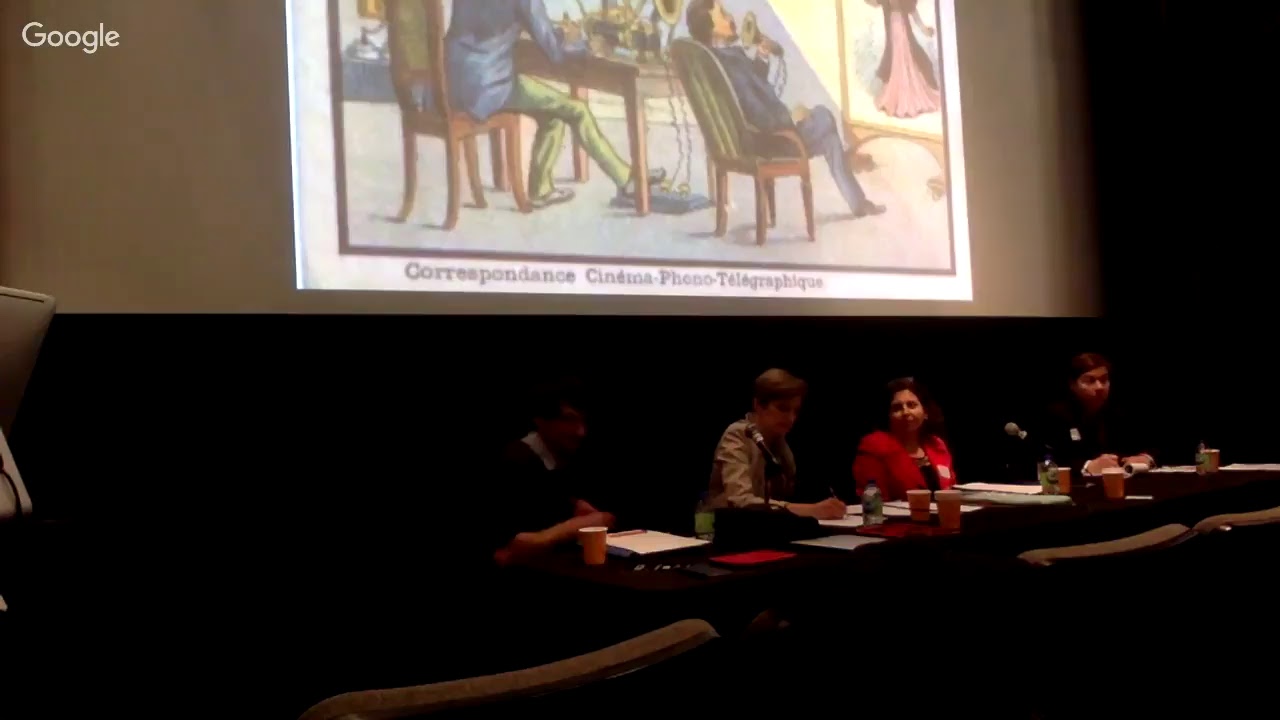
Colloque L'invention littéraire des médias - Généalogies médiatiques
Symposium The Literary Invention of Media - Media Genealogies
Keywords
Summary
148 words
Critical Evaluation
Value of the Information & Strength of the Argument
The value lies in the close reading of primary texts and the historical contextualization of media predictions. The argumentation is solid: each presentation grounds its claims in specific textual evidence and situates works within their socio-historical moment (e.g., the Dreyfus affair, industrial capitalism, and the rise of cinema). The analyses are nuanced, recognizing both the enthusiasm for new media and the critical concerns about cultural commodification. The presentations build on each other, creating a cohesive exploration of literary media imaginaries. Strengths include the original linking of literary tropes to actual media archaeology, and the attention to visual illustrations (e.g., Robida’s engravings) as evidence. Possible weaknesses: some arguments rely heavily on close textual interpretation without broader comparative framework, and no counter-examples are discussed.
Scientific Rigor, Source Quality, Title Accuracy
The rigor is high: the scholars use primary sources (the novels and tales) and clearly cite them. They also reference visual materials (illustrations) and historical journals. The title of the conference is adequate, though ‘invention littéraire des médias’ is slightly broader than the specific focus on French anticipatory fiction. The content stays within the announced scope, and the presentations are coherent and mutually reinforcing. The sources are clearly identified within the talks, but no external references (e.g., academic papers) are explicitly cited beyond the primary works. The overall scientific rigor is commendable, with an appropriate level of historical and textual precision.
238 words
Title / Content Match
The title accurately reflects the content: a focused conference on how literature imagined media transformations, with three complementary presentations on media genealogy.
Quality & Reliability
8/10
The presentation is academic, based on meticulous textual analysis and historical context, delivered by recognized scholars. The arguments are well-supported with primary sources, but no external validation or contrasting perspectives are provided within the frame.
Key Moments
Markers derived by PSI from the transcript: the creator did not define chapters.
- Introduction of the colloque and the session.
- Claire Barel-Moisan begins her analysis of new reading practices in anticipation literature, focusing on Uzanne.
- Discussion of Robida's illustrations and the theme of cultural democratization.
- Thomas Meynier introduces his talk on Uzanne and Allais, comparing the two texts.
- Marie-Ève Thérenty presents her concept of media archaeology and neologisms.
Cited Sources
- La fin des livres (Octave Uzanne) — Discussed as a primary text in the first two presentations.
- L'agonie du papier (Alphonse Allais) — Analyzed by Thomas Meynier.
- Ravages (René Barjavel) — Mentioned in Claire Barel-Moisan's talk.
Contribution & Novelties
The original contribution lies in the systematic juxtaposition of literary anticipations with actual media archaeology, showing how authors like Uzanne and Barjavel prefigured audio books, streaming, and automated content distribution. The talks also highlight the role of illustrations in shaping the imaginary of new media. The session demonstrates how literary history can inform media studies and vice versa.
Pour aller plus loin :
- Octave Uzanne (Wikipedia) — A key author; his ‘La fin des livres’ is central to the discussion.
- Alphonse Allais (Wikipedia) — The humorist and writer of ‘L’agonie du papier’.
- Media archaeology (Wikipedia) — A methodological approach directly relevant to Marie-Ève Thérenty’s ‘archéologie littéraire des médias’.
- Phonograph (Wikipedia) — The device imagined as a substitute for reading in Uzanne’s tale.
122 words
Radar Profile
The radar profile shows high scores in quality and reliability, moderate in quantity and technical level, indicating a dense, well-supported academic discussion without overwhelming technical jargon. The modest technical score reflects the focus on literary analysis rather than hard methodology.