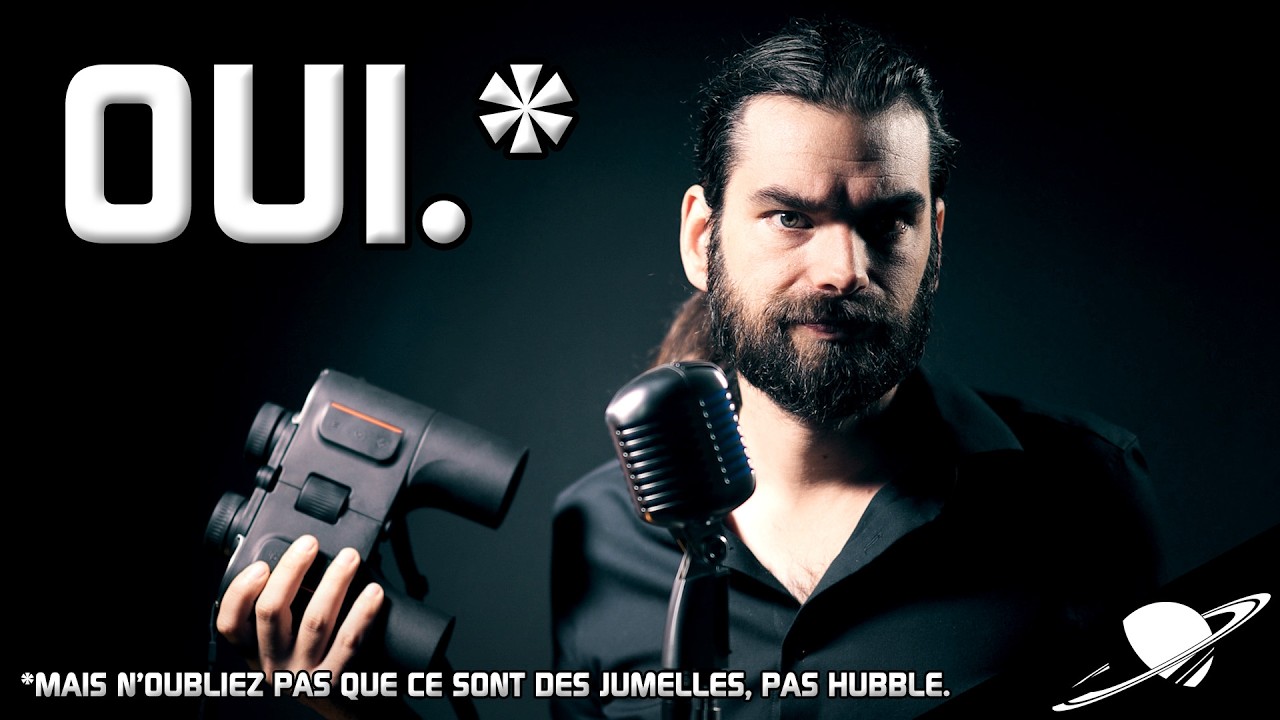
🪐Jumelles Envision : promesses tenues ?
🪐Envision Binoculars: do they live up to the hype?
Title history
- 🪐Jumelles Envision : promesses tenues ? — observed on 20261120-1642 UTC (YouTube)
Keywords
Summary
219 words
Critical Evaluation
Value of the Information & Strength of the Argument
The information value is high, offering a hands-on, practical perspective that goes beyond specifications. The creator provides clear comparisons with other binocular types (e.g., ornithology, military-grade) and explains the physics of light gathering and hand-held stability to justify the product’s compromises. The argumentation is solid and logically structured, moving from the unboxing and setup to a detailed explanation of the augmented reality features and then to a critical assessment of the optical and functional limits. He explicitly debunks potential misconceptions, such as expecting image capture or AI-based object recognition, and supports his points with direct examples from his testing experience. The narrative is transparent about the conflict of interest, stating that although he is in good terms with Unistellar, he paid for his unit and committed to an honest review, which strengthens the credibility of his assessment.
Scientific Rigor, Source Quality, Title Accuracy
The scientific rigor is acceptable for a product review; the test is subjective but grounded in practical use and comparison with known reference points (Nikon optics, premium brands). The primary sources directly referenced are the official Unistellar product page and the OpenStreetMap data mentioned in the software. The video clearly specifies a testing window of one day and two nights, which limits the generalizability of the autonomy claims. A short promotional sequence is present at the beginning of the video (approximately 30 seconds). The title/content adequacy is excellent: it poses a direct question and delivers a measured answer without overpromising, appropriately matching the detailed and critical content of the episode.
262 words
Title / Content Match
The title accurately frames the central question of the video, which systematically verifies whether the Envision binoculars fulfill their promises. The conclusion is nuanced, confirming the promise while pointing out limitations.
Quality & Reliability
7/10
The video is a detailed and honest expert review. It clearly discloses the conflict of interest (the creator funded the device via crowdfunding but has a partnership with the manufacturer). The assessment is based on a short testing period (one day and two nights), and while it compares the device favorably against high-end brands, some claims rely on the manufacturer's statements and lack independent technical verification.
Key Moments
Markers derived by PSI from the transcript: the creator did not define chapters.
- Disclosure of conflict of interest: the creator funded the device through crowdfunding and is not sponsored by Unistellar for this specific test.
- Review of previous connected astronomy devices (Stellina, EVScope, Odyssey) and the technological background leading to the Envision.
- Explanation of the crowdfunding campaign, the two-year delay, the industrial manufacturer problem, and the current shipping timeline.
- Unboxing and physical specifications: weight of 1.26 kg, battery life of 5 hours, and the content of the package.
- Detailed functionality: pairing with the smartphone, GPS and OpenStreetMap data, and the different augmented reality modes offered.
- Explanation of the night mode, target locking mechanism, and how the device guides the user to celestial objects.
- Critical limitations: no imaging capability, no image recognition AI, hand-held only, and the impossibility of seeing colored nebulae.
- Quality assessment of the Nikon optics, comparing the field of view, chromatic aberration, and overall optical performance to high-end brands.
Cited Sources
- Unistellar Envision official product page — Linked in the video description as the manufacturer's product page, used as a reference for the device specifications and purchase.
- Incompetech - Royalty Free Music — Listed in the description as the source of the background music composed by Kevin MacLeod under a Creative Commons license.
Concurring Sources
- OpenStreetMap — Mentioned in the video as the data source for the mapping functions, which can be verified independently.
External References
Contribution & Novelties
The video’s main original contribution is a critical, unbiased review of a novel consumer augmented reality binocular, offering a nuanced perspective that separates the device’s actual functionality from common expectations. It clearly explains the technical operation of the AR system and the inherent trade-offs of the design.
Pour aller plus loin :
- Augmented reality — Relevant to the core technology integrated into the binoculars.
- Smart telescope — Context on similar automated connected devices in the same field.
- OpenStreetMap — The mapping data source used by the device’s software for terrain display.
91 words
Radar Profile
The radar profile shows high scores across the board, particularly in quality of information and technical level, reflecting the creator's expertise and detailed hands-on approach. The slightly lower overall reliability score is justified by the short testing period and reliance on some manufacturer claims for certain features like future updates.