Physique des ondes & outils mathématiques #03 : ondes monochromatiques
Wave physics & mathematical tools #03: monochromatic waves
Keywords
Summary
220 words
Critical Evaluation
Value of the Information & Strength of the Argument
The value of the content lies in its pedagogical clarity and rigorous step-by-step derivations. The professor carefully demonstrates why functions of the form f(x-ct) and f(x+ct) solve the wave equation, using the chain rule for composite functions. He then gives physical meaning to the parameter c as the propagation velocity, and distinguishes between wave speed and local medium velocity, a common source of confusion. The introduction of Fourier series and transforms is motivated by the need to express arbitrary waves as superpositions of sinusoidal components, which will later prove essential for spectral analysis. The argumentation is solid: each mathematical step is justified, and examples such as the camel-shaped pulse and the impossibility of representing exp(x) sin(t) as g(x-ct) reinforce the concepts. The instructor also warns about potential pitfalls, such as the sign convention in the argument and the fact that not every two-variable function qualifies as a progressive wave. The reasoning is exhaustive and accessible to the target audience of third-year physics students, without oversimplifying the underlying mathematics.
Scientific Rigor, Source Quality, Title Accuracy
The scientific rigor is high: the lecture adheres to established wave mechanics and harmonic analysis, with no evident errors or unsubstantiated claims. The derivation of the general solution and the application of the Fourier transform are standard and correctly presented. The quality of sources is limited, as the video does not cite specific publications or external references; instead, it relies on well-known theorems (e.g., Fourier’s theorem) which are accurately invoked. The title adequately reflects the content, as the episode indeed focuses on monochromatic waves and introduces the Fourier transform as a mathematical tool. The coherence between the title and the delivered material is strong, although the title could be slightly more specific about the inclusion of the general wave equation and the superposition principle. Overall, the rigour is commendable for an educational video.
316 words
Title / Content Match
The title accurately reflects the content: the video covers monochromatic waves and introduces the Fourier transform as a mathematical tool.
Quality & Reliability
8/10
The content is a university-level lecture by a physics professor, presenting established concepts of wave physics with rigorous mathematical derivations. No external references are cited, but the material is standard and accurate.
Key Moments
Markers derived by PSI from the transcript: the creator did not define chapters.
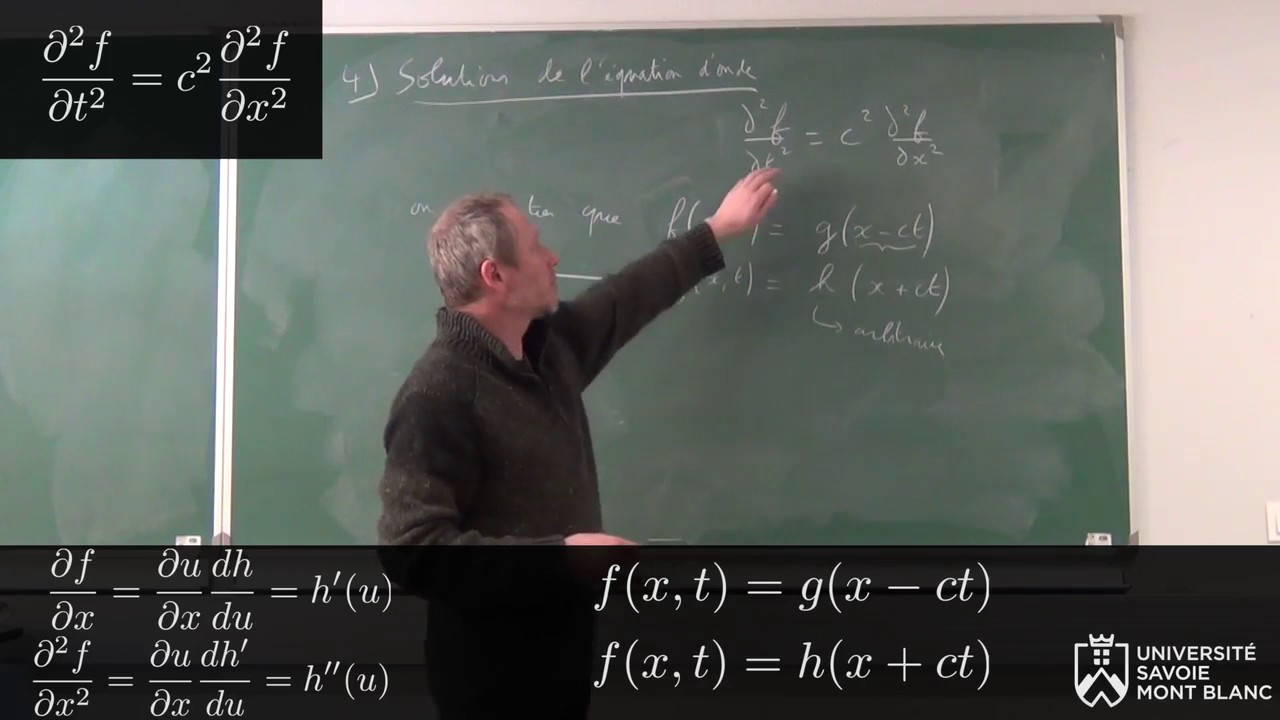
- Introduction of the wave equation and statement of the general solution in terms of arbitrary functions g(x-ct) and h(x+ct).
- Derivation showing that g(x-ct) satisfies the wave equation, using the chain rule and defining the phase u = x - ct.
- Physical interpretation of the solution: the wave profile translates at speed c without deformation, with a visual example of a camel-shaped pulse.
- Introduction of periodic functions and Fourier series, recalling that any periodic function can be expressed as a sum of sines and cosines.
- Extension to non-periodic functions using the Fourier transform, replacing the discrete sum with an integral over wavenumber k.
- Application of the Fourier transform to the progressive wave, defining angular frequency ω = kc and expressing the wave as a superposition of monochromatic components.
Cited Sources
- Fourier transform — Mentioned in the video when introducing the Fourier series and transform for decomposing waves into sinusoidal components.
- Wave equation — La base de l'équation des ondes is discussed throughout the video, and the general solution is derived and interpreted.
Contribution & Novelties
136 words
Radar Profile
The radar profile shows balanced scores across all dimensions, with a slight emphasis on quantity and technical level, reflecting a dense and mathematically rigorous lecture. The quality and reliability scores are also high, indicating that the content is accurate and well-presented for an educational setting.