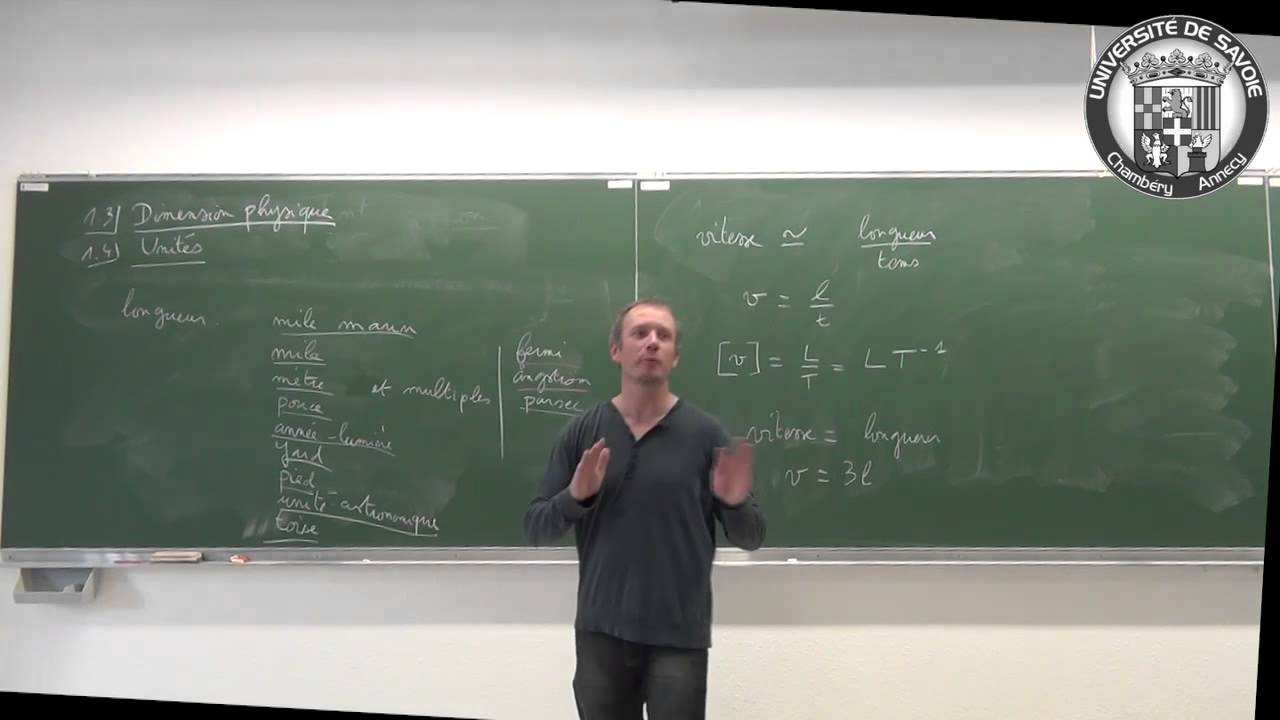
Introduction à la mécanique en L1 - cours 1
Introduction to mechanics in L1 - lesson 1
Keywords
Summary
143 words
Critical Evaluation
Value of the Information & Strength of the Argument
The video presents a remarkable pedagogical progression, starting from concrete needs to motivate each abstract notion. The professor uses an interactive game to illustrate the necessity of coordinates, anchoring learning. The argumentation is rigorous: each concept is justified by examples and dimensional checks. The demonstration on dimensions shows how to avoid common mistakes in physics. The course insists on the nuance between dimension and unit, often misunderstood. The clarity of the exposition and the coherence of the examples constitute the main value of this lesson.
Scientific Rigor, Source Quality, Title Accuracy
The course relies on established scientific foundations, presented with pedagogical clarity. The title perfectly matches the content: it is indeed an introduction to mechanics for first-year bachelor’s degree students. The references proposed in the description provide complementary material: the full version of the course and other physics lessons from the same university. These resources are institutional (University Grenoble Alpes). The quality of the sources is therefore high. The adequacy between the title and the content is perfect, without ambiguity.
179 words
Title / Content Match
The title accurately reflects the content: a comprehensive introduction to mechanics for first-year university students.
Quality & Reliability
9/10
The course is a well-structured university lecture by an expert physicist, covering established concepts with clear explanations and rigorous scientific methodology. The content is accurate and aligns with standard physics curricula. Sources are institutional and reliable.
Key Moments
Markers derived by PSI from the transcript: the creator did not define chapters.
- Introduction and course objectives: study of forces and motion
- Distinction between kinematics (description of motion) and dynamics (causes of motion)
- Interactive robot game to introduce the need for three coordinates in space
- Introduction of the concept of physical dimensions (L, T, M) and dimensional analysis
- Discussion on units, historical evolution from the meter standard to modern definitions
Cited Sources
- Cours complet de mécanique du point (PHYS 111) — The full 11-episode course on point mechanics
- Page de la formation physique à l'université de Savoie — Information about physics programs at the University of Savoie
- Cours d'optique ondulatoire (L3) — Related course in wave optics
- Cours de thermodynamique (L2) — Related course in thermodynamics
- Introduction à la relativité générale (M1) — Graduate-level course on general relativity
Concurring Sources
- Cours complet de mécanique du point (PHYS 111) — The full course extends the concepts introduced here, providing continuity.
- Cours d'optique géométrique (L1) — Another first-year physics course from the same institution, using similar pedagogical approach.
External References
Contribution & Novelties
This course provides a clear and engaging introduction to mechanics, using interactive demonstrations and historical context to explain fundamental concepts like physical dimensions and units. It makes abstract mathematical tools (vectors, coordinates) tangible through everyday examples. The originality lies in the pedagogical method rather than new scientific content.
Pour aller plus loin :
- Dimensional analysis — Essential tool introduced in the course to check equations.
- International System of Units — Background on modern unit definitions.
- Cartesian coordinate system — Basis for describing positions in space.
85 words
Radar Profile
The radar profile shows high scores in quality and reliability, with substantial information quantity typical of a university lecture. The technical level is moderate, appropriately calibrated for a beginner audience, while the overall trustworthiness is excellent.
💬 très positif - Sur les 30 commentaires analysés, tous expriment une forte admiration pour la pédagogie du professeur et la clarté du cours, avec de nombreux remerciements et encouragements.