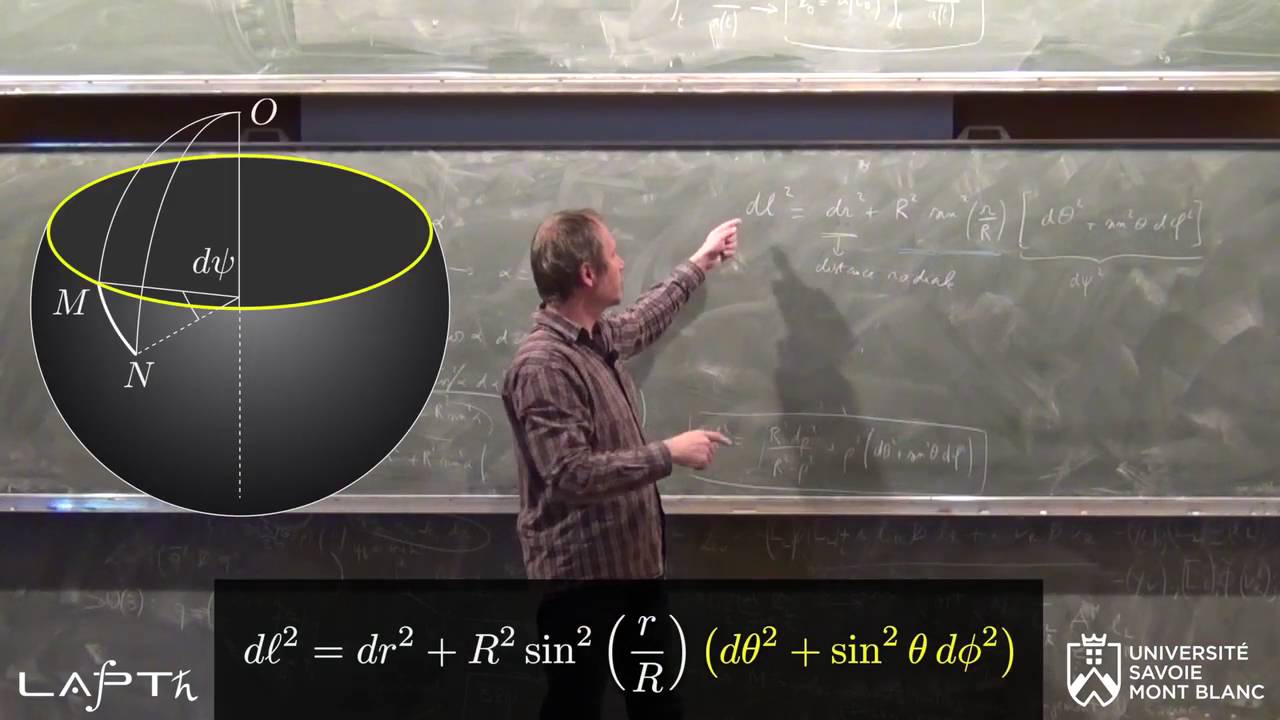
Cours de cosmologie - épisode 4 : métrique de Friedmann-Lemaître-Robertson-Walker
Cosmology course - episode 4: Friedmann-Lemaître-Robertson-Walker metric
Keywords
Summary
197 words
Critical Evaluation
Value of the Information & Strength of the Argument
The video provides a clear and rigorous step-by-step derivation of the FLRW metric, starting from an accessible analogy with the 2-sphere. Its value lies in the careful separation between coordinate distances and physical distances, the explicit construction of the 3-sphere metric, and the introduction of comoving coordinates. The argumentation is solid: each step follows from the previous one, with visible coordinate transformations and simplifications. The lecturer openly acknowledges the difficulty of visualising a 3-sphere and compensates with a mathematical approach. The connection between the scale factor and the physical expansion of space is convincingly explained, preparing the ground for later cosmological applications.
Scientific Rigor, Source Quality, Title Accuracy
The scientific rigor is high: the lecture is based on established cosmology and general relativity, and the derivations are self-contained. No external bibliography is cited inside the video, but the description links to the official course podcast and several related university courses, including an introduction to general relativity and a history of cosmology. The title accurately describes the content: the episode is indeed dedicated to the FLRW metric and its derivation. The minor typo ‘Friedman’ rather than ‘Friedmann’ is the only discrepancy, and it does not obscure the subject.
206 words
Title / Content Match
The title accurately reflects the content: the episode develops the FLRW metric step by step, using the previously studied 2-sphere analogy. The minor spelling variation 'Friedman' versus 'Friedmann' does not affect the match.
Quality & Reliability
8/10
University-level lecture by a physicist. The derivations are detailed, mathematically explicit, and self-consistent. The description provides access to updated course materials and related courses, though no external references are cited in the video itself.
Key Moments
Markers derived by PSI from the transcript: the creator did not define chapters.
- Introduction and plan: from the 2-sphere analogy to the 3-dimensional curved space.
- Review of the 2-sphere metric and embedding in 3D, used as a template.
- Derivation of the 3-sphere metric by embedding in a 4D Euclidean space.
- Introduction of the angle alpha to express the metric in a more physical form.
- Discussion of the three possible curvature cases k = +1, 0, -1 and their spatial metrics.
- Explanation of comoving coordinates and the role of the scale factor in cosmic expansion.
- Final expression of the FLRW spacetime interval with the cosmic time coordinate.
Cited Sources
- Cours de cosmologie (Grenet podcast) — Official updated version of this course is hosted at this link.
- Cours d'introduction à la relativité générale — Related master's-level physics course from the same university.
- Cours de thermodynamique L2 — Additional physics course listed in the video description.
- Cours d'électromagnétisme — Additional physics course listed in the video description.
- Cours d'optique ondulatoire — Additional physics course listed in the video description.
- Histoire de la cosmologie — Historical background relevant to cosmology.
- Histoire des sciences – histoires de la lumière — Additional history of science course listed in the description.
- Introduction à la relativité restreinte — Prerequisite course for special relativity concepts.
- Mécanique du point – PHYS 111 — Introductory mechanics course from the same university.
- Optique géométrique – PHYS 112 — Introductory optics course from the same university.
- Université Savoie Mont Blanc – Physics formations — Institutional page for physics studies at the university.
Contribution & Novelties
The original contribution of this video is not new scientific research, but a particularly clear and methodical pedagogical derivation of the FLRW metric. It builds the metric step by step from the 2-sphere analogy, explicitly showing how the embedding coordinates are eliminated and how the scale factor appears. The explanation of comoving coordinates and the distinction between coordinate and physical distances is especially valuable for learners.
Pour aller plus loin :
- Friedmann–Lemaître–Robertson–Walker metric — Full formulation and context of the metric presented in the video.
- 3-sphere — Mathematical object used as the model of a positively curved 3D space.
- Comoving and proper distances — Clarifies the distinction between coordinates and physical distances in an expanding universe.
- Scale factor (cosmology) — Directly relevant to the scale factor a(t) introduced in the lecture.
131 words
Radar Profile
The radar profile is strongly oriented toward high technical level and high information quality, with a slightly lower quantity score, reflecting a focused and rigorous theoretical lecture rather than a broad overview.