Histoire des sciences : épisode #03 – Calculer
History of sciences: episode #03 – Calculate
Keywords
Summary
190 words
Critical Evaluation
Value of the Information & Strength of the Argument
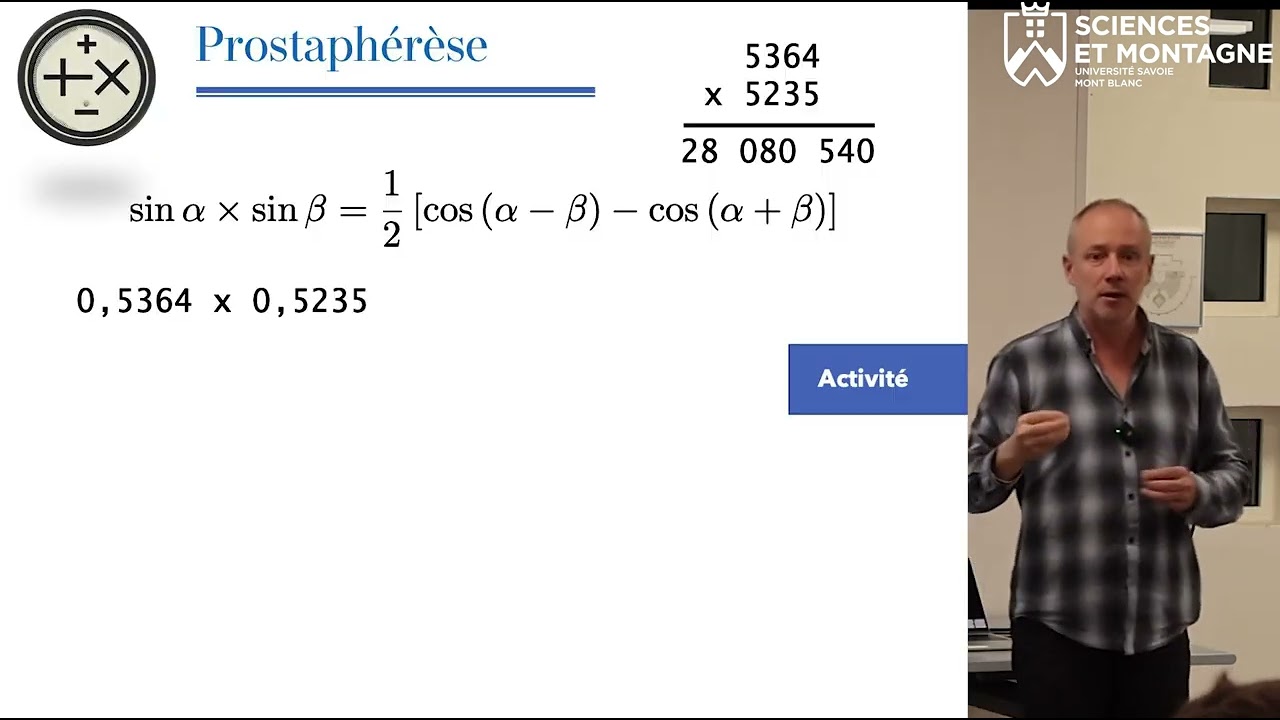
The lecture provides substantial value by connecting mathematical techniques to their historical and economic contexts. The explanation of prosthaphaeresis is detailed and includes a worked example, demonstrating how trigonometric identities were used to simplify multiplication. The argument for the superiority of logarithms is well-articulated, showing how they not only accelerate multiplication but also enable division, exponentiation, and root extraction. The speaker effectively argues that the development of calculation methods was driven by practical needs, particularly in astronomy and finance, and that these methods had profound impacts on scientific progress. The argumentation is logical, building from the problem (multiplication is slow) to solutions (prosthaphaeresis, logarithms) and their consequences (slide rule, human computers). The use of a quiz and historical images adds an engaging narrative element. However, the lecture is truncated, so the full argument for later periods (mechanization, electronization) is not available for assessment.
Scientific Rigor, Source Quality, Title Accuracy
The lecture maintains high scientific rigor, with accurate mathematical explanations and historical context. The speaker acknowledges an error about ENIAC’s components, demonstrating intellectual honesty. Sources are not extensively cited in the transcript, but the speaker mentions a key book, ‘When Computers Were Human’ by David Alan Grier, which is a reputable historical reference. The title accurately reflects the content, which is a broad history of calculation methods. The lecture is part of a university course, indicating a reliable academic origin. The absence of a formal bibliography in the transcript is a minor weakness, but the content itself is well-researched and presented by an expert in physics.
264 words
Title / Content Match
The title 'Histoire des sciences : épisode #03 – Calculer' accurately reflects the content, which is a lecture on the history of calculation methods from 1600 onward. The title is concise and matches the subject matter.
Quality & Reliability
8/10
The content is a university-level history of science lecture delivered by a physics professor (Richard Taillet, Université Savoie Mont Blanc). It is well-structured, historically accurate, and includes a self-correction (erratum) about ENIAC's components. The mathematical explanations (prosthaphaeresis, logarithms) are correct and pedagogically sound. The main limitation is the absence of explicit citations for most historical claims, although the speaker mentions a key reference book ('When Computers Were Human'). The transcript is truncated, so the full content cannot be fully assessed.
Key Moments
Markers derived by PSI from the transcript: the creator did not define chapters.
- Introduction to the third history of science lecture, focusing on the evolution of calculation methods from 1600 onwards.
- Quiz with five historical images to engage the audience, including a mysterious object, women at machines, and a microchip.
- Explanation of multiplication complexity versus addition, introducing the concept of elementary operations.
- Detailed demonstration of prosthaphaeresis using trigonometric identities to simplify multiplication.
- Introduction of logarithms by John Napier in 1614, with economic origins in interest calculations.
- Explanation of logarithmic properties and their use for multiplication, division, and exponentiation.
- Introduction of the slide rule as a mechanical analog calculator, used until the 1970s.
- Mention of 'human computers' and reference to the book 'When Computers Were Human' by David Alan Grier.
Cited Sources
- When Computers Were Human — Book by David Alan Grier, referenced by the speaker as a key source for the history of human computers.
Concurring Sources
- History of logarithms — Wikipedia article that corroborates the historical development and impact of logarithms as described in the lecture.
- Prosthaphaeresis — Wikipedia article that provides additional details on the method and its use by Tycho Brahe, consistent with the lecture.
Contribution & Novelties
The lecture offers a comprehensive overview of the history of calculation, highlighting the transition from manual methods to mechanical and electronic aids. It uniquely connects mathematical techniques to economic and practical motivations, such as the role of interest calculations in the development of logarithms. The detailed explanation of prosthaphaeresis, a lesser-known method, provides historical insight often overlooked in standard curricula. The discussion of human computers, particularly women, sheds light on a hidden aspect of scientific labor.
Pour aller plus loin :
- Prosthaphaeresis — Wikipedia article on the trigonometric multiplication technique.
- John Napier — Wikipedia article on the inventor of logarithms.
- Slide rule — Wikipedia article on the mechanical analog calculator.
- Human computer — Wikipedia article on people who performed calculations before electronic computers.
123 words
Radar Profile
The radar profile shows a strong emphasis on information quality and reliability, with high scores in those areas. The quantity of information and technical level are moderate, reflecting the broad historical scope and the lecture's accessible yet detailed approach. The overall profile indicates a well-balanced educational content with a solid factual basis.