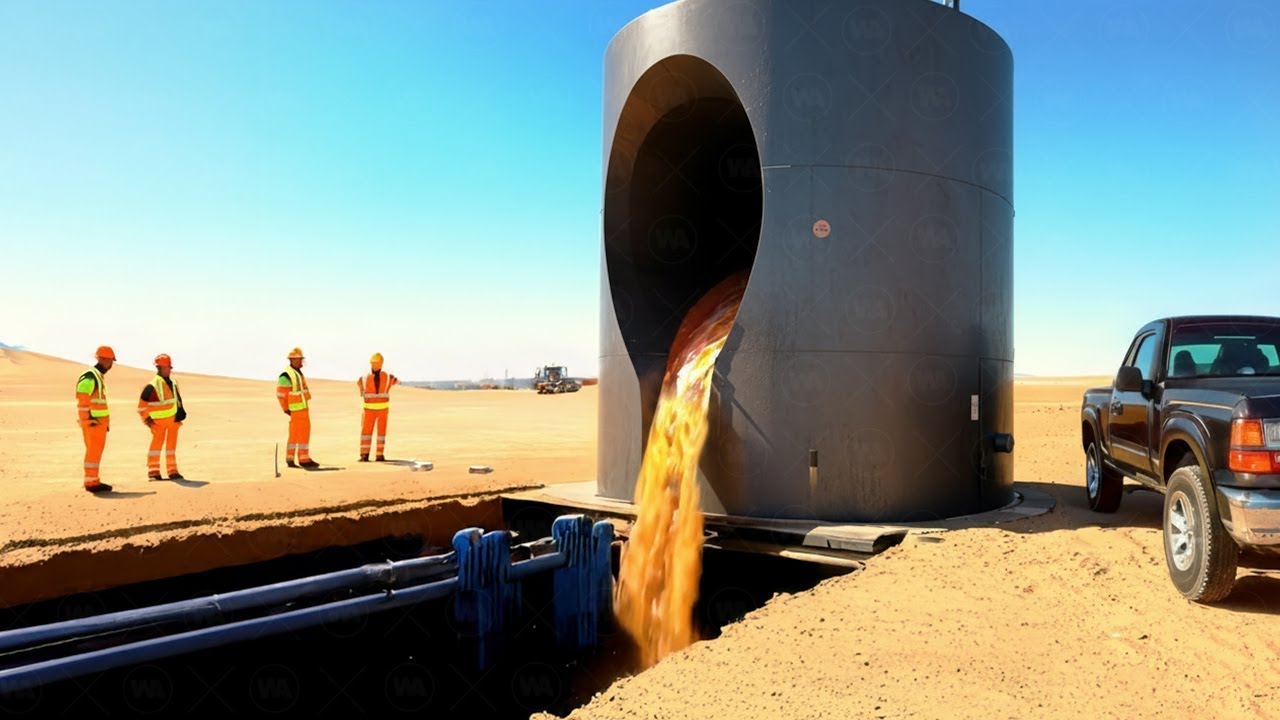
L'Égypte Perce Le Sahara Pour Laisser Entrer La Méditerranée Sans Réaliser Ce Qui Va Se Passer
Egypt Pierces the Sahara to Let the Mediterranean In Without Realizing What Will Happen
Title history
- L'Égypte Perce Le Sahara Pour Laisser Entrer La Méditerranée Sans Réaliser Ce Qui Va Se Passer — observed on 20261101-0158 UTC (YouTube)
Keywords
Summary
173 words
Critical Evaluation
Value of the Information & Strength of the Argument
The video delivers substantial factual content, covering historical background, technical details, and potential outcomes. It presents both positive and negative aspects, acknowledging the evaporation issue and salt buildup while highlighting the energy and water benefits. The argumentation is generally reasonable, though it occasionally leans toward optimistic projections without rigorous evidence. The discussion of desalination and pumped-storage is accurate and well-explained. However, the video does not provide concrete numbers or feasibility studies beyond general claims, and some statements about climate modification and economic impact are speculative. Overall, the information is valuable for understanding the project’s scope, but the argumentation could be more balanced with critical evaluation of scientific studies.
Scientific Rigor, Source Quality, Title Accuracy
The video references specific historical sources like John Ball’s 1927 study, a 1957 CIA document, and the 2023 Egypt Consulting contract, but provides no direct citations or links. The lack of a description with sources reduces verifiability. The title overstates the drama with ‘Without Realizing What Will Happen,’ while the content is more measured. The public comments (30 analyzed) show a skeptical audience, with many raising environmental concerns such as evaporation, salt pollution, and groundwater contamination. The video does not address these criticisms head-on, which slightly undermines its rigor. Overall, the sources are mentioned but not transparently, and the title is somewhat sensationalist.
226 words
Title / Content Match
The title is catchy but slightly sensationalist; the content is more balanced and informative.
Quality & Reliability
7/10
The video provides a comprehensive overview of the Qattara Depression project, citing historical studies and recent contracts, but lacks direct citations and contains sensationalist framing.
Key Moments
Markers derived by PSI from the transcript: the creator did not define chapters.
- Historical proposals: John Ball's 1927 geological study and early ideas for hydroelectric generation.
- CIA's 1957 plan and the proposal to use nuclear explosions to excavate the canal, with associated risks.
- Technical challenges: crossing the El Diffa plateau, tunnel boring machines, and Egypt's existing experience.
- Energy generation: pumped-storage hydroelectricity, desalination via reverse osmosis, and potential output.
- Environmental and economic concerns: evaporation, salt accumulation, climate change effects, and regional development plans.
Cited Sources
- John Ball's geological study of Qattara Depression (1927) — Mentioned as first detailed study suggesting hydroelectric exploitation of the depression.
- CIA document on flooding Qattara Depression (1957) — Discussed four advantages including climate modification and job creation.
- Friedrich Bassler's proposal and nuclear excavation plan — Led a consulting body and advocated using nuclear bombs to dig the canal.
- Egypt Consulting contract (April 2023) — Signed to conduct a new feasibility study for the project.
Contribution & Novelties
The video synthesizes historical and modern perspectives on the Qattara Depression project, offering a comprehensive overview of its technical and economic dimensions. It highlights the potential for a hybrid energy-water system, integrating hydroelectric generation with desalination, and introduces the concept of extracting lithium from salt deposits as a byproduct. The video also contextualizes the project within Egypt’s energy challenges and demographic growth.
Pour aller plus loin :
- Qattara Depression — Provides geographical and historical background.
- Pumped-storage hydroelectricity — Explains the energy storage mechanism discussed.
- Reverse osmosis desalination — Overview of the desalination technique mentioned.
- Lithium extraction from salt — Details on lithium recovery from brines, relevant to the byproduct idea.
110 words
Radar Profile
The radar profile shows a moderate level of information quantity and quality, with technical detail and reliability slightly lower. The video performs best in providing substantial content (quantity 8) but suffers from limited source transparency (quality 7, reliability 6). The technical level is decent (7), reflecting clear explanations of engineering concepts without excessive depth.
💬 Negative. Sur les 30 commentaires analysés, la majorité exprime un scepticisme marqué, évoquant des risques environnementaux comme l'évaporation, l'accumulation de sel et la contamination des nappes phréatiques, ainsi qu'un ton critique envers la faisabilité du projet.