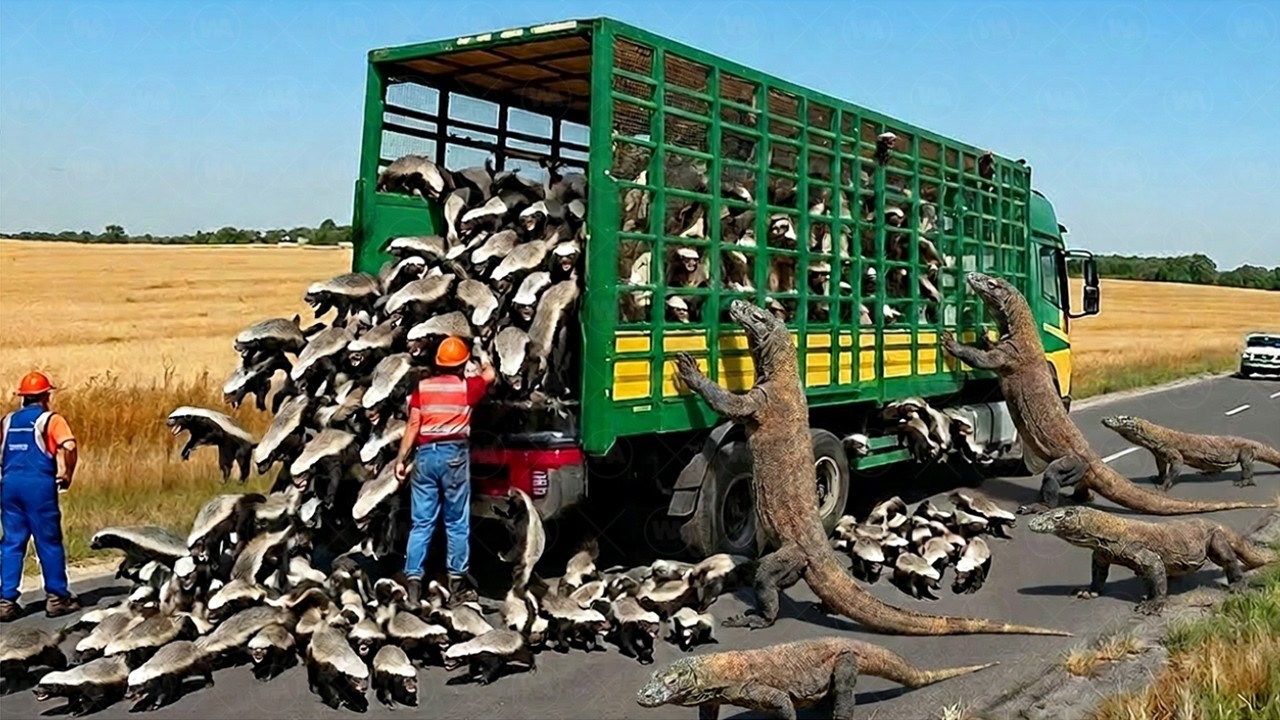
Lâcher De 100 Ratels Pour Tuer Les Dragons De Komodo
Release Of 100 Ratels To Kill The Komodo Dragons
Title history
- Lâcher De 100 Ratels Pour Tuer Les Dragons De Komodo — observed on 20261101-0108 UTC (YouTube)
Keywords
Summary
137 words
Critical Evaluation
Value of the Information & Strength of the Argument
The video provides valuable insights into the biology of both species, their adaptations, and the concept of island gigantism. The argumentation is structured logically: it builds from background information to a speculative scenario, then evaluates the likely outcomes. The presenter uses credible data (e.g., Komodo National Park attack statistics) and explains complex concepts like kleptoparasitism and insular evolution. However, the reasoning is at times speculative, especially when predicting the interactions between the two animals, and the conclusion relies on common ecological principles rather than rigorous scientific modeling. The overall value lies in its educational content and the provocative thought experiment, though the title overstates its realism.
Scientific Rigor, Source Quality, Title Accuracy
The video cites the Komodo National Park as a source for attack data and mentions the Serengeti and Kalahari as regions with high honey badger densities. No external URLs are provided in the description, and the video does not reference peer-reviewed studies directly. The title is clearly clickbait, promising an actual release that never occurs, which is reflected in the critical comments. The content itself is reasonably rigorous for a popular science format, but the lack of transparent citations and the speculative premise reduce its scientific authority. The video’s internal logic is consistent, and it correctly warns against ecological interventions, aligning with scientific consensus on invasive species.
228 words
Title / Content Match
The title suggests a real release event, but the video is a thought experiment about the hypothetical consequences, leading to audience disappointment.
Quality & Reliability
7/10
The video presents generally accurate biological and ecological facts about honey badgers and Komodo dragons, but the central premise is purely speculative and the title is misleading about an actual event.
Key Moments
Markers derived by PSI from the transcript: the creator did not define chapters.
- Introduction of the hypothetical scenario and its premise.
- Explanation of island gigantism and the evolution of Komodo dragons.
- Discussion of the dangers Komodo dragons pose to villagers and protected species status.
- Introduction of the honey badger's characteristics and reputation.
- Logistics of capturing and transporting honey badgers, including necessary equipment.
- Analysis of potential fights and the likely negative outcomes of the introduction.
Cited Sources
- Komodo National Park data on attacks — Mentioned as the source for attack statistics on humans from 1974 to 2012.
- Serengeti and Kalahari regions — Cited as areas with high honey badger population densities.
- Concept of insular gigantism — Used to explain the large size of Komodo dragons on islands.
Contribution & Novelties
The video offers an original thought experiment that synthesizes knowledge from ethology, ecology, and conservation science to evaluate a hypothetical biological control scenario. It goes beyond simple animal comparison by considering logistical, legal, and ecological dimensions. The novelty lies in systematically deconstructing the idea and concluding with a cautionary message about human interference.
Pour aller plus loin :
- Honey badger (Wikipedia) — Overview of its biology, behavior, and reported resistance to venom.
- Komodo dragon (Wikipedia) — Details on its ecology, venom, and conservation status.
- Island gigantism (Wikipedia) — Explains the evolutionary phenomenon that produced the Komodo dragon’s large size.
99 words
Radar Profile
The radar profile shows moderate scores across all axes, with slightly higher quantite_information and qualite_information, reflecting the video's educational content but also its speculative nature. The fiabilite_globale is moderate due to the lack of transparent citations and the hypothetical premise.
💬 négatif — Sur les 30 commentaires analysés, la majorité critique le titre trompeur et la nature spéculative de la vidéo, certains remettant en question l'idée même d'introduire une espèce invasive. Quelques commentaires positifs saluent le contenu éducatif, mais le climat général est celui d'une réception mitigée.