Current State of Diagnostic Testing in Pediatric Sarcoma:Practical Solutions to Diagnostic Challenge
Title history
- Current State of Diagnostic Testing in Pediatric Sarcoma:Practical Solutions to Diagnostic Challenge — observed on 20261118-1753 UTC (YouTube)
Keywords
Summary
129 words
Critical Evaluation
Value of the Information & Strength of the Argument
The video provides valuable insights into the state of diagnostic testing for pediatric sarcomas, a rare disease with unique genomic features. The survey data, though limited in sample size, offers a snapshot of current practices and underscores the reliance on traditional cytogenetics over newer molecular methods. The argumentation is clear: by identifying gaps and challenges, the workgroup proposes scenario-based solutions to optimize testing. The case example effectively demonstrates the practical steps, from karyotyping to FISH, and the importance of detecting specific fusions for targeted therapies. The presentation is informative for clinicians and laboratory professionals, highlighting both the advantages and limitations of various assays.
Scientific Rigor, Source Quality, Title Accuracy
The presentation is based on a survey conducted within the CGC community, which lends some authority. However, no specific published sources are cited beyond the organization’s website. The scientific rigor is moderate: the survey design and results are presented without detailed methodology, and the recommendations are expert-driven. The title accurately matches the content, focusing on current diagnostic testing and practical solutions. There are no comments provided to assess public reception.
188 words
Title / Content Match
The title accurately reflects the content: an overview of current diagnostic testing approaches for pediatric sarcomas and practical solutions to challenges, as discussed via survey results and a clinical scenario.
Quality & Reliability
7/10
The content is presented by a professional organization (CGC) and based on a survey of members, but it relies on self-reported data and expert opinion without peer-reviewed publication cited. The information is practical but limited in scope.
Key Moments
Markers derived by PSI from the transcript: the creator did not define chapters.
- Introduction and acknowledgments, mention of Ruthanne Fou and workgroup history
- History and establishment of the CGC sarcoma workgroup after FDA approval of larotrectinib
- Definition and diversity of sarcomas in children, need for germline testing consideration
- Survey overview: demographics and testing landscape, dominance of cytogenetics
- Detailed results on FISH, rtPCR, and targeted panels, with probe availability and panel composition
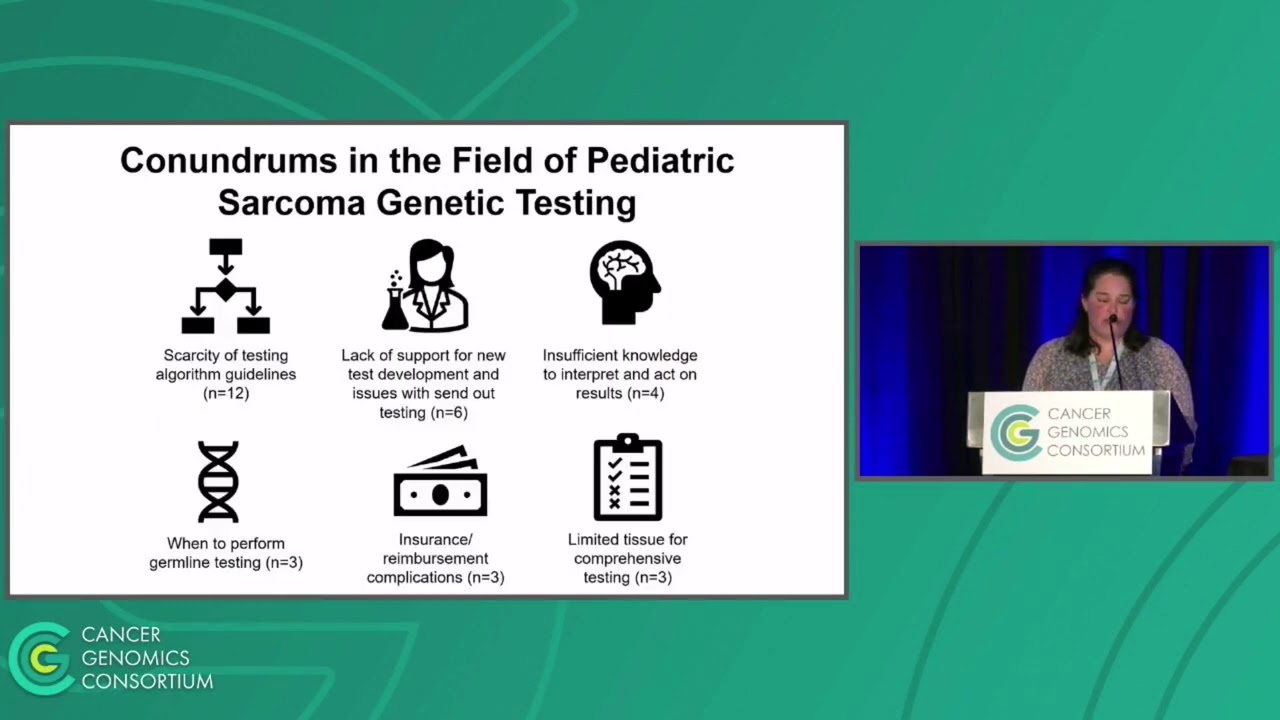
- Key conundrums in testing: lack of guidelines, reimbursement, limited tissue, etc.
- Clinical case scenario: infantile fibrosarcoma with ETV6-NTRK3 fusion, diagnostic steps and next steps
Cited Sources
- Cancer Genomics Consortium — Official website of the organization hosting the presentation.
- CGC Membership — Information on becoming a member of the consortium.
Contribution & Novelties
The original contribution of this presentation is the survey-based overview of diagnostic testing practices for pediatric sarcomas, combined with scenario-based practical recommendations. The novelty lies in addressing the gap between adult-derived testing panels and the unique genomic landscape of pediatric sarcomas, and in providing a framework for decision-making in resource-limited settings.
Pour aller plus loin :
- Larotrectinib — Targeted therapy for NTRK fusion-positive tumors, central to the case described.
- Fluorescence in situ hybridization — Technique used to detect gene rearrangements, a key part of the diagnostic workflow.
- RNA sequencing — A method for detecting novel fusions, relevant to advanced molecular testing.
- Li-Fraumeni syndrome — Example of cancer predisposition syndrome associated with sarcomas, linked to germline testing discussion.
117 words
Radar Profile
The radar profile shows high technical level and moderate quantity/quality of information, with moderate reliability. This indicates a technically detailed but narrow presentation, characteristic of a specialty conference talk.