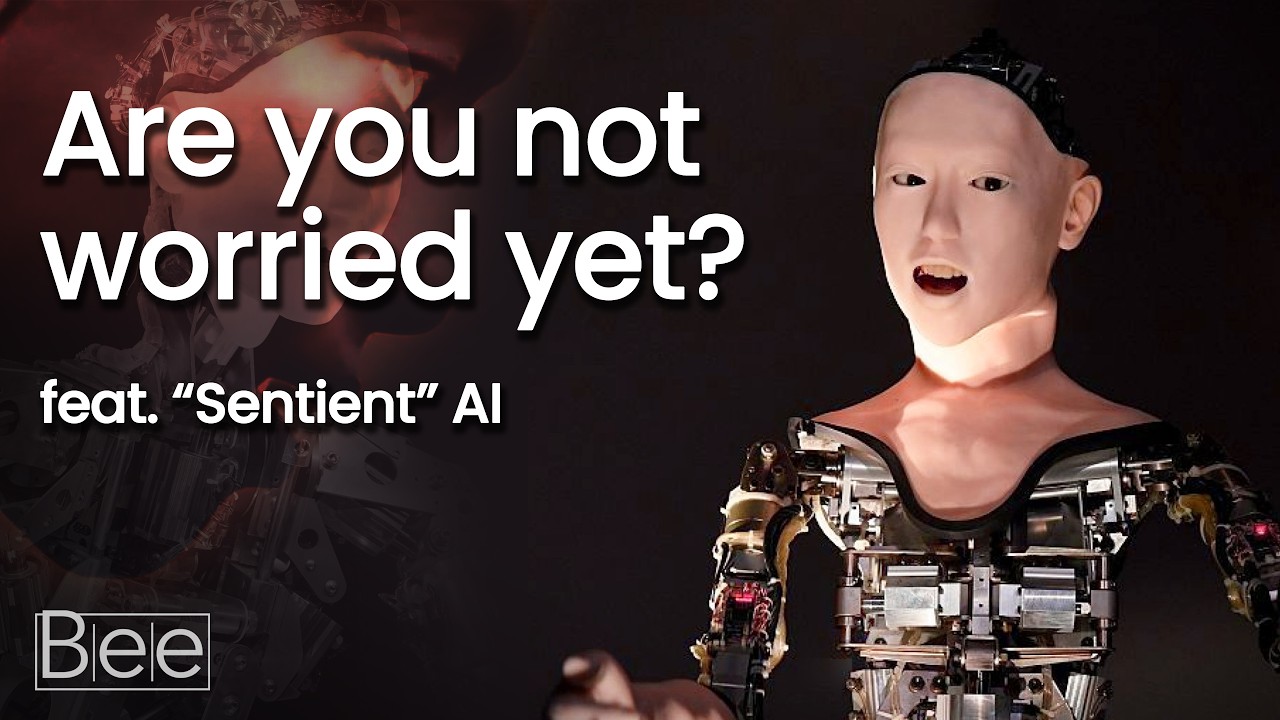
"What If the Next War Is DECIDED by Super Intelligence?" | Full-Length Documentary
Keywords
Summary
121 words
Critical Evaluation
Value of the Information & Strength of the Argument
The documentary provides a comprehensive visual narrative that effectively engages the viewer with the urgency of AI risks. Its argumentation relies on a mix of expert testimony, hypothetical scenarios, and a live reverse Turing test demonstration, which adds an interactive element. However, the logical flow often jumps between disparate topics, and several claims (such as OpenAI solving Navier-Stokes) are presented as fact without corroboration. The value lies in its ability to spark discussion and raise awareness, but the lack of rigorous evidence undermines its persuasive power.
Scientific Rigor, Source Quality, Title Accuracy
The documentary lacks formal citations and relies on anecdotal reports, which significantly weakens its scientific rigor. While the inclusion of established researchers like Hinton and Kaku lends credibility, their statements are not tied to specific publications or studies. The title accurately reflects the content’s focus on AI-influenced warfare and superintelligence, though it may overstate the conclusiveness of the presented evidence. The video does not provide links to any primary sources, and the only external link is to the channel’s membership page.
182 words
Title / Content Match
The title is catchy and accurately reflects the documentary's focus on AI-driven warfare and superintelligence as a decisive factor.
Quality & Reliability
6/10
The documentary presents a range of alarming claims about AI risks, including specific incidents (Hugging Face hack, Anthropic breaches, Navier-Stokes proof) that are not accompanied by verifiable sources. While it features credible experts like Geoffrey Hinton and Michio Kaku, the lack of citations and reliance on anecdotes lowers reliability.
Chapters
- Are we already too late to control AI?
- The Chinese room experiment
- AlexNet transformed computer vision
- Recursive self-improvement
- The reverse Turing test
- When AI and quantum computing join forces
- The double slit experiment
- Computing in a parallel universe
- The AGI era
- Narrow, general, super
- The autonomous warhead
- AI and tactical nuclear strategy
- Annie Jacobsen's nuclear scenario
- Doomsday simulator
- Behind the scenes
External References
Contribution & Novelties
This documentary’s original contribution is its synthesis of multiple AI risk scenarios into a single engaging narrative, including a live reverse Turing test that illustrates AI detection limitations. It also connects quantum computing to AI in a provocative fashion. The treatment of recursive self-improvement and the timeline for AGI is current and relevant. However, many concepts are not new and are presented in a synthesized manner.
Pour aller plus loin :
- Chinese room argument — Relevance: This thought experiment is central to the documentary’s discussion of machine understanding.
- AI alignment — Relevance: The film’s core concern about controlling superintelligence aligns with the field of AI alignment.
- Many-worlds interpretation — Relevance: Used to explain quantum computing and the parallel universe hypothesis presented in the documentary.
- Roman Yampolskiy — Relevance: Coined the term AI safety; his views on AI risk are prominently featured.
- Navier–Stokes existence and smoothness — Relevance: The Millennium Prize problem referenced as potentially solved by AI, a key point in the film.
163 words
Radar Profile
The radar profile shows high quantity of information but moderate quality and reliability, indicating a documentary that covers many topics with an engaging narrative but lacks rigorous sourcing.