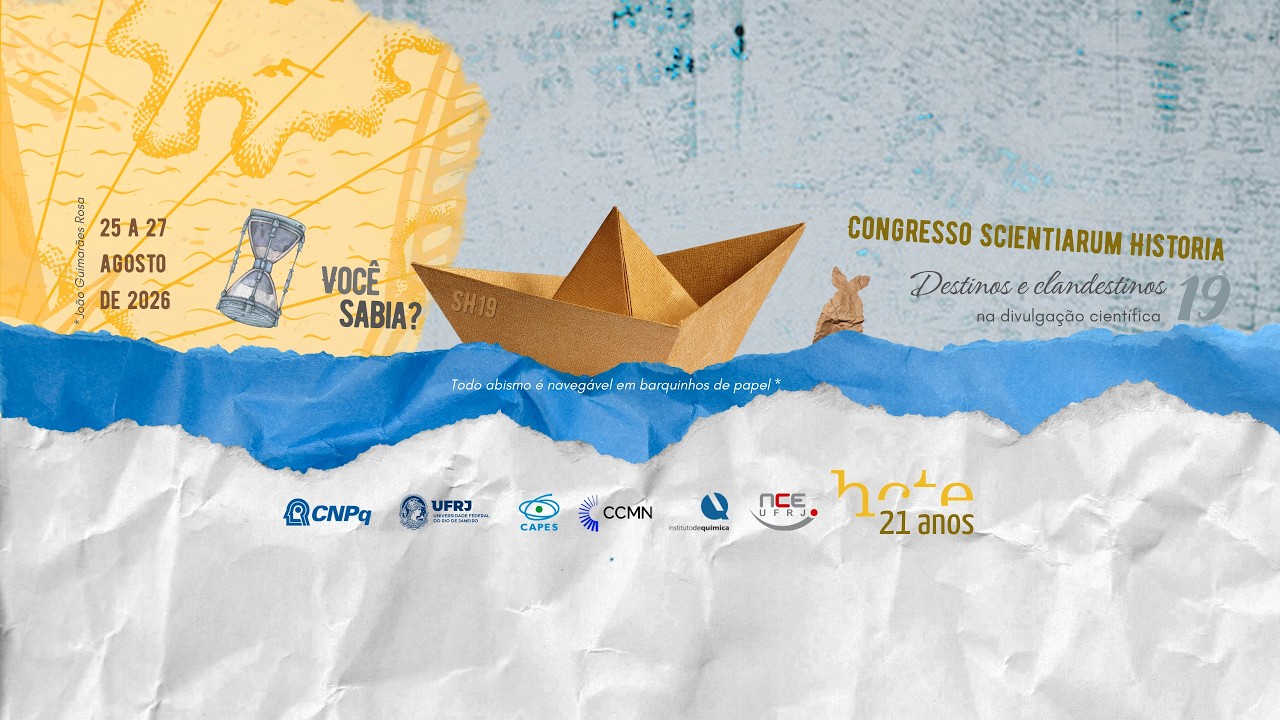
Os saberes Clandestinos: navegando nas ciências do Sul Global
Clandestine Knowledges: navigating the sciences of the Global South
Keywords
Summary
153 words
Critical Evaluation
Value of the Information & Strength of the Argument
The value of the information lies in its rich theoretical synthesis of decolonial thought applied to science communication and education. The speakers provide concrete conceptual tools—such as the criteria to distinguish denialism from traditional knowledge—that are immediately useful for practitioners. The argumentation is solid: Natália anchors her critique in historical references (e.g., 1930s science writing) and contemporary publications (the article by Rosa, Alves Brito, and Karine). She carefully avoids relativistic traps by insisting on the falseability and community validation of traditional knowledges. The panel exemplifies a collaborative, cross-disciplinary approach, integrating astronomy, physics, history, and education. The use of metaphors like ‘multiple compasses’ and ‘barquinhos de papel’ enriches the discourse, making complex ideas accessible without oversimplifying.
Scientific Rigor, Source Quality, Title Accuracy
The speakers cite specific scholarly works and authors, such as Carl Sagan’s ‘The Demon-Haunted World,’ the article ‘Pós-verdade para quem?’ by Katemari Rosa et al., and the work of Anna Tsing and Nego Bispo. These references are pertinent and give the discussion an academic grounding. However, the citations are made in passing without formal references, and no external links are provided in the video description. The title accurately encapsulates the theme, and the content delivers on the promise of exploring clandestine knowledges in the Global South. The structure is that of a round-table conversation, which is coherent for a conference panel. No comments were available to analyze public reception.
239 words
Title / Content Match
The title accurately reflects the central theme: examining marginalized knowledges and counter-hegemonic scientific practices in the Global South. The content aligns closely with this framing.
Quality & Reliability
8/10
The panel brings together recognized academics and practitioners (historian, physicists, astronomer) with strong institutional affiliations. They discuss decolonial epistemologies and science communication with nuanced arguments, referencing scholarly works and projects. The tone is reflective and rigorous, though the format is a discussion rather than a peer-reviewed presentation.
Key Moments
Markers derived by PSI from the transcript: the creator did not define chapters.
- Introductions and the panel begins with acknowledgments to staff and a poetic reading of Thiago de Melo's 'Estatuto do Homem'.
- Natália Amarinho starts her talk, critiquing the 'Promethean' image of science communicators and the hierarchical model of knowledge dissemination.
- Discussion on distinguishing scientific denialism from traditional knowledges, listing criteria such as interests, verifiability, and historical depth.
- Sharing of educational materials and projects: the constellation map of the Tukano people, the 'Dance of the Sun' calendar, and the audiovisual project 'Ciência, Cultura'.
- Closing reflections on institutional policies (e.g., UFMG's public science communication policy) and epistemological patchwork, followed by final thanks.
Cited Sources
- O mundo assombrado pelos demônios (The Demon-Haunted World) — Mentioned by Natália Amarinho as an example of the 'Sagan-esque' aesthetics in science communication, where science is presented as a light against ignorance.
- Pós-verdade para quem? (Post-truth for whom?) — Article by Katemari Rosa, Alan Alves Brito, and Bárbara Karine, referenced to argue that hegemonic scientific argumentation is itself a post-truth state for Black people.
- Anna Tsing's concept of 'justaposição' (juxtaposition) — Used by Natália to describe placing different knowledges side by side without forced translation.
- Nego Bispo's 'confluência' — Referenced as a similar concept to Tsing's, emphasizing coexistence of knowledges.
Concurring Sources
- Decoloniality in Science Studies — Provides theoretical background consistent with the panel's arguments about hegemonic epistemologies.
- Traditional Ecological Knowledge — Supports the idea that indigenous knowledges are cumulative and adaptive, echoing the speakers' points.
Contribution & Novelties
The panel’s original contribution lies in its explicit operational criteria to differentiate scientific denialism from legitimate traditional knowledges, addressing a common confusion in public debates. It also offers a practical model for ’epistemological patchwork’ in education, championing the inclusion of indigenous and Afro-diasporic knowledge systems alongside Western science. The speakers demonstrate how institutional policies (like UFMG’s) can be implemented concretely, and they share open educational resources such as the Tukano constellation map.
Pour aller plus loin :
- Decoloniality — Overview of the decolonial turn and its relevance to science studies.
- Traditional ecological knowledge — Widely discussed concept that aligns with the ‘saberes tradicionais’ mentioned in the video.
- Science communication — Contextualizes the critiques of the Promethean model and the call for broader public engagement.
124 words
Radar Profile
The radar profile shows high values for information quantity and quality, reflecting the dense and conceptually rich panel. Technical level is moderate, and reliability is strong due to the academic credibility of the speakers. The balance suggests a video that is substantive and trustworthy, though perhaps best suited for an audience already familiar with decolonial discourse.