MOSFET Fundamentals: Threshold Voltage, Operations, IV characterstitics| 2026 L11
Keywords
Summary
145 words
Critical Evaluation
Value of the Information & Strength of the Argument
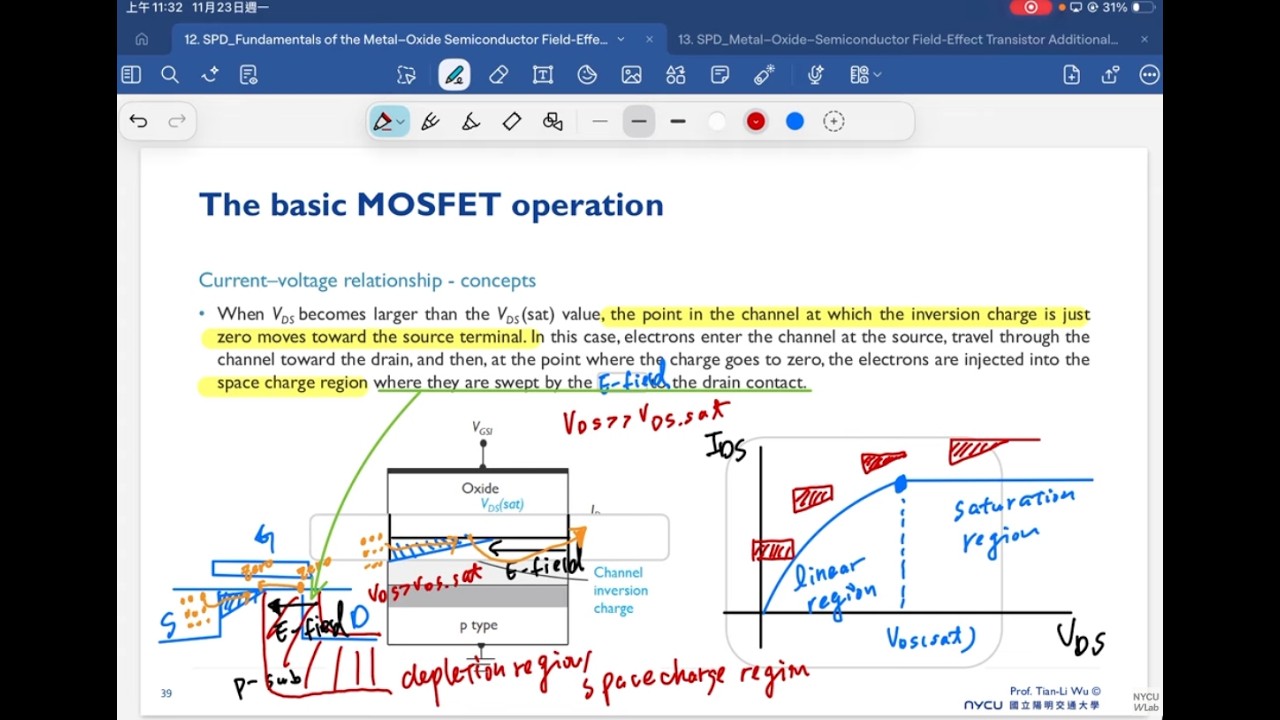
The value of this lecture lies in its systematic derivation of MOSFET physical principles from first principles. The instructor explains the flat-band condition, threshold voltage, and CV characteristics with a strong emphasis on charge conservation and band diagrams. The argumentation is logically presented, building each concept on previous ones, which aids comprehension. However, the lecture is largely theoretical and does not include experimental data or real device measurements, which would strengthen the practical relevance. The treatment of interface states and trapping is particularly valuable for understanding reliability issues. The explanation of frequency effects on CV is concise but accurate, clarifying why high-frequency CV differs from low-frequency behavior.
Scientific Rigor, Source Quality, Title Accuracy
The lecture demonstrates high scientific rigor, adhering to standard semiconductor physics formulations. The instructor uses conventional notation and derives equations meticulously. No external references are explicitly cited on screen or in the description, which is typical for a lecture; the content is based on established textbook knowledge (likely Sze or similar). The title accurately describes the content, and the lecture progresses logically from fundamental concepts to device-level application. The absence of external links means we cannot verify sources, but the internal consistency and theoretical correctness are strong indicators of reliability. The public comments, if any, would be useful but none are provided.
224 words
Title / Content Match
The title accurately reflects the content: the lecture covers threshold voltage, device operation, and IV characteristics comprehensively. The '2026 L11' suggests it is part of a course lecture series, which matches the academic style.
Quality & Reliability
8/10
The lecture provides a rigorous derivation of MOSFET fundamentals based on established semiconductor physics, with clear step-by-step reasoning. The instructor appears highly knowledgeable, and the content aligns with standard textbook treatments (e.g., Sze). The presentation is well-structured, though the method of delivery is monotone and lacks engagement.
Key Moments
Markers derived by PSI from the transcript: the creator did not define chapters.
- Introduction to flat-band voltage and its physical meaning
- Derivation of threshold voltage condition and analytical formula
- Analysis of CV characteristics: accumulation, depletion, inversion modes
- Frequency effects on CV: low vs high frequency behavior
- Impact of fixed oxide charge and interface states on threshold voltage
- Discussion of interface state trapping and reliability issues
- Introduction to CMOS inverter and body effect
- Example of 2D MoS₂ transistor scaling
Contribution & Novelties
The lecture offers a clear, pedagogical synthesis of standard MOSFET theory, emphasizing the physical reasoning behind the equations. Its originality lies in the explicit connection between band diagrams, charge distributions, and the resulting electrical characteristics, which is valuable for students. The step-by-step derivation of threshold voltage and CV curves is well-executed. The inclusion of the 2D MoS₂ example highlights current research directions, though it is brief.
Pour aller plus loin :
- MOSFET — Comprehensive overview of MOSFET operation and history.
- Threshold voltage — Detailed explanation of threshold voltage in MOSFETs.
- Capacitance–voltage profiling — Technique used to characterize semiconductor devices, closely related to the CV analysis discussed.
- CMOS — Complementary metal-oxide-semiconductor technology, relevant to the inverter section.
116 words
Radar Profile
The profile shows high scores across all dimensions, indicating a dense, technically rigorous, and reliable lecture. The weakest point is overall reliability (8/10) due to lack of external citations, but the internal consistency is strong. The lecture is highly informative and technically deep, making it excellent for advanced students.