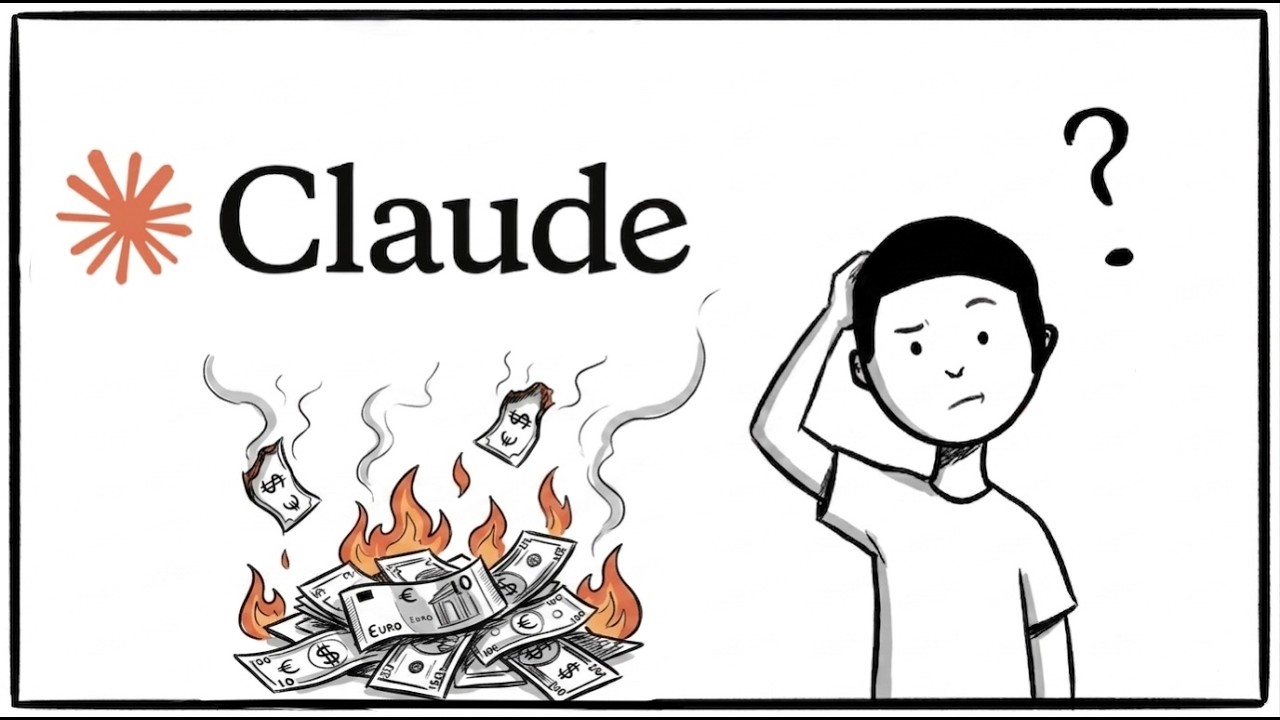
Ma stack IA pour développer des produits sans me ruiner
My AI stack for developing products without breaking the bank
Title history
- Ma stack IA pour développer des produits sans me ruiner — observed on 20261110-0303 UTC (YouTube)
Keywords
Summary
180 words
Critical Evaluation
Value of the Information & Strength of the Argument
The video offers valuable practical insights for developers seeking to leverage AI cost-effectively. The argumentation is built on personal experience, with concrete examples and rationale behind each technique. He clearly explains how context engineering, specs, and discipline reduce token usage and improve output quality. The emphasis on avoiding excessive context filling and breaking work into small tasks is well-argued and logically sound. He also stresses the importance of guardrails like tests and linting, reinforcing the need for sound engineering practices when using AI. The demonstration of real-world projects and metrics (e.g., MRR growth, SEO score improvement) adds credibility to his claims.
Scientific Rigor, Source Quality, Title Accuracy
The creator shares links to his own tools and open-source skills, but does not cite external scientific sources. His advice is based on empirical usage rather than formal research, yet it aligns with established best practices in prompt engineering and context management. The title accurately matches the content, promising a budget-friendly AI stack and delivering exactly that. The description provides relevant links to additional resources he mentions, enhancing the video’s utility. No comments were analyzed for this review.
194 words
Title / Content Match
The title accurately reflects the content, which details a personal AI development stack emphasizing budget constraints.
Quality & Reliability
6/10
The video provides practical, experience-based advice on using AI for development with cost optimization. Claims are plausible but unverified and subjective, with no empirical data or external validation.
Chapters
Cited Sources
- Dev with AI (Slack community) — Mentioned at the end as a community for AI developers.
- Claude SEO GitHub repository — Skills for SEO audits, downloaded and used.
- Marketing skills by Corey Haines — Open-source marketing skills for AI, referenced for comparison pages and copywriting.
- Writizzy — His own blogging platform (alternative to Medium/Substack), used as example project.
- Hakanai — His toolkit for bloggers (analytics, newsletter, SEO).
- Bloggrify — Open-source static blog generator he developed.
- Eventually Coding Blog — His personal blog where he shares articles.
- Bluesky Profile — Social media profile.
- Mastodon Profile — Social media profile.
External References
Contribution & Novelties
The video provides a pragmatic, field-tested perspective on minimizing AI development costs through context engineering, structured specs, and disciplined session management. His distinction between skills and MCPs in terms of token overhead is particularly relevant for practitioners. The sharing of his own open-source tools and skills contributes to the community. Overall, it’s a useful synthesis of known techniques applied to a real-world business.
Pour aller plus loin :
- Anthropic Claude Documentation — Official documentation for Claude models and features.
- Model Context Protocol (MCP) — The protocol used to connect AI to external tools and data sources.
- Ollama — Tool for running local LLMs, which he experiments with for cost reduction.
110 words
Radar Profile
The radar profile shows high scores in quantity and technical level, reflecting the dense, hands-on content. Quality and reliability are moderate, as expected from a personal experience sharing. The overall shape indicates a practically useful tutorial with a strong technical depth but limited formal scientific backing.