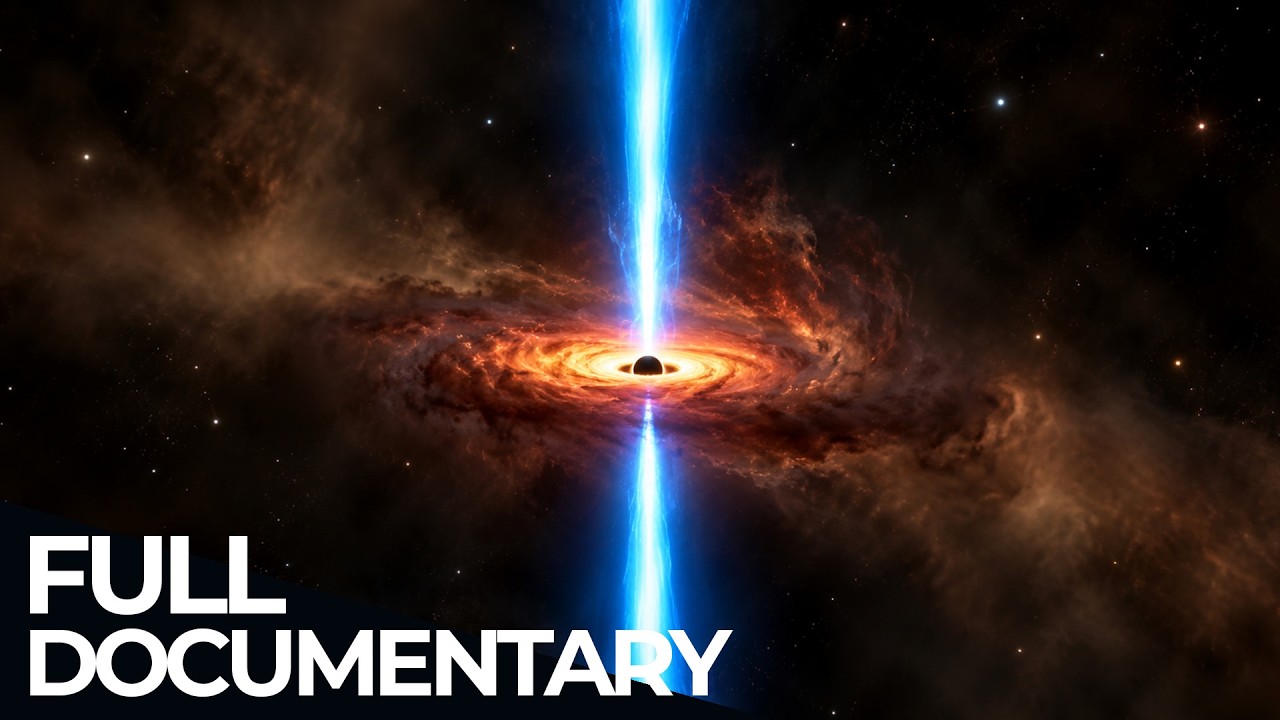
Black Holes: The Universe’s Darkest Mystery | Strip the Cosmos | Free Documentary Space
Keywords
Summary
121 words
Critical Evaluation
Value of the Information & Strength of the Argument
The video provides substantial informational value by synthesizing current knowledge on black holes, from their origin to their cosmic role. It argues that black holes are not merely destructive but also crucial for galaxy formation, supporting this with evidence from observations of stellar orbits around Sagittarius A* and the prevalence of supermassive black holes in galaxies. The argumentation is coherent and builds on expert testimonies, though some leaps are made in speculative sections about wormholes. The use of analog experiments to illustrate relativistic effects strengthens the explanatory power, making complex concepts accessible without oversimplifying the underlying physics.
Scientific Rigor, Source Quality, Title Accuracy
The documentary cites reputable scientific institutions and missions, including the Keck Observatory and LIGO, which lend credibility. However, specific papers or studies are not explicitly referenced, and some claims rely on general consensus rather than precise citations. The title adequately matches the content, which stays focused on black holes and their mysteries. The video maintains scientific rigor in its core explanations, although the speculative parts on wormholes are presented with appropriate caveats. Overall, the sources are reliable, but the lack of direct references limits transparent verification.
198 words
Title / Content Match
The title accurately reflects the content, which explores the mysteries of black holes, their formation, role in galaxies, and speculative aspects like wormholes.
Quality & Reliability
7/10
The documentary presents a broad yet accurate overview of black holes, relying on well-established scientific institutions such as Keck Observatory and LIGO. While some explanations are simplified for a general audience, the core physics and observational facts are correct and current.
Key Moments
Markers derived by PSI from the transcript: the creator did not define chapters.
- Introduction: black holes as the most mysterious objects in the universe
- Formation of black holes from supernovae and hypergiant stars
- Sagittarius A* and its role at the center of the Milky Way
- Detection of gravitational waves with LIGO and black hole collisions
- Event horizon, analog gravity experiments, and frozen light
- Speculative concepts: white holes, wormholes, and potential travel
Cited Sources
- Keck Observatory — Observations of Sagittarius A* and its stellar environment
- LIGO — Detection of gravitational waves from black hole mergers
- Daniel Faccio's experiment — Analog black hole experiment using light to simulate event horizon phenomena
Concurring Sources
- Black hole — General reference confirming the description of black holes and their properties.
- Event horizon — Definition and significance of the event horizon.
- Gravitational wave — Confirmation of LIGO's role in detecting gravitational waves.
Contribution & Novelties
The documentary offers a comprehensive and engaging synthesis of black hole science, combining observational discoveries with theoretical speculation. Its unique contribution lies in presenting recent findings like gravitational wave detection and analog experiments in an accessible format, while also exploring forward-looking ideas such as wormholes. It effectively communicates the current state of knowledge and the remaining mysteries.
Pour aller plus loin :
- Black hole — General overview and properties.
- Event horizon — The boundary around a black hole.
- Gravitational wave — Ripples in spacetime detected by LIGO.
- Wormhole — Hypothetical tunnel through spacetime.
93 words
Radar Profile
The scores indicate a documentary that is information-rich and reliable, with a moderate technical depth. The high quantity of information is balanced by simplified explanations, making it suitable for a broad audience while maintaining scientific credibility. The profile suggests a well-rounded educational piece.