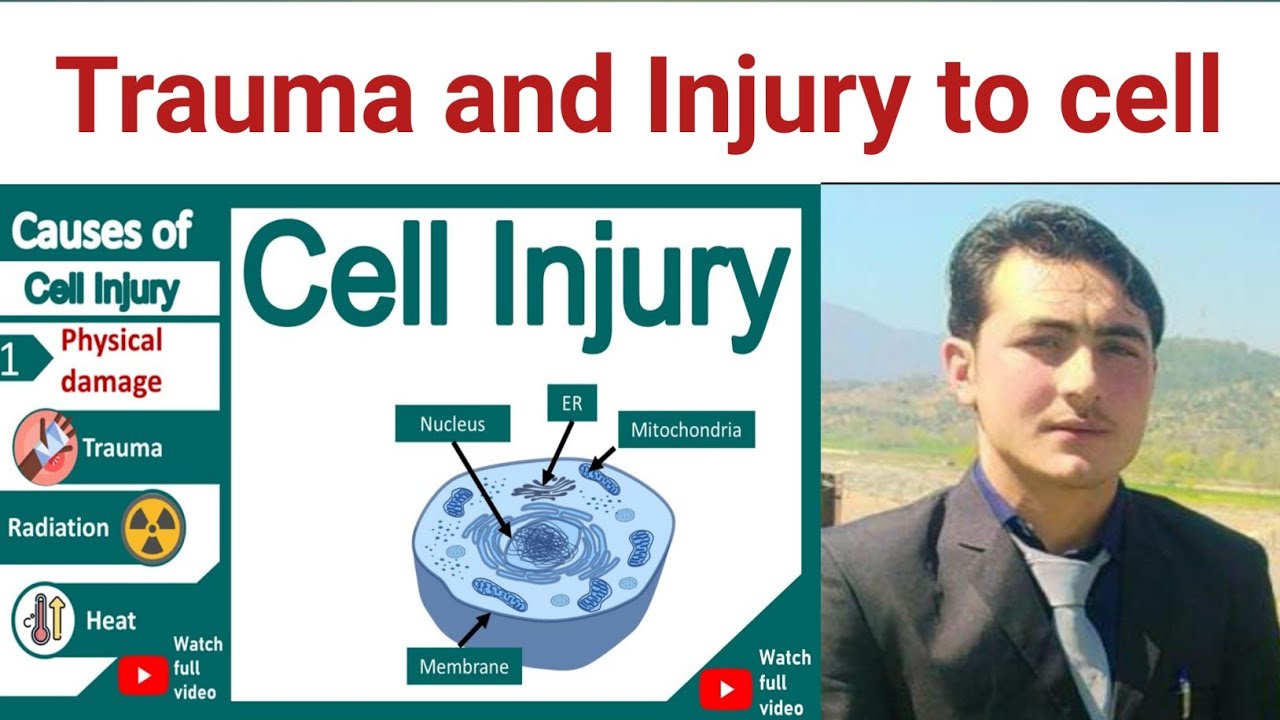
Trauma and cell Injury chapter:4 part:1 pathophysiology BSN Third semester kmu slides in pashto
Keywords
Summary
128 words
Critical Evaluation
Value of the Information & Strength of the Argument
The video provides educational value by systematically walking through core concepts of pathophysiology—trauma definitions, cellular adaptation, and injury mechanisms. The argumentation is didactic, presenting textbook knowledge without deep critical analysis. The lecture’s strength lies in its structured approach, moving from general trauma to specific biochemical pathways. However, the presentation lacks original insights or novel interpretations; it is a straightforward curriculum-based explanation. The reasoning is logical and consistent, but it does not engage with conflicting evidence or advanced mechanistic debates, making it suitable for introductory nursing students rather than advanced researchers.
Scientific Rigor, Source Quality, Title Accuracy
The scientific rigor is moderate: the content is derived from established medical knowledge, but the video does not cite specific studies or textbooks. The lack of references makes it difficult to verify the exact accuracy of every statement. The title’s claim of being in Pashto is not reflected in the transcript, which appears entirely in English, suggesting possible auto-transcription or mixed-language delivery. The absence of a description and external sources limits the ability to cross-check information. Overall, the lecture is reliable as a general overview but lacks the academic rigor expected of research-based content. The title accurately describes the subject matter, and no significant mismatch between title and content is observed.
216 words
Title / Content Match
Title accurately reflects the content: a nursing lecture on trauma and cell injury, explicitly noting the Pashto language component.
Quality & Reliability
6/10
The content is a standard pathophysiology lecture covering established medical concepts, but the transcript is garbled and no primary sources are cited, limiting verifiability.
Key Moments
Markers derived by PSI from the transcript: the creator did not define chapters.
- Introduction and opening with the lecturer's name.
- Definition of trauma and cellular injury.
- Emotional and physical symptoms associated with trauma.
- Cellular response to stress and adaptations.
- Overview of mechanisms of cell injury (biochemical).
- Discussion of ATP depletion and its effects.
- Reversible vs irreversible cell injury with examples.
- Necrosis and permanent cell damage.
- Conclusion and summary of key points.
Contribution & Novelties
This video offers a structured educational overview of trauma and cell injury, typical of nursing curricula. Its contribution lies in presenting foundational pathophysiology concepts in a slide-based format, which may be helpful for revision. It does not introduce new research or novel perspectives, but serves as a didactic resource. The approach is conventional, covering standard topics like ATP depletion, reactive oxygen species, and necrosis. For deeper exploration, related concepts include:
Pour aller plus loin :
- Cell injury — Overview of types and mechanisms, directly related to the lecture’s scope.
- Necrosis — Detailed description of cell death patterns, complementing the discussion on irreversible injury.
- Reactive oxygen species — Explains the role of ROS in cellular damage, as mentioned in the lecture.
- Apoptosis — A distinct form of cell death, useful for contrast with necrosis.
- Ischemia-reperfusion injury — Relevant to the lecture’s example of myocardial infarction and reversible injury.
147 words
Radar Profile
The radar profile indicates a moderate-to-high presence across all dimensions, with quantity and technicality rating higher than quality and reliability. This suggests a content-dense but potentially less rigorously sourced presentation.