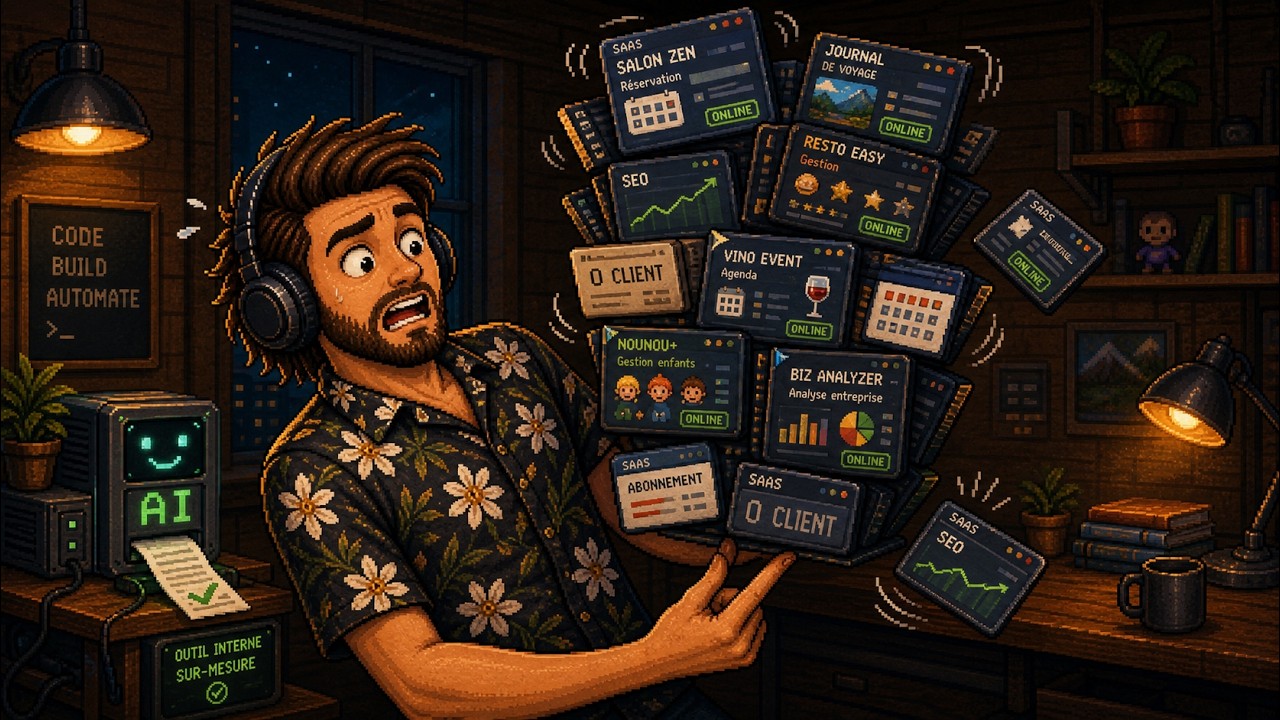
J’ai créé 20 SaaS... et je pense que ça sert à rien !
I created 20 SaaS... and I think it's useless!
Title history
- J’ai créé 20 SaaS... et je pense que ça sert à rien ! — observed on 20261111-0817 UTC (YouTube)
Keywords
Summary
185 words
Critical Evaluation
Value of the Information & Strength of the Argument
The video’s value lies in its hands-on demonstration: concrete evidence (actual deployed SaaS products, screenshots, real users) that AI-driven development can autonomously generate functional niche software overnight. This anecdotal proof strengthens the central argument that the technical barrier to software creation has collapsed. The reasoning is structured logically — from demonstrating capability, to identifying commercialization as the true bottleneck, then to a broader claim about the obsolescence of niche SaaS. However, key assertions (e.g., ‘all non-infrastructural SaaS will disappear’) are strong predictions grounded in intuition rather than empirical market data, and the creator himself acknowledges the difficulty of validating his hypothesis. The argumentation is coherent but contains leaps from personal experience to general market forecasts that would benefit from heavier evidence.
Scientific Rigor, Source Quality, Title Accuracy
The video is an opinion-led testimony rather than a rigorous scientific study. Primary evidence is the creator’s personal experience, with secondary mentions of external actors (Claude by Anthropic, Planity, Brevo, ChatGPT, DeepSeek, Mistral, and other YouTube creators) used as illustrative examples rather than as verified data sources. No quantitative market statistics, industry reports, or academic references are provided. The title is truthful and well matched: the creator did create 20 SaaS and does think it is useless. The chapter structure is coherent and the demos appear authentic. From a scientific standpoint, the lack of verifiable external sources and the speculative nature of the core thesis limit its weight; it should be read as experiential testimony.
251 words
Title / Content Match
The title accurately reflects the content: the creator did create 20 SaaS applications and explains why he believes the exercise is now largely futile.
Quality & Reliability
6/10
The creator provides an authentic first-hand account of a working AI-powered SaaS factory, with visible deployed products and a clear process description. However, the central thesis ('niche SaaS is dead') is a personal prediction supported by no quantitative market data or external authoritative sources, and several claims (e.g., that all non-infrastructural SaaS will disappear) rest on speculation rather than evidence. The demonstrated experience gives the video credibility, while its forward-looking assertions remain insufficiently grounded.
Key Moments
Markers derived by PSI from the transcript: the creator did not define chapters.
- Introduction: created 20 SaaS in vibe coding, but considers them futile today
- Screenshots of niche SaaS examples: Stylify (hairdressing), Trippy (travel), restaurant and winemaker tools
- Presents the two core skills of his SaaS factory: 'scout' (market analysis, scoring) and the common stack
- The 'loop' mode: fully autonomous generation, testing, and overnight deployment of a new SaaS
- The real bottleneck is commercialization; his automated telemarketing attempt was a failure
- Why niche SaaS are doomed; predicts a shift to personalized internal tools and 'agentic OS'
- Sovereignty and data-ownership concerns: dependence on proprietary clouds, the choice between external and internal AI agents
- Concrete example of a childminder needing a personal AI agent rather than a niche SaaS; conclusion on the collapsed technical barrier
Cited Sources
- Claude (Anthropic) — AI model used as the core engine of the SaaS factory pipeline
- Brevo — Cited as an example of a SaaS with infrastructural reasons to exist (SMTP/email)
- ChatGPT (OpenAI) — Mentioned as the platform that already offers hosted app creation for end users
- DeepSeek — Mentioned as an alternative LLM provider for sovereign AI choices
- Mistral — Mentioned as an alternative LLM provider for sovereign AI choices
Contribution & Novelties
The video’s original contribution is its first-hand, practical testimony of a fully automated AI software factory: while many creators discuss AI coding theoretically, here we see a working pipeline that generates, deploys, and even attracts organic traffic to multiple niche SaaS products autonomously. The insight that the collapse of the technical barrier shifts all remaining value to commercialization, and that this dynamic undermines the niche-SaaS business model, is a compelling and reasonably original analysis. The longer-term hypothesis of personal AI agents (‘agentic OS’) replacing standalone SaaS resonates with emerging industry trends.
Pour aller plus loin :
- Vibe coding - Wikipedia — Introduces the concept of AI-assisted coding that underpins the creator’s pipeline.
- Intelligent agent - Wikipedia — Academic framing for the personal-agent paradigm the author predicts.
- Software as a service - Wikipedia — Context for the business model whose decline the author argues for.
- Claude (language model) - Wikipedia — The model used as the core engine of his SaaS factory.
161 words
Radar Profile
The radar profile shows a video that is moderately well-rounded: information quantity and quality (6-7/10) are the strongest dimensions, supported by concrete demonstrations of the AI pipeline, while technical depth remains relatively limited (5/10) since the explanation stays largely conceptual. Overall reliability (6/10) is constrained by the speculative nature of the video's forward-looking claims and its reliance on personal experience rather than external data.