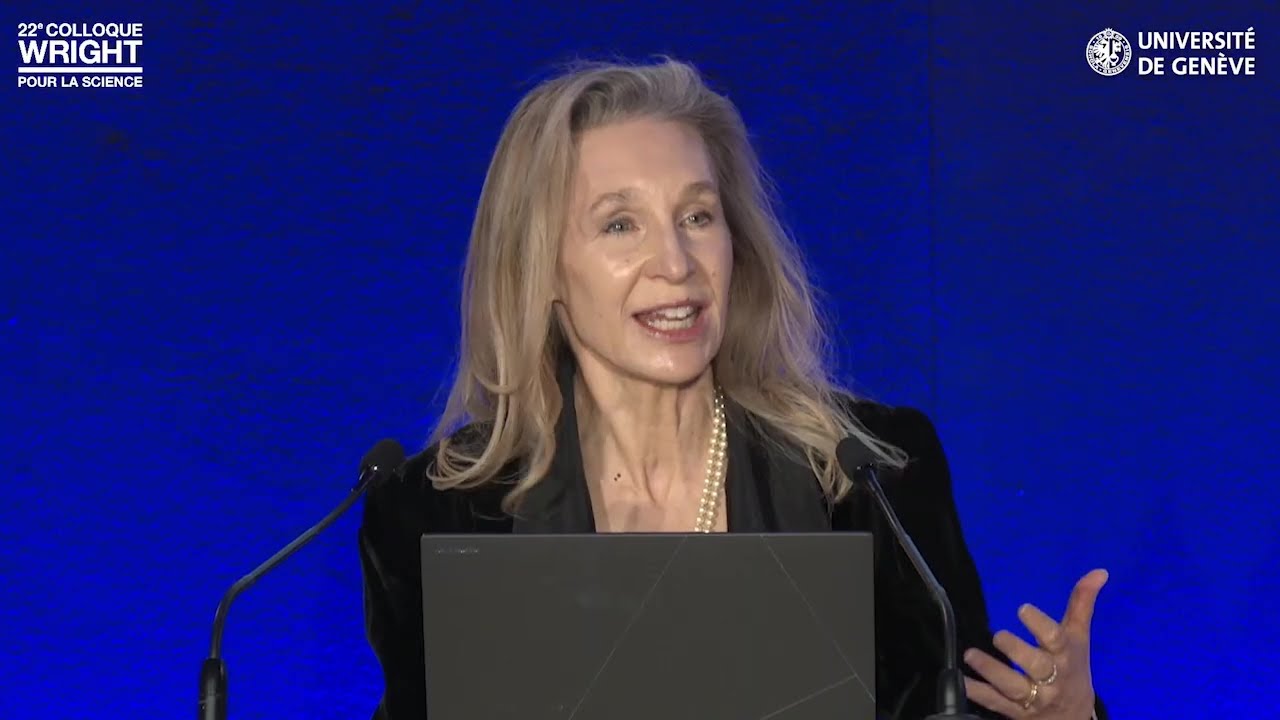
La naissance d’un souvenir
The birth of a memory
Title history
- La naissance d’un souvenir — observed on 20261120-1642 UTC (YouTube)
Keywords
Summary
157 words
Critical Evaluation
Value of the Information & Strength of the Argument
The lecture provides a comprehensive overview of modern memory research, blending historical context with cutting-edge findings. The argumentation is strong: Josselyn systematically builds from earlier failures to identify the engram to her own successful experiments, using causal manipulations that demonstrate both necessity and sufficiency. The use of clear analogies (like comparing memory encoding to a sparse code) and the emphasis on direct experimental evidence (optogenetic control) make the case compelling. The presentation also acknowledges the collaborative nature of science and the persistence required to solve fundamental questions.
Scientific Rigor, Source Quality, Title Accuracy
The scientific rigor is high; Josselyn presents peer-reviewed research, including her own published studies, and clearly distinguishes between evidence and inference. While the talk is aimed at a general audience, it avoids oversimplification of the core findings. The title is apt, as the lecture indeed covers the birth of a memory from the perspective of neuronal allocation. However, no specific external sources are cited with web links, and the talk is primarily a synthesis of her own work and that of others.
184 words
Title / Content Match
The title accurately reflects the content, which focuses on the formation and storage of memories at the neuronal level.
Quality & Reliability
8/10
The talk is given by a leading researcher in the field, with robust experimental evidence presented in an accessible manner. Some simplifications are made for a general audience, but the core scientific content remains accurate and well-supported.
Key Moments
Markers derived by PSI from the transcript: the creator did not define chapters.
- Introduction and presentation of Sheena Josselyn, personal anecdote about Taylor Swift.
- Historical background: Richard Semon's concept of the engram and its evolution.
- Karl Lashley's search for the engram and his conclusion that it is widely distributed.
- Early experiments with CREB in the lateral amygdala; evidence for neuronal allocation.
- Optogenetic techniques used to activate or silence specific engram neurons, confirming their causal role.
Cited Sources
- In search of the engram (1950) — Karl Lashley's famous paper concluding that the engram is distributed throughout the cortex.
- The concept of engram by Richard Semon — Introduction of the term engram in the early 20th century, referenced in the lecture.
Contribution & Novelties
The video offers a clear and engaging explanation of how specific neuronal populations encode memories, synthesizing decades of research and highlighting recent advances such as optogenetics. It contributes by making complex neuroscience accessible without losing scientific accuracy.
Pour aller plus loin :
- Engram — Wikipedia overview of the concept and its evolution in neuroscience.
- Optogenetics — Detailed description of the technique used to manipulate neuronal activity in the experiments.
- CREB — Transcription factor implicated in memory allocation, as discussed in the lecture.
82 words
Radar Profile
The profile shows high scores across all dimensions, reflecting a well-balanced presentation with substantial information, solid quality, moderate technical depth, and strong reliability.