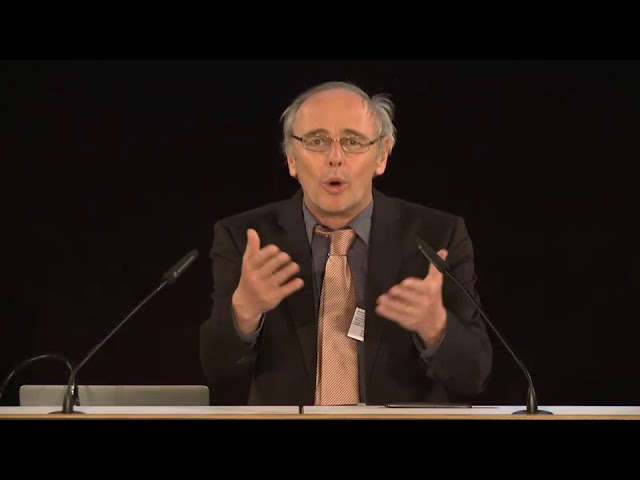
Colloque Wright 2014 - Conférence du 10 novembre 2014
Wright Symposium 2014 - Lecture of November 10, 2014
Keywords
Summary
173 words
Critical Evaluation
Value of the Information & Strength of the Argument
The lecture offers valuable scientific content, combining historical perspective with recent findings from planetary exploration. Brahic makes a compelling case that studying other worlds deepens our understanding of Earth, using examples such as Saturn’s rings, cyclone patterns, and atmospheric phenomena. His argumentation is clear and logically structured, moving from the general usefulness of science to specific astronomical processes. He grounds his claims in well-established astrophysical principles and his own extensive experience, which strengthens the credibility of the presentation.
Scientific Rigor, Source Quality, Title Accuracy
The scientific rigor is high: Brahic draws on decades of peer-reviewed research and direct involvement in major space missions, and he correctly explains key concepts such as the formation of planets from residual matter around young stars. The description provides no external links or formal bibliography, but the speech itself references mission data and established astronomical findings. The video title is descriptive of the event but does not convey the subject; the subtitle in the description provides the necessary context. No comment data were available for analysis.
180 words
Title / Content Match
The title accurately identifies the event and date but remains generic; the specific lecture topic 'Nous, enfants des étoiles' is only disclosed in the description.
Quality & Reliability
9/10
Lecture by a renowned astrophysicist, based on established planetary science and decades of direct involvement in space missions such as Voyager and Cassini.
Key Moments
Markers derived by PSI from the transcript: the creator did not define chapters.
- Opening and welcome remarks by the Rector of the University of Geneva.
- Thierry Courvoisier introduces the 2014 Wright Colloquium theme, the Sun, and practicalities.
- André Brahic begins his lecture, reflecting on the purpose of science.
- Discussion of the formation of the Sun and planets, and the origin of the universe.
- Description of the Solar System, the eight planets, and composition differences.
- Saturn's rings, the Cassini mission, and comparison with Earth; exoplanets and the search for life.
Contribution & Novelties
This lecture synthesizes current knowledge of stellar and planetary formation, presenting it in an accessible yet scientifically accurate manner, with a unique personal perspective from a scientist who contributed to Voyager and Cassini imaging teams. It also clarifies the historical debate about planet definitions and recent discoveries of exoplanets.
Pour aller plus loin :
- Star formation — Core topic of the lecture, explaining how stars and planetary systems emerge from clouds of gas and dust.
- Exoplanet — Directly linked to the lecture’s discussion of planets beyond the Solar System and the search for life.
- Cassini–Huygens — Space mission emphasized by Brahic, which explored Saturn, its rings, and its moons.
- Stellar nucleosynthesis — Provides scientific context for the idea that Earth and life are made of elements forged in stars.
129 words
Radar Profile
The radar profile shows a solid balance: high reliability and information quality, with a somewhat lower technical difficulty and moderate information density, reflecting an engaging science communication lecture.