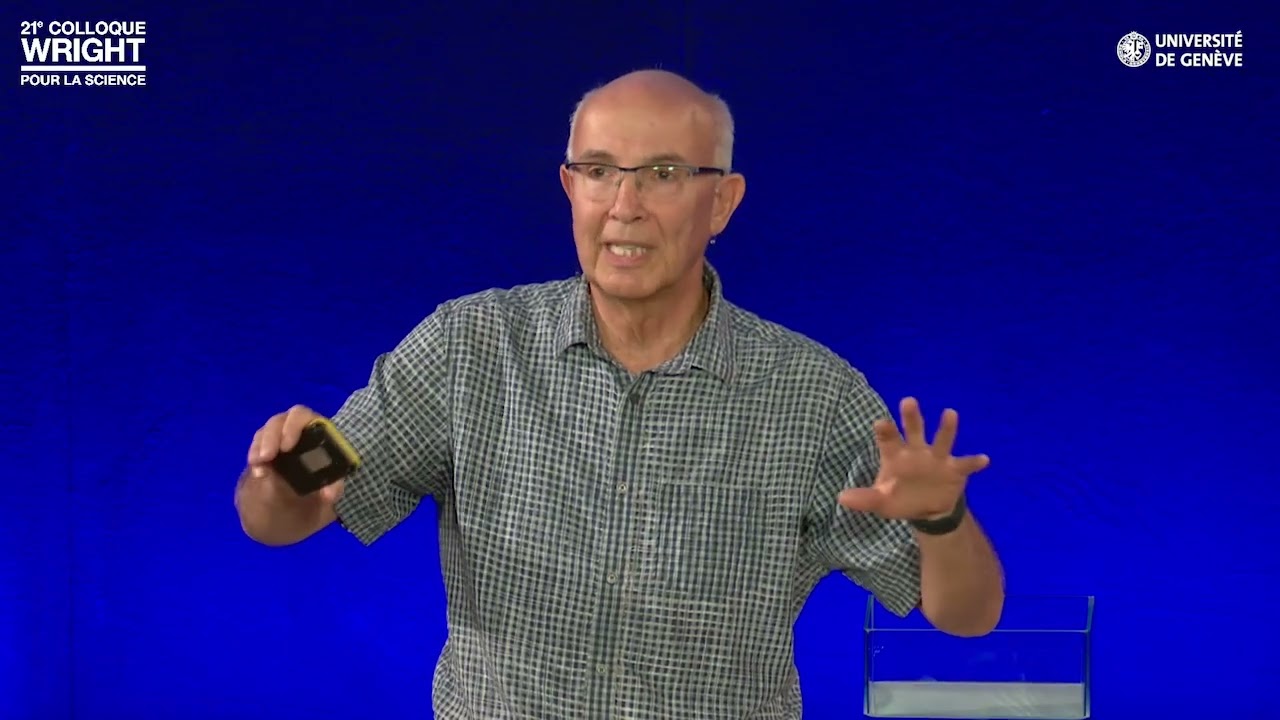
Des atomes aux orchidées : dévoiler les symétries de la vie
From atoms to orchids: unveiling the symmetries of life
Keywords
Summary
175 words
Critical Evaluation
Value of the Information & Strength of the Argument
The talk offers high informational value by connecting fundamental physics concepts (symmetry, invariance) to biological development. It presents a clear conceptual framework: symmetries emerge from repeated simple rules, and biological systems add a layer of genetic control that can amplify small molecular changes into large morphological differences. The argument is built on concrete examples: water molecules, snowflakes, the balloon analogy, and the snapdragon model. The balloon experiment effectively demonstrates how external constraints can break spherical symmetry into cylindrical symmetry. The explanation of microtubule self-organization via collision rules and polar regions is a compelling example of how complex cellular patterns can arise from local interactions. The argumentation is logical and accessible, though it relies on analogies and simplified models rather than presenting primary data. The speaker acknowledges the complexity of scaling from genes to form and uses the plant system to dissect it. Overall, the value lies in synthesizing physics and biology to explain a fundamental aspect of life.
Scientific Rigor, Source Quality, Title Accuracy
The talk is delivered by a renowned expert, Enrico Coen, whose work on Antirrhinum and plant development is widely recognized. The scientific content aligns with established knowledge in plant cell biology and developmental genetics. However, the lecture format does not include explicit citations or references to specific studies, and the transcript is truncated, limiting assessment of the full rigor. The title ‘From atoms to orchids: unveiling the symmetries of life’ accurately reflects the content, which spans from atomic to organismal scales and uses orchids as an example. The title is not misleading; it captures the broad scope and the central theme of symmetry. No comments were provided for analysis.
282 words
Title / Content Match
The title accurately reflects the content: the talk spans from atomic/molecular symmetries to orchid and flower symmetries, with a focus on plant development. The subtitle 'unveiling the symmetries of life' matches the broad scope.
Quality & Reliability
8/10
The content is presented by a leading researcher (Royal Society, NAS member) and is based on decades of his own work on Antirrhinum and plant cell morphogenesis. The mechanisms described (microtubule alignment, cellulose synthesis guidance, symmetry breaking) are well established in plant developmental biology. However, the talk is a public lecture without detailed citations or data shown in the transcript, and some claims are simplified for a general audience. The transcript is truncated, so the full argument cannot be fully assessed.
Key Moments
Markers derived by PSI from the transcript: the creator did not define chapters.
- Introduction by the host, setting the stage for the lecture on biological symmetry.
- Enrico Coen begins by thanking organizers and sharing a humorous anecdote about breakfast.
- Coen contrasts the lack of symmetry in a landscape with the symmetries of water molecules and snowflakes.
- Explanation of how physical laws being invariant in space and time leads to molecular symmetry.
- Introduction of the snapdragon (Antirrhinum) as a model for studying floral symmetry.
- Demonstration of how mutations in single genes can alter flower symmetry.
- Balloon experiment illustrating how a spherical cell can become cylindrical when constrained.
- Explanation of cellulose microfibrils and microtubules guiding cell shape.
- Microtubule collision rules and the emergence of alignment; role of polar regions.
- Experimental evidence for polar protein localization in plant cells.
Contribution & Novelties
The talk’s originality lies in its integrative perspective, bridging physics and biology to explain symmetry in living organisms. It presents a multi-scale view from molecules to flowers, emphasizing how simple rules and genetic control interact. The balloon analogy and microtubule collision model are effective pedagogical tools. The concept of symmetry as a result of both physical invariance and natural selection’s economy is a unifying theme.
Pour aller plus loin :
- Symmetry in biology — Overview of biological symmetry types and their evolutionary significance.
- Antirrhinum — Model organism used by Coen, with details on its genetics and floral symmetry.
- Microtubule — Cellular structures that guide cellulose synthesis and cell shape in plants.
- Cellulose — Key component of plant cell walls, forming microfibrils that constrain cell growth.
125 words
Radar Profile
The radar profile shows high reliability and information quality, with moderate technical depth and quantity. The talk is accessible yet substantive, balancing conceptual explanations with concrete examples. The lower technical score reflects the public lecture format, which avoids deep mathematical or experimental details.