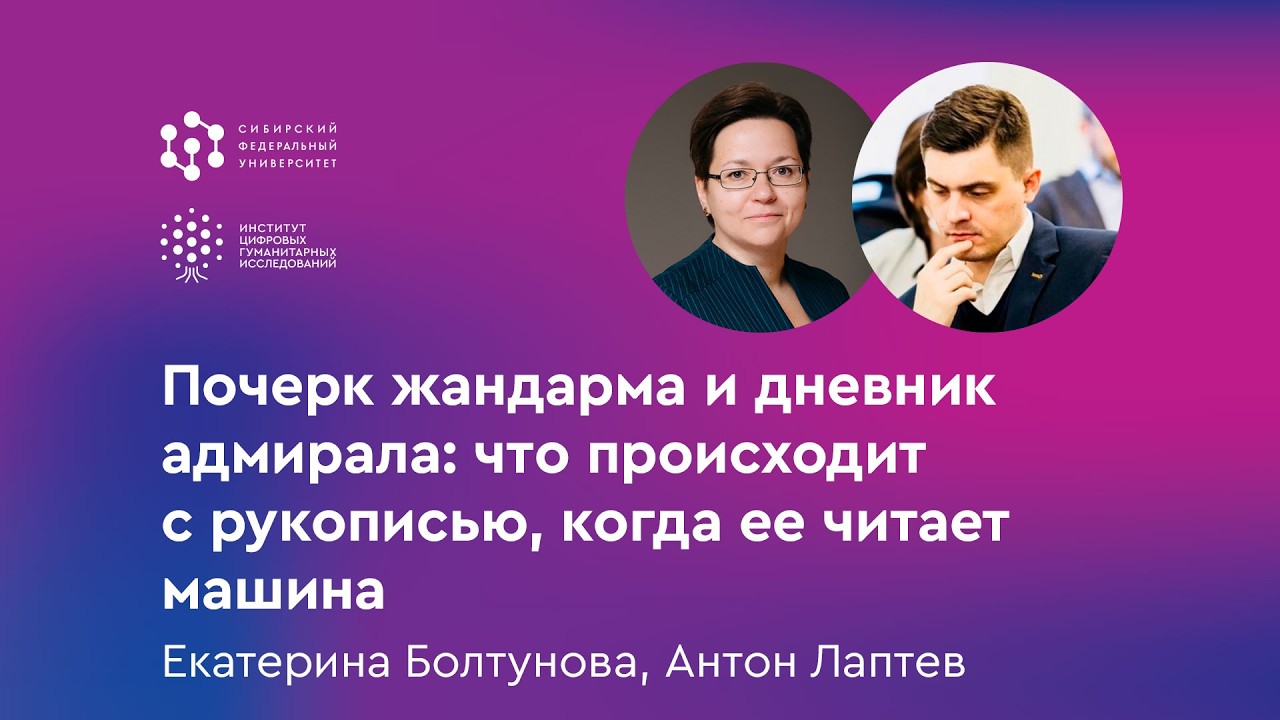
Почерк жандарма и дневник адмирала: что происходит с рукописью, когда ее читает машина
Gendarme's handwriting and admiral's diary: what happens to a manuscript when a machine reads it
Title history
- Почерк жандарма и дневник адмирала: что происходит с рукописью, когда ее читает машина — observed on 20261119-2226 UTC (YouTube)
Keywords
Summary
173 words
Critical Evaluation
Value of the Information & Strength of the Argument
The talk provides valuable insights into the practical application of AI for historical manuscript analysis. The speakers present concrete metrics, comparative evaluations, and honest discussions of methodological risks (e.g., LLM corrections degrading recall). They argue for a pipeline approach rather than a single universal model, and stress the necessity of human verification. The argumentation is clear and evidence-based, though the reliance on specific tools (YandexGPT, DeepSeek R1) and self-reported metrics limits independent verification.
Scientific Rigor, Source Quality, Title Accuracy
The presentation demonstrates strong methodological rigor: they explicitly analyze error types, compare with international benchmarks, and highlight limitations. The sources cited in the description are links to the seminar website and social media, not peer-reviewed literature, but the talk mentions prior publications and collaborations with mathematicians and philologists. The title accurately reflects the content. No external academic references are provided in the video itself, so the reliability rests on the speakers’ credentials and the internal coherence of their results.
167 words
Title / Content Match
The title accurately reflects the core content: the talk centers on two specific manuscript collections (gendarme's transcripts of prisoner letters and Admiral Litke's diary) and the challenges of machine reading.
Quality & Reliability
8/10
The presentation is given by recognized researchers (Doctor and Candidate of Historical Sciences) and describes a three-year funded interdisciplinary project. Detailed methodological discussions, concrete quantitative metrics, and comparison with existing models (e.g., Transkribus) support a high level of reliability, though the talk is primarily descriptive and does not provide full reproducibility details.
Key Moments
Markers derived by PSI from the transcript: the creator did not define chapters.
- Introduction by seminar moderator, welcoming speakers
- Project overview: team, grant, and objectives
- First case study: Smolensk prisoner letters - OCR and metrics (WER, CER)
- Discussion of text-image alignment and verification technique
- Second case: Admiral Litke's diary - challenges of multilingual text and LLM analysis
- Third case: Korff's diaries - YOLO HTR model and entity extraction
- Discussion of broader implications, limitations, and future directions
Cited Sources
- Seminar 'Digital Environment' official page — Website of the seminar series where this talk was given, containing information about the seminar and its organizers.
- Telegram channel 'Humanities in Digital' — Channel for updates from the Digital Humanities Research Institute (DHRI).
- VK page of the Institute — Social media page of the Institute for Digital Humanities Research.
Contribution & Novelties
The project contributes practical insights into fine-tuning OCR models for historical handwritten documents with limited training data. It introduces the concept of ‘weak transcription’ and emphasizes the importance of text-image alignment for verification. The talk also critiques the over-reliance on LLMs for text correction, showing that they can harm keyword extraction. The original contribution lies in the systematic evaluation of a multi-stage pipeline on diverse ego-document collections and the methodological lessons for digital historians.
Pour aller plus loin :
- Handwriting recognition — Overview of the technology, relevant to the OCR methods used in the talk.
- Optical character recognition — Foundational concept for the digitization of historical texts.
- Large language model — Discusses LLMs used for text correction and analysis in the project.
- Digital humanities — Context of the broader field in which this project operates.
135 words
Radar Profile
The radar profile shows high scores in quantity and technical level, reflecting the dense presentation of methods and results. Quality and reliability are slightly lower due to the lack of external citations and reliance on self-reported metrics, but the overall profile is balanced and indicative of a solid expert seminar.