MGV3702 - Genética de Populações Aula4
MGV3702 - Population Genetics Class4
Keywords
Summary
178 words
Critical Evaluation
Value of the Information & Strength of the Argument
The value of this lecture lies in its clear pedagogical approach to a fundamental topic in population genetics. The instructor takes time to build intuition about degrees of freedom, often a stumbling block for students, by using concrete examples like the F2 population and link to the information purchased (sample size, allele frequencies). The argumentation is solid: each test is presented with its assumptions, calculation steps, and interpretation of p-values, allowing students to compare methodologies. The shift from conventional chi-square to likelihood ratio and Fisher’s exact test is well-motivated, showing that multiple statistical frameworks exist for the same biological question. However, the lecture is purely expository and does not present original research or novel synthesis; its value is primarily educational.
Scientific Rigor, Source Quality, Title Accuracy
The lecture demonstrates rigor in its statistical treatment: definitions are precise, formulas are correctly derived, and the instructor consistently emphasizes the use of counts rather than frequencies where appropriate. The discussion of degrees of freedom is particularly strong, clarifying a common source of confusion. No external sources or references are cited in the video or description, which limits the ability to cross-verify claims, but the internal consistency and logical flow suggest a solid command of the subject. The title accurately reflects the content, and the organization follows a coherent progression from equilibrium basics to advanced testing frameworks. Overall, while not drawing on published literature, the lecture maintains scientific integrity through its careful explanation of statistical principles.
251 words
Title / Content Match
The title accurately indicates a graduate-level population genetics lecture, matching the content on equilibrium testing and related statistical methods.
Quality & Reliability
7/10
The lecture provides a thorough and systematic explanation of statistical tests for Hardy-Weinberg equilibrium, with clear didactic examples and proper handling of degrees of freedom. However, no external references are cited, and the video has minimal engagement, limiting cross-verification.
Key Moments
Markers derived by PSI from the transcript: the creator did not define chapters.
- Introduction to the topic: verifying Hardy-Weinberg equilibrium, conditions and hypothesis testing.
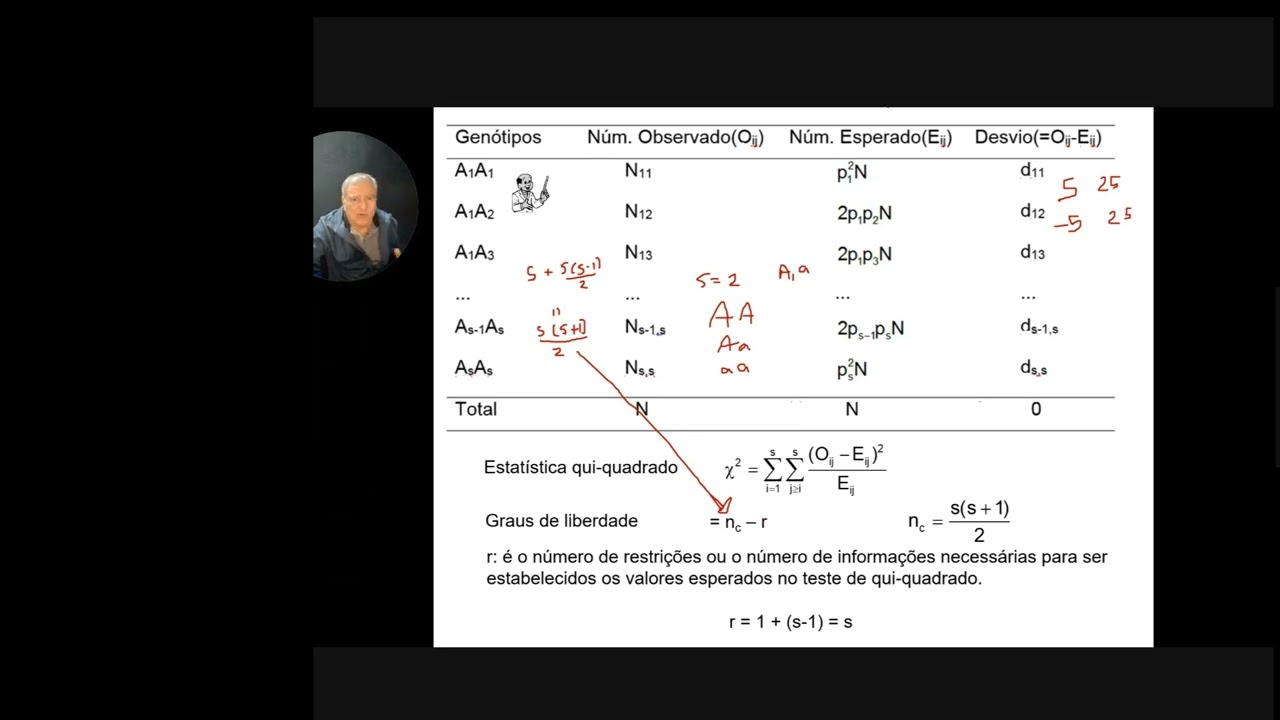
- Detailed explanation of degrees of freedom, using examples of sample size and allele frequencies as purchased information.
- Conventional chi-square test applied to two example populations; calculation of expected counts and p-value interpretation.
- Introduction of the likelihood ratio test, its philosophical basis, and comparison with the conventional chi-square test.
- Fisher exact test described as an alternative approach, with emphasis on its different conception of randomness.
- Discussion of sex-linked genes and their impact on equilibrium testing.
- Introduction to gametic phase disequilibrium, setting the stage for subsequent lectures.
Contribution & Novelties
The main contribution is the clear pedagogical exposition of multiple statistical tests for Hardy-Weinberg equilibrium, particularly the often-overlooked distinction in degrees of freedom calculation. It offers a framework for understanding why the conventional chi-square test uses df = number of genotypes - number of alleles (or -2 for two alleles), which is rarely explained in basic courses.
Pour aller plus loin :
- Hardy-Weinberg principle — Core concept underlying the lecture.
- Chi-square test — The conventional test described in detail.
- Likelihood-ratio test — Alternative statistical framework.
- Fisher’s exact test — Another approach for small sample sizes.
95 words
Radar Profile
The radar profile shows high scores in quantitative and technical depth, reflecting the lecture's comprehensive coverage and advanced level. Quality and reliability are moderate, indicating solid internal consistency but lack of external references. This suggests a strong educational resource for graduate students, though not a source of novel scientific findings.