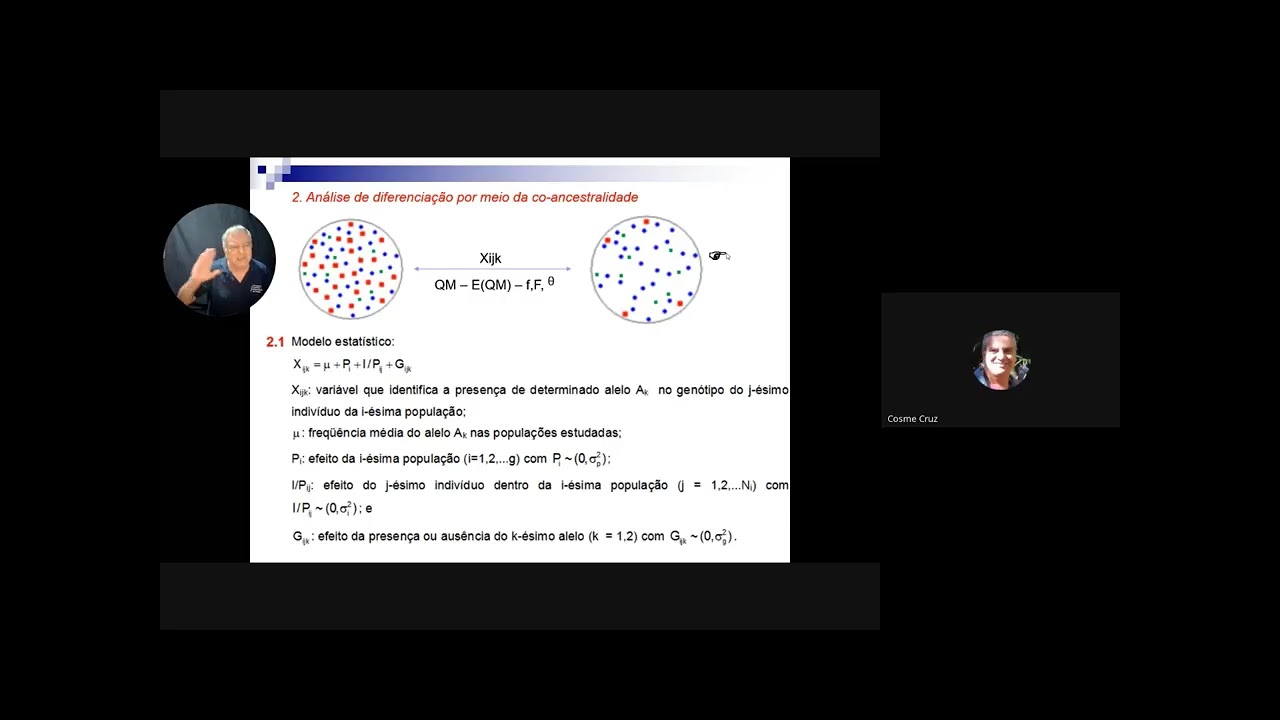
MGV3702 - Genética de Populações Aula13
MGV3702 - Population Genetics Class13
Title history
- MGV3702 - Genética de Populações Aula13 — observed on 20261119-2233 UTC (YouTube)
Keywords
Summary
197 words
Critical Evaluation
Value of the Information & Strength of the Argument
The value of the lecture lies in its clear progression from basic concepts to a detailed exposition of Wright’s variance decomposition and its link to AMOVA. The instructor builds a coherent argument: first defining the model, then explaining the coding of alleles, the necessary ANOVA, and the genetic interpretation of variance components. He successfully illustrates the difference between statistical tests for means (common in other agricultural sciences) and genetic variance decomposition, which is specific to population genetics. The argumentation is solid and well-structured, though it is sometimes long-winded with repetitive examples. The lecture effectively conveys how to ’listen to the signals’ that populations emit, making the methodology accessible to students with a background in quantitative genetics.
Scientific Rigor, Source Quality, Title Accuracy
The scientific rigor is generally high, as the lecture covers classical theory accurately, referencing seminal works by Nei (1973), Wright, and Excoffier et al. (1992). However, the instructor does not explicitly cite any literature during the talk, and the video description only mentions the topics. The title faithfully reflects the content. No comments were provided to analyze public feedback, so no further assessment of audience reception is possible. The lack of visible citations in the video itself is a slight limitation, but the content is consistent with established population genetics textbooks.
222 words
Title / Content Match
The title exactly matches the content: it is indeed the 13th lecture on population genetics, focusing on population differentiation, Wright's analysis, and AMOVA.
Quality & Reliability
7/10
The lecture is based on established population genetics theory (Wright, Nei, Excoffier) and provides a detailed, coherent methodological walkthrough. However, it is an informal classroom recording without visual aids or formal citation to the primary literature, and it contains some repetitive digressions.