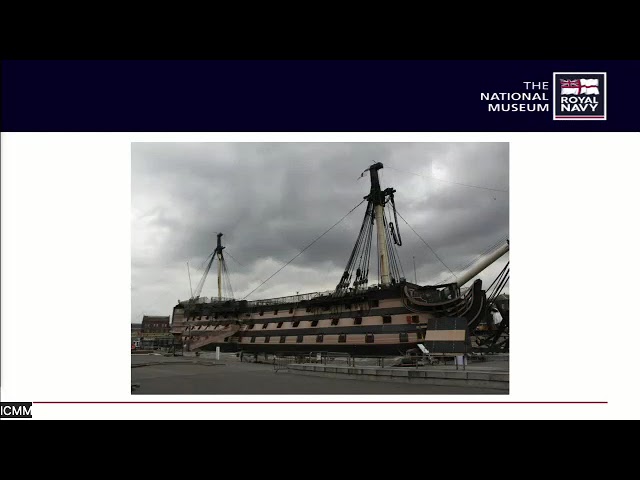
HMS Victory - The Rational Conservation of a National Icon? - Andrew Baines, NMRN (UK)
Keywords
Summary
202 words
Critical Evaluation
Value of the Information & Strength of the Argument
The presentation offers valuable firsthand insights into a high-profile conservation project, illustrating how a rational, evidence-based approach can be applied to heritage preservation. Baines effectively argues that significance must guide decisions, citing examples such as the decision to accept a 1960s reconstruction as part of the ship’s history and the use of paint analysis to justify the controversial pink color. The argumentation is clear and structured, walking the audience through the project’s phases and the reasoning behind each choice. However, the talk is relatively general; it does not delve deeply into specific technical details or data, and the claim that 35 million pounds will be spent over a decade is stated without breakdown. Nonetheless, the value lies in the strategic perspective and the practical lessons on managing complex heritage projects.
Scientific Rigor, Source Quality, Title Accuracy
The scientific rigor is moderate. Baines does not cite external sources directly, but he references methodologies (dendrochronology, paint analysis) and historical events. The talk is based on professional experience rather than literature review. The title matches the content well, as the speaker explicitly discusses what a rational conservation approach means. There is no mention of conflicting sources, but the speaker acknowledges differing public opinions, such as the outrage over the pink paint. Overall, the presentation is credible due to the speaker’s role, but it lacks formal citations. The title is appropriate and does not overpromise.
240 words
Title / Content Match
The title accurately reflects the content: Andrew Baines discusses the rational, significance-based approach to conserving HMS Victory, directly addressing the question of how to preserve a national icon.
Quality & Reliability
7/10
The speaker is the Deputy Executive Director of Museum Operations at the National Museum of the Royal Navy and Project Director for HMS Victory Conservation. The information is based on a decade of practical experience, but it is a conference presentation without peer review or formal citations. Claims about costs, beetle damage, and structural analysis are plausible but unverifiable in this context.
Key Moments
Markers derived by PSI from the transcript: the creator did not define chapters.
- Introduction and thanks to the audience
- Andrew Baines describes the poor condition of HMS Victory when the museum took over: rainwater, beetle infestation, movement, and collapse.
- Methods used to understand the ship: race marks, paint analysis, dendrochronology, and shipwright surveys.
- Structural analysis reveals the main problem is the support system, leading to replacement of 22 cradles with 134 props.
- The rational approach: significance guides decisions, not sentimentality. Discusses history of ship's modifications and 1922 restoration.
- Outlines the planning process and emphasizes blending engineering, shipwright, conservation, and archaeological perspectives.
- Conclusion: importance of evaluation, reflection, and mid-course correction. Closing remarks.
Contribution & Novelties
This presentation contributes an overview of the strategic decision-making behind a major conservation project, highlighting the shift from a traditional, sentiment-driven approach to a rational, significance-based framework. It shares lessons on stabilizing a wooden ship and the use of diagnostic techniques like dendrochronology and paint analysis. While not presenting new research, it offers a case study that can inform other heritage institutions.
Pour aller plus loin :
- HMS Victory on Wikipedia — Background on the ship’s history and significance.
- Dendrochronology — Explanation of tree-ring dating used to date timbers.
- Deathwatch beetle — Insights into the pest that threatened the ship’s structure.
- National Museum of the Royal Navy — Official site for further information on ongoing conservation work.
117 words
Radar Profile
The profile shows moderate scores across all dimensions, with quality and reliability slightly higher than quantity and technical depth. This reflects a concise expert talk that is informative and credible but not exhaustive or deeply technical, consistent with a conference presentation aimed at professionals.