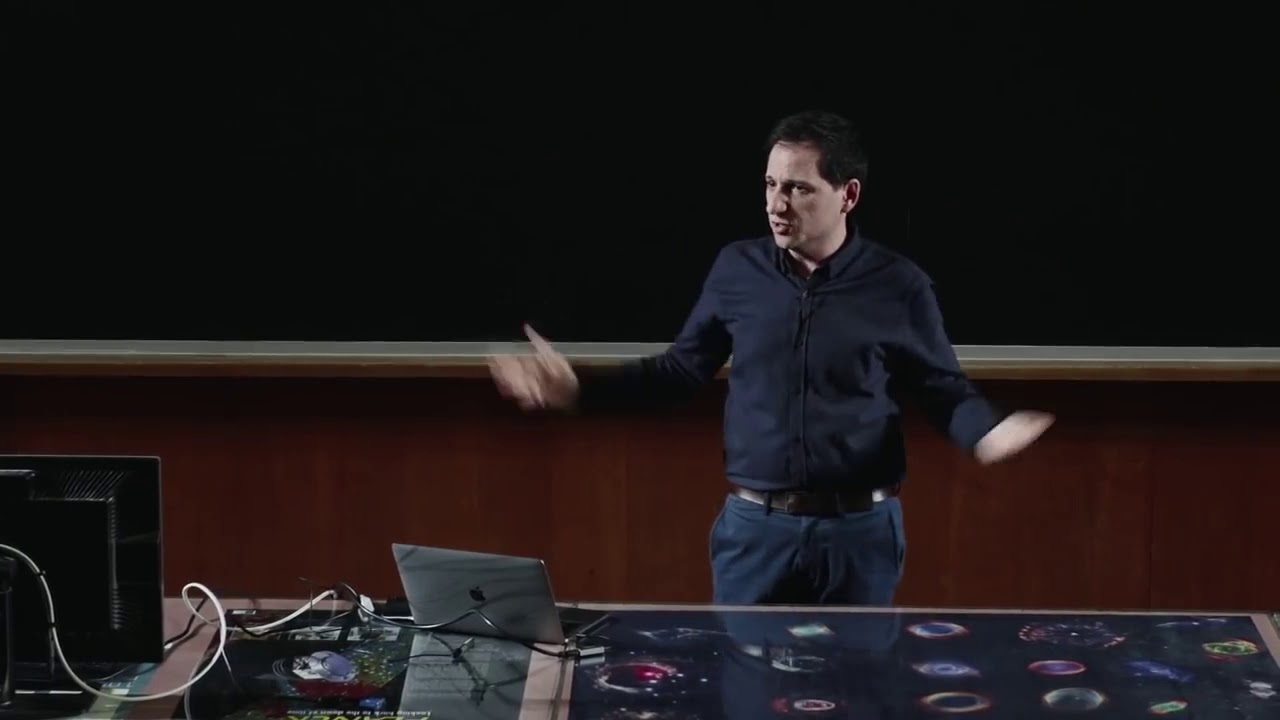
SUPRÉMATIE QUANTIQUE - Julien Bobroff
QUANTUM SUPREMACY - Julien Bobroff
Keywords
Summary
207 words
Critical Evaluation
Value of the Information & Strength of the Argument
The lecture excels in providing a comprehensive and accessible explanation of quantum computing while maintaining scientific rigor. Bobroff systematically builds intuition from first principles, using analogies (e.g., guitar strings for quantization) and interactive demonstrations. His argumentation is solid: he evaluates the Google claim critically, noting that the calculation is not useful, but does not dismiss the achievement altogether. He presents both sides (IBM’s counterclaim and Google’s defense) and explains the limitations of current quantum devices, such as noise and decoherence. The discussion on the Schrödinger cat and entanglement clarifies the distinction between classical and quantum behavior. The overall value is high for a general audience, offering a clear-eyed view of the state of quantum computing without exaggerated promises.
Scientific Rigor, Source Quality, Title Accuracy
Bobroff demonstrates high scientific rigor by referencing a peer-reviewed Nature article and historical experimental milestones (e.g., interference of large molecules published in Nature Physics). He avoids equations, which could be seen as oversimplifying, but the concepts remain faithful. The title ‘Quantum Supremacy’ is appropriate and matches the content’s focus on evaluating this claim. The author is a known physics professor and communicator, which adds credibility. The lecture is part of a university program (‘Une question un chercheur’), further ensuring quality. No unsupported claims are made, and the presentation distinguishes between established science and speculation.
227 words
Title / Content Match
The title accurately reflects the content: the lecture focuses on the concept of quantum supremacy, discussing whether it has truly been achieved and explaining the underlying physics. It is faithful and directly relevant.
Quality & Reliability
9/10
The lecture is delivered by a renowned physicist and science communicator (Julien Bobroff) and is based on a peer-reviewed article published in Nature about Google's Sycamore experiment. The content is well-structured, avoids equations, and provides a balanced, critical analysis of the quantum supremacy claim. The scientific concepts presented (wave function, quantization, entanglement, superconductivity) are accurately explained for a broad audience. The absence of equation does not detract from rigor, and the presentation includes references to historical experiments (e.g., interference with large molecules) that support the claims.
Key Moments
Markers derived by PSI from the transcript: the creator did not define chapters.
- Introduction by the host about Julien Bobroff's background and the lecture topic.
- History of quantum computing in the media, highlighting Time magazine coverage and Google's announcement.
- Explanation of the Nature paper and Google's claim of quantum supremacy in 200 seconds.
- Introduction to quantum mechanics: wave function and the measurement collapse.
- Wave-particle duality and interference experiments, including molecules.
- Quantization: energy levels trapped in a box, illustrated with guitar strings.
- Second key concept: superposition of states and the quantum bit (qubit).
- Entanglement and its role in quantum computing; historical debate and verification.
- Physical implementation of qubits using superconducting circuits and Josephson junctions.
- Challenges: decoherence, error correction, and the debate over quantum advantage.
- Conclusion: whether quantum supremacy is real and what the future holds.
Cited Sources
- Canal-U - SUPRÉMATIE QUANTIQUE ? — The video is hosted on Canal-U, a French academic video platform; the lecture is part of the 'Une question un chercheur' program.
Contribution & Novelties
This lecture offers a refreshingly critical and educational perspective on quantum supremacy, countering media hype with a clear explanation of the underlying physics. Bobroff’s contribution is to make complex quantum concepts accessible without equations, and to contextualize Google’s achievement within the broader timeline of quantum computing development. He effectively demystifies the ‘magic’ of quantum computers by showing the practical challenges and the utility of the demonstrated calculation.
Pour aller plus loin :
- Quantum supremacy — Wikipedia article providing an overview of the concept and the Google experiment.
- Quantum computing — Comprehensive introduction to quantum computing principles and systems.
- Wave function — Mathematical description of quantum states, central to the talk’s explanation.
- Superconductivity — Physical phenomenon used to realize qubits in the Sycamore processor.
123 words
Radar Profile
The radar profile shows high scores in quantity and quality of information, reflecting a dense and accurate presentation. Fiabilité is strong due to the academic context and peer-reviewed references. Niveau technique is moderate, appropriate for a general audience but not negligible. The lecture excels in popularization without sacrificing scientific integrity.