NAISSANCE ET VIE DES TROUS NOIRS - Françoise COMBES
BIRTH AND LIFE OF BLACK HOLES - Françoise COMBES
Keywords
Summary
206 words
Critical Evaluation
Value of the Information & Strength of the Argument
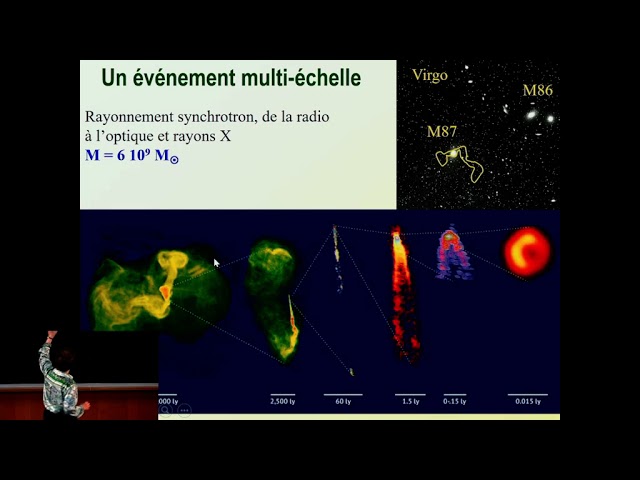
The lecture provides a robust synthesis of black hole research, combining theoretical foundations with the latest observational data. The argumentation is solid, built on established scientific results and logical reasoning. Combes carefully explains complex concepts in an accessible manner, making the case for black holes as real astrophysical objects. She supports her points with specific examples, such as the M87 image, the S2 star orbit, and gravitational wave events, all of which strengthen the credibility of her presentation.
Scientific Rigor, Source Quality, Title Accuracy
The scientific rigor is exemplary. The speaker is a leading expert, and the content is up-to-date as of 2021, including the 2020 Nobel Prize in Physics and recent LIGO/Virgo detections. All claims are backed by published research and observations. The title accurately reflects the content, and no significant discrepancies are present. If any, the lecture is a clear and reliable account of the current state of black hole astrophysics.
162 words
Title / Content Match
The title accurately describes the content, which covers the formation, properties, and observational evidence of black holes.
Quality & Reliability
9/10
The speaker is a highly respected astrophysicist, member of the French Academy of Sciences, and the content reflects current understanding and recent discoveries, including Nobel Prize-winning observations.
Key Moments
Markers derived by PSI from the transcript: the creator did not define chapters.
- Historical context of black holes from Mitchell and Laplace.
- Explanation of Schwarzschild radius and event horizon.
- First image of a black hole (M87) by the Event Horizon Telescope.
- Formation of stellar-mass black holes from supernovae.
- Observation of the Milky Way's central black hole and star S2.
- Gravitational wave detections of black hole mergers.
- Neutron star merger confirming speed of gravitational waves.
Cited Sources
- IAP public conferences — Program of conferences at the Institut d'Astrophysique de Paris where this talk was given.
- Canal-U — Platform hosting the conference recording.
Contribution & Novelties
The speaker offers a comprehensive and current overview of black holes, synthesizing historical discoveries, recent observations, and theoretical insights. She emphasizes the importance of multi-messenger astronomy and the convergence of evidence from electromagnetic and gravitational wave observations. This lecture serves as an excellent educational resource for understanding black holes.
Pour aller plus loin :
- Event Horizon Telescope — The project that captured the first black hole image.
- Gravitational wave — Ripples in spacetime predicted by Einstein, now directly observed.
- Schwarzschild radius — The radius of the event horizon relevant to black hole size.
- Sagittarius A* — The supermassive black hole at the center of the Milky Way.
107 words
Radar Profile
The radar profile shows high scores in information quantity, quality, and global reliability, with a slightly lower but still solid technical level, reflecting an accessible yet expert-level presentation.