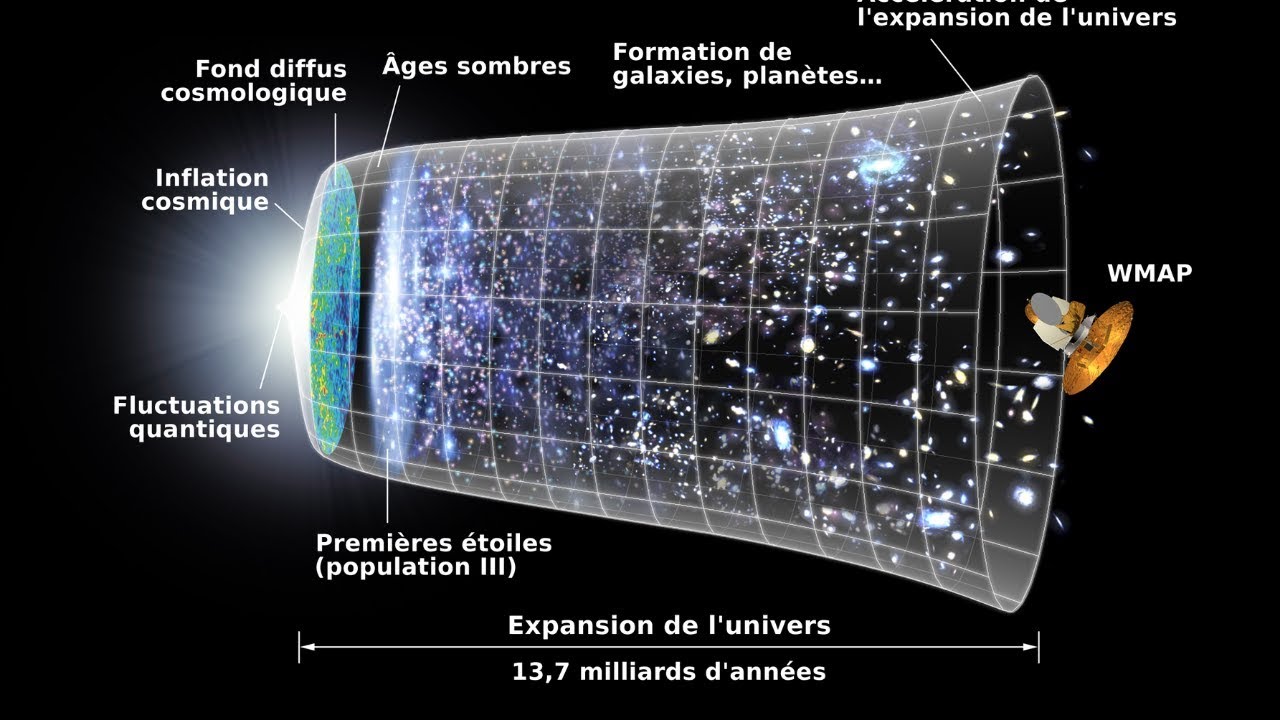
LES CENDRES DU BIG BANG - Hubert REEVES
THE ASHES OF THE BIG BANG - Hubert REEVES
Keywords
Summary
185 words
Critical Evaluation
Value of the Information & Strength of the Argument
The value of this talk lies in its combination of scientific explanation with personal history, providing a unique perspective on the development of modern cosmology. The argumentation is solid, as Reeves carefully explains each piece of evidence for the Big Bang, from the recession of galaxies to the cosmic microwave background and primordial nucleosynthesis. He also addresses counterarguments, such as the steady-state theory, and explains why it was eventually discarded. His personal recollections of scientists like Gamow and Hoyle add depth and authenticity. The scientific content is accurate and well-presented.
Scientific Rigor, Source Quality, Title Accuracy
The talk demonstrates strong scientific rigor, as it is based on well-established astronomical and physical observations. Reeves cites specific experiments and observations, such as the discovery of the CMB by Penzias and Wilson, and the measurements of helium and lithium abundances. He also uses theoretical arguments from nuclear physics. The source of the video is Canal-U, an academic resource. The title accurately reflects the content, focusing on the ‘ashes’ of the Big Bang, i.e., the synthesized elements. The talk is not a formal literature review but an expert narrative, which is appropriate for this format.
200 words
Title / Content Match
The title 'The Ashes of the Big Bang' directly relates to the central theme of nucleosynthesis, the production of chemical elements in the early universe, which are the 'ashes' left over from the Big Bang. The content thoroughly addresses this topic.
Quality & Reliability
9/10
The content is presented by a renowned astrophysicist and covers well-established cosmology. The evidence for the Big Bang is based on multiple independent pillars, and the speaker provides personal insights into the history of discoveries. The information is reliable and scientifically accurate.
Key Moments
Markers derived by PSI from the transcript: the creator did not define chapters.
- Introduction by the seminar organizer, mentioning the schedule and the 100th anniversary of relativistic cosmology.
- Hubert Reeves begins, pays tribute to René Bernas and outlines the three pillars of the Big Bang.
- Reeves recalls his early work at the Dominion Observatory and the mystery of CO2 excitation in space.
- Encounter with Fred Hoyle and the idea that elements are synthesized in stars.
- Studies at Cornell University, discussions about the atomic bomb, and meeting with Hans Bethe.
- Discussion of the steady-state theory versus the Big Bang, and its philosophical implications.
- George Gamow's predictions: primordial helium abundance and the cosmic microwave background.
- Discovery of the cosmic microwave background by Penzias and Wilson in 1965, confirming the Big Bang.
- Details of primordial nucleosynthesis, producing helium, deuterium, and lithium.
- The Spite brothers' measurement of lithium in old stars, supporting primordial nucleosynthesis.
Cited Sources
- Canal-U — Source of the conference recording, indicated in the video description.
Contribution & Novelties
The talk’s original contribution is the interweaving of personal history with scientific development, offering insider anecdotes about key figures. It also clearly explains the three pillars of the Big Bang, with emphasis on nucleosynthesis as the ‘cinders’. The explanation of the triple-alpha process and the Spite plateau is particularly illuminating.
Pour aller plus loin :
- Big Bang nucleosynthesis — Wikipedia article detailing the production of light elements in the early universe.
- Cosmic microwave background — Wikipedia article on the CMB, its discovery, and its role as a cornerstone of the Big Bang.
- Stellar nucleosynthesis — Wikipedia article on the formation of heavier elements in stars, complementing the talk’s discussion of stellar processes.
- Triple-alpha process — Wikipedia article describing the fusion of helium into carbon, central to Hoyle’s prediction.
- Spite plateau — Wikipedia article on the constant lithium abundance in old stars, a key observational constraint for primordial nucleosynthesis.
148 words
Radar Profile
The radar profile is balanced, with high scores on information quantity and quality, a moderate technical level, and strong reliability. This indicates a detailed and trustworthy presentation.