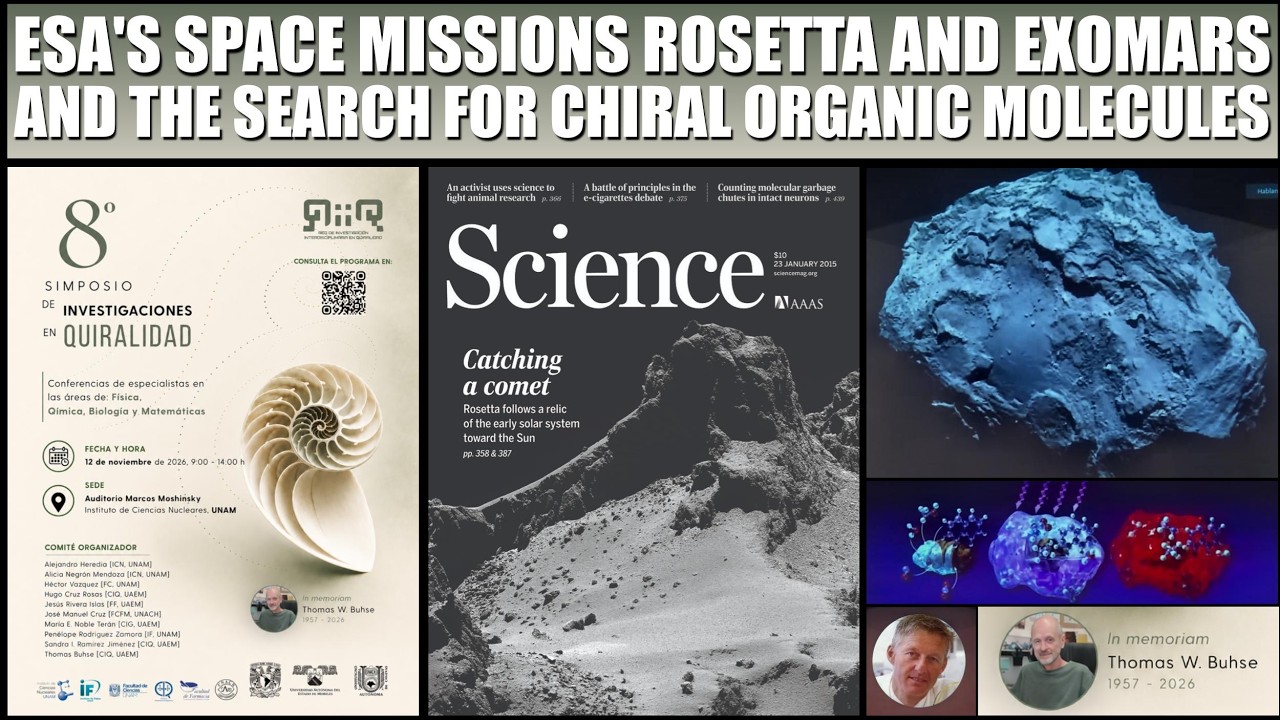
ESA's Space Missions Rosetta & ExoMars & the Search for Chiral Organic Molecules (Uwe Nleierhenrich)
Title history
- ESA's Space Missions Rosetta & ExoMars & the Search for Chiral Organic Molecules (Uwe Nleierhenrich) — observed on 20261121-1631 UTC (YouTube)
Keywords
Summary
169 words
Critical Evaluation
Value of the Information & Strength of the Argument
The talk provides a valuable synthesis of laboratory astrochemistry and space exploration, demonstrating a strong chain of reasoning from controlled experiments to mission applications. The speaker systematically shows how isotopic labeling and analytical techniques ensure contamination-free results, and how circular polarization experiments connect interstellar conditions to biomolecular asymmetry. The argument is well-structured, moving from theory to experimental evidence and then to mission design. However, some claims rely on the researcher’s own authority without detailed external citations, and the audience is expected to accept the significance of enantiomeric excess in prebiotic chemistry without deeper discussion. Nonetheless, the overall argumentation is coherent and compelling, particularly in linking lab results to the selection of chiral columns for space instruments.
Scientific Rigor, Source Quality, Title Accuracy
The presentation demonstrates scientific rigor through explicit mention of peer-reviewed publications (Nature, Science) and controlled experiments. The use of carbon-13 isotopes to exclude contamination is a strong methodological point. The speaker references his own published work and collaborations, but does not provide citations for all claims (e.g., the 2002 Nature paper). The title accurately reflects the content: both Rosetta and ExoMars are discussed in detail, and the search for chiral molecules is a central theme. No contradictory sources are mentioned, and the overall tone is authoritative. The symposium page in the description likely provides additional context, but no external validation is available within the talk itself.
237 words
Title / Content Match
The title accurately summarizes the talk's focus on ESA missions and the search for chiral organic molecules, matching the content well.
Quality & Reliability
8/10
The speaker is an active researcher directly involved in the Rosetta and ExoMars missions, presenting internal laboratory results and mission outcomes. The talk references peer-reviewed publications (Nature, Science) and includes control experiments (isotopic labeling) to rule out contamination. While some claims are presented without detailed citations, the overall methodology and involvement lend a high level of reliability.
Key Moments
Markers derived by PSI from the transcript: the creator did not define chapters.
- Introduction: objective to investigate origins of molecular asymmetry via space missions.
- Laboratory simulation of cometary ices: deposition of C1 molecules and UV irradiation.
- Discovery of 16 amino acids in artificial comets, published in Nature in 2002.
- Introduction of multi-dimensional gas chromatography for enantiomer separation.
- Experiments with circularly polarized light from SOLEIL, inducing chirality in amino acids.
- Overview of Rosetta mission: flyby of asteroid Lutetia and arrival at 67P/Churyumov-Gerasimenko.
- Philae landing: the first landing on a comet, despite unexpected rebound; analysis of surface chemistry.
- ExoMars mission: Rosalind Franklin rover and MUMA GCMS for enantioselective analysis of Martian subsurface.
Cited Sources
- Página del 8° Simposio de Investigaciones en Quiralidad — Event page for the 8th Symposium on Chirality Investigations, where this talk was presented.
- Página de la Red de Investigación Interdisciplinaria en Quiralidad — Facebook page for the interdisciplinary chirality research network, mentioned in the description.
Contribution & Novelties
The talk offers a unique synthesis of laboratory experiments on chiral asymmetry with two major ESA missions, highlighting the role of stereochemistry in astrobiology. The speaker’s own contributions, such as the 2002 Nature paper on amino acids in simulators and the 2016 Science paper on sugars, are significant. The idea that circularly polarized light in space can transfer chirality to organic molecules is compelling and directly supported by his experiments. The presentation also underscores the importance of enantioselective analysis in planetary exploration, which is a novel approach for future missions.
Pour aller plus loin :
- Chirality — Fundamental concept of handedness in molecules, central to the talk.
- Circular polarization — The type of light used to induce enantiomeric excess, relevant to interstellar photochemistry.
- Rosetta (spacecraft) — ESA mission page providing mission details and findings.
- ExoMars — ESA mission page for the upcoming ExoMars rover and its search for life.
- Amino acid — Key molecules studied; the talk shows their formation in cometary ices.
163 words
Radar Profile
The radar profile is strong across all dimensions, with particularly high scores in technical level and information quality, reflecting the speaker's deep expertise and experimental rigor. The lower but still solid score in information quantity and reliability indicates a well-structured talk with substantial content, though not exhaustive in external citations.