Predicting Seed Variance, Warmup & LR Decay | Stanford CS312 Quiz Review with Suhas Kotha
Keywords
Summary
236 words
Critical Evaluation
Value of the Information & Strength of the Argument
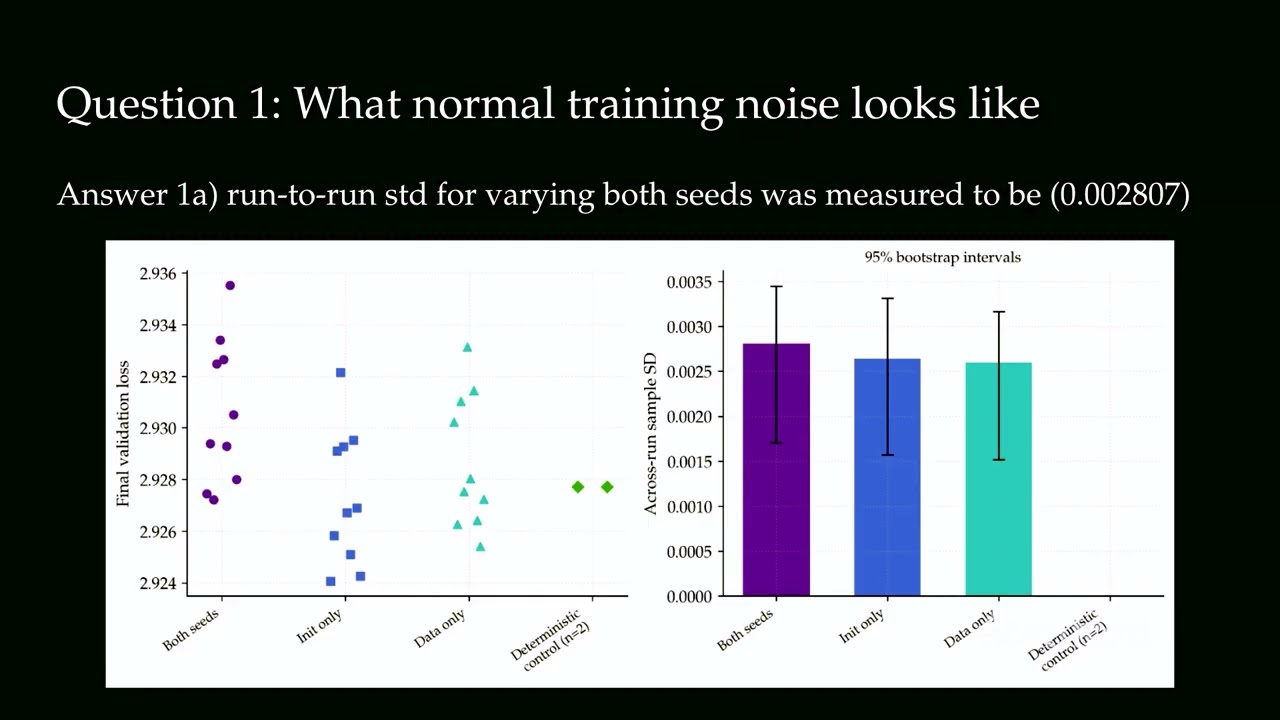
The value lies in converting abstract training questions into concrete, reusable magnitudes: 0.003 validation-loss noise, 0.02 as a plausibly real gain, 1/sqrt(batch) jitter, roughly 20% cooldown, 20-30% warmup, and distinct parameter and gradient norm trajectories. These numbers are presented as setting-specific but operationally useful for judging whether an apparent improvement is noise and for designing ablations. The argumentation is empirical and unusually transparent: each answer is tied to sweeps or plots, the speaker distinguishes papers from experiments, flags instructor opinions as mental-model updates rather than facts, and repeatedly notes confounders such as learning-rate tuning across schedules. It also acknowledges unresolved mechanisms, for example why activation norms spike without warmup or why norm growth reverses only with combined weight decay and linear decay. The main weakness is that the reasoning is often heuristic and compressed; several claims rest on a single model family or course setup, and the lecture does not provide full experimental protocols in the transcript. Still, the argument is internally coherent and appropriately hedged, making it more valuable as a guide to empirical practice than as a definitive theoretical account.
Scientific Rigor, Source Quality, Title Accuracy
Scientific rigor is high for a course review: the claims come from controlled sweeps, held-out quiz answers, and repeated-seed measurements, and the speaker explicitly separates experimental results from opinionated takeaways. The presentation is careful about scope, saying that numbers depend on data, model size, and token horizon, and it notes where a paper’s qualitative shape matched while its magnitudes did not. Source quality is mixed but generally credible: the description links the official CS312 course site, the Stanford Online deep-learning catalog, and the full lecture playlist, while the talk names papers, including seed-variance work attributed to Summers, Dean and Jordan and the AdamC paper, without giving full bibliographic details in the transcript. The video therefore functions as a guided pointer to literature rather than a self-contained citation trail, and viewers would need the course materials to recover exact references. Title/content fit is strong: the title promises seed variance, warmup, and LR decay in a Stanford CS312 quiz review, and the lecture delivers those topics plus batch-size jitter, norm trajectories, and scaling-law extrapolation.
369 words
Title / Content Match
The title accurately signals a CS312 quiz review focused on seed variance, warmup, and learning-rate decay. The content delivers those topics with experimental plots and caveats.
Quality & Reliability
8/10
Stanford course lecture based on held-out experiments, repeated-seed measurements, and explicit caveats about setting dependence; reliability is limited by compressed methodological detail and references that are named but not fully cited in the transcript.
Chapters
- How the quiz review works: papers vs experiments
- Q1: Run-to-run std across seeds (0.003)
- Training loss jitter: train vs validation
- Q2: Jitter scales as 1/sqrt(batch size)
- Q3: Skipping warmup and activation norm spikes
- Q4: How long the WSD decay phase must be
- Q5: Warmup raises the optimal learning rate
- Q6: Parameter and gradient norm trajectories
- Why norms grow: layer norm and weight decay
- Q7: Extrapolating scaling laws (dropout, LR)
- QK norm and learning rate at depth 9
- Q8: One-token perturbation and run variance
- Assignment 2 preview: NQM and µP
Cited Sources
- Stanford CS312: Deep Learning Alchemy course website — Official course site for CS312, providing assignments, course context, and further materials referenced by the lecture.
- Stanford Online deep-learning courses — Stanford Online catalog link included in the description for browsing deep-learning courses.
- CS312 full lecture playlist — YouTube playlist for the full CS312 course, linked in the description.
Concurring Sources
- Decoupled Weight Decay Regularization — Supports the general role of weight decay as a separate regularizer that can affect parameter norms; it does not duplicate the lecture's specific d8 results.
- Neural scaling law — General background consistent with the lecture's discussion of fitting small-scale scaling laws and extrapolating rankings to larger models.
Contribution & Novelties
Its main contribution is pedagogical and empirical synthesis rather than a new research result: it turns a set of quiz questions into a compact map of practical LLM pretraining heuristics, with concrete magnitudes and caveats about when those magnitudes should not be generalized. It is especially useful for distinguishing noise from real gains, for understanding why validation loss is cleaner than training loss, and for seeing how warmup, WSD cooldown, weight decay, and parameter-norm behavior interact in a specific experimental setting.
Further reading:
- Stanford CS312: Deep Learning Alchemy — Course site for assignment context and further experiments.
- Neural scaling law — Background for the extrapolation discussion in Q7.
- Decoupled Weight Decay Regularization — Reference on AdamW-style weight decay relevant to parameter-norm control.
- Learning-rate warmup and WSD cooldown schedules, without a single canonical URL — Discussed as setting-dependent empirical knobs in Q4-Q5.
141 words
Radar Profile
The profile is high on technical depth and information quantity, with solid but not perfect reliability because the lecture is empirically grounded yet setting-specific and does not expose full protocols. Information quality is strong for a course review, while overall reliability is tempered by reliance on a single model family and unstated experimental details.