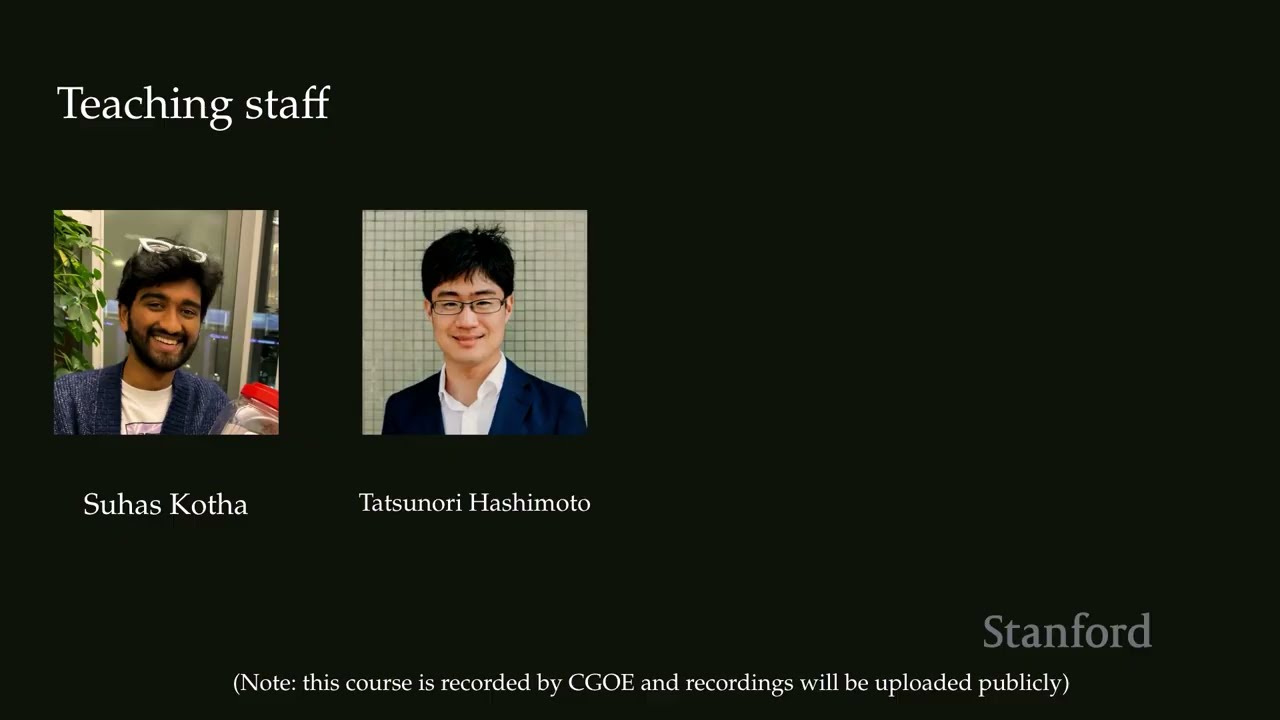
Deep Learning by Prediction: Intro | Stanford CS312 Lecture 1 with Tatsunori Hashimoto & Suhas Kotha
Keywords
Summary
226 words
Critical Evaluation
Value of the Information & Strength of the Argument
The lecture provides significant value by addressing a critical gap in deep learning education: the inadequacy of classical statistical theories when applied to large neural networks. The argumentation is solid: it starts by demonstrating the failure of traditional intuitions with concrete examples (e.g., the brittleness of double descent), then pivots to the idea that prediction-based learning builds robust mental models. The pedagogical approach is innovative, using prediction quizzes as a stress test for understanding. The speakers justify the ungraded assignments by noting the reality of AI-assisted learning and fairness, and they provide a practical framework with the d8 model to enable reproducible experiments. The live demos (learning rate sweep, ablations) ground the discussion in empirical evidence, strengthening the argument that empirical prediction is superior to theoretical narratives.
Scientific Rigor, Source Quality, Title Accuracy
The lecture demonstrates scientific rigor by referencing influential works: Ali Rahimi’s ‘Random Kitchen Sinks’ (2017 Test of Time Award) and Noam Shazeer’s gated linear unit paper (2020) which admitted the lack of explanations for architecture choices. These references anchor the course in the broader debate about deep learning’s theoretical foundations. The course website (deep-learning-alchemy.github.io) is a credible institutional source. The title accurately describes the content: it is an introduction to deep learning by prediction, aligned with the course’s philosophy. No discordant sources were found; the lecture is internally consistent. However, the lecture does not provide formal citations beyond these two papers and the course website, but that is typical for an introductory lecture.
255 words
Title / Content Match
The title accurately reflects the content: an introductory lecture on the CS312 course, focusing on prediction as a method to understand deep learning.
Quality & Reliability
9/10
The lecture is delivered by Stanford professors and PhD students with deep expertise in deep learning, and it references well-known research (Rahimi's and Shazeer's work). The content is current as of 2026 and presented with clarity and caution about the brittleness of DL phenomena.
Chapters
- Welcome and course staff introductions
- Deep learning breaks classical ML intuitions
- Embracing the alchemy: Rahimi and Shazeer
- Teaching deep learning with prediction quizzes
- Why prediction is understanding
- Assignments: topics, 0% grade, AI use
- Quizzes, partial credit, and fairness
- Tutorials, Modal compute, and the waitlist
- Who this class is for: pros and cons
- Scoping deep learning down to pre-training
- The d8 model organism and default run
- Demo: learning rate sweep and 2.93 loss
- Sample assignment: ablations and residuals
- In-class sample quiz and answers
Cited Sources
- CS312: Deep Learning Alchemy Course Website — Official course website with assignments, quizzes, and resources.
- Stanford Online Deep Learning Courses — Link to browse Stanford's online deep learning courses.
Contribution & Novelties
This lecture proposes a radical rethinking of deep learning education by replacing theory-based instruction with prediction-based experimentation. It introduces the concept of ‘prediction as understanding’, drawing an analogy to early astronomy where prediction preceded theory. The course also pioneers the use of a small, reproducible model organism (d8) to make experiments accessible and scalable, and it embraces AI-assisted learning by making assignments ungraded. The ‘alchemy’ perspective openly acknowledges the lack of theoretical explanations, yet argues for empirical understanding through prediction quizzes. This approach has not been previously formalized as a pedagogical method, making this a novel contribution to AI education.
Pour aller plus loin :
- Bias–variance tradeoff — Central concept critiqued in the lecture as misleading for deep learning.
- Double descent — Phenomenon discussed as a brittle explanation for deep learning generalization.
- Ali Rahimi — Researcher who popularized the alchemy metaphor for deep learning in his 2017 NeurIPS talk.
149 words
Radar Profile
The radar profile is balanced with high scores in information quality, technical level, and reliability, while quantity of information is slightly lower due to the introductory nature of the lecture. The high technical level reflects the advanced audience, but the content remains accessible through clear examples and demos.