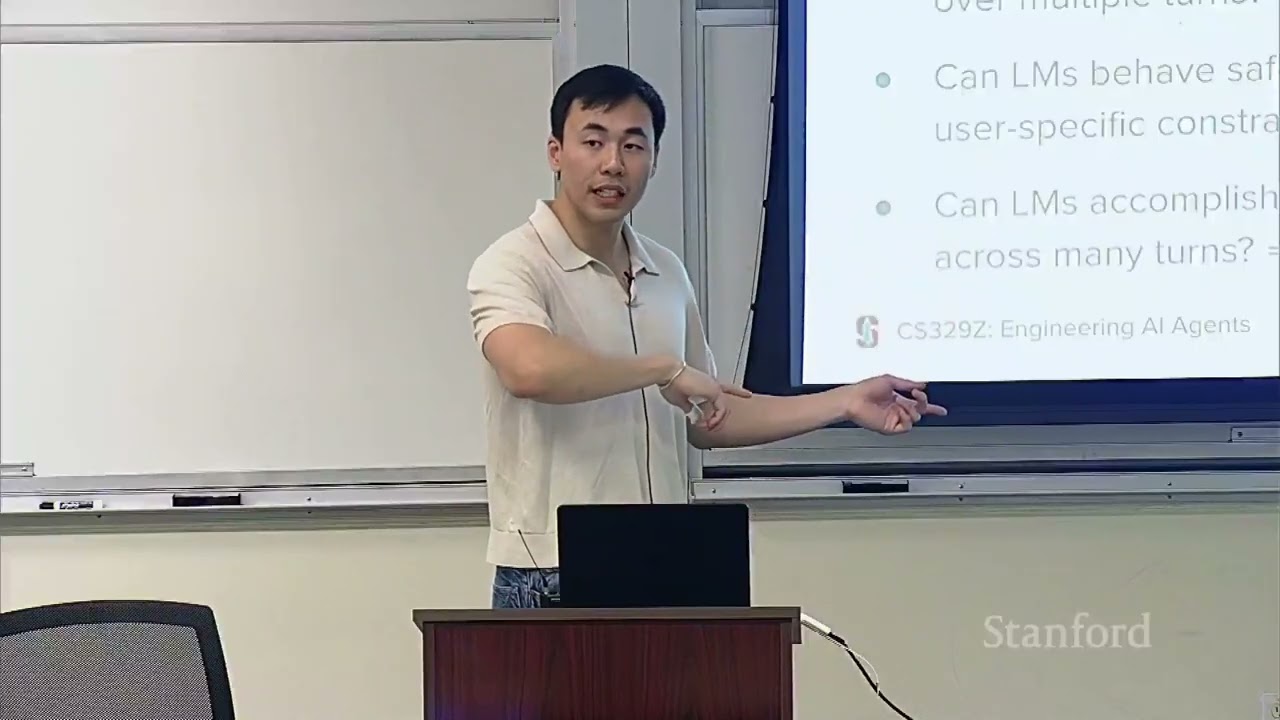
How to Evaluate AI Agents: Benchmark Design | Stanford CS329Z Lecture 12 with John Yang
Keywords
Summary
219 words
Critical Evaluation
Value of the Information & Strength of the Argument
The lecture’s value lies in organizing a messy evaluation landscape into usable distinctions. The 4-tuple framing (request, environment, stopping criteria, scorer) gives practitioners a concrete checklist, and the separation between task formulation and evaluation protocol clarifies why two benchmark runs on the same model can yield different scores. The discussion of harnesses, scaffolds, budgets, and stopping rules is especially useful because it names variables that are often left implicit in leaderboard comparisons.
The argumentation is pedagogical and cumulative: Yang moves from early NLP and exam benchmarks to chat, safety, and agent benchmarks, then uses case studies to illustrate design choices and failure modes. It is strong in conceptual synthesis and practical judgment, especially on contamination and saturation. Its main limitation is that the argument is largely qualitative; the lecture does not present original experiments or systematically test the claimed effects of harness design, budget choices, or contamination-mitigation strategies.
Scientific Rigor, Source Quality, Title Accuracy
Scientific rigor is generally strong for a course lecture: the speaker has direct credibility in agent benchmarking, and the presentation is structured, transparent about design trade-offs, and careful to distinguish capabilities from behavior. Source quality is uneven in the spoken format: many benchmarks and papers are named informally, but citations are sparse, and the description supplies only one explicit reading (Zhu et al., 2025) plus course links. Some claims about contamination, Elo saturation, and harness effects are plausible and consistent with the literature, but they are not evidenced in detail within the talk.
Title/content fit: the title accurately describes a lecture focused on evaluating AI agents and designing benchmarks, including task formulation, protocols, case studies, and benchmark properties.
281 words
Title / Content Match
Accurate and specific: the lecture is centered on evaluating AI agents and on benchmark design, including task formulation, evaluation protocols, case studies, and desirable benchmark properties.
Quality & Reliability
8/10
High-quality expert lecture from a leading benchmark builder, with clear structure, explicit framework, and concrete case studies. It remains a pedagogical overview rather than a systematic review; several empirical claims about contamination, saturation, and harness effects are asserted rather than demonstrated with data in the talk.
Chapters
- Introduction: Measuring Agent Progress
- From Next-Token Prediction to NLP Benchmarks
- Exam Benchmarks: MMLU to Humanity's Last Exam
- Chat and Safety Benchmarks: Chatbot Arena
- Q&A: Responding to Poor Benchmark Results
- Why Benchmarks Matter and Benchmark Overfitting
- Q&A: How Models Overfit to Benchmarks
- Agent Benchmarks: Task Formulation and Protocol
- Designing Tasks, Environments, and Verification
- Q&A: Harnesses, Scaffolds, and Reward Hacking
- Evaluation Protocol: Attempts, Stopping, Budgets
- Case Studies: Text Games, Web Agents, τ-bench
- Case Studies: Terminal-Bench, OSWorld, CodeClash
- Properties of a Good Agent Benchmark
Cited Sources
- CS329Z: Engineering AI Agents course website — Official course site referenced in the description; source for course structure and readings.
- Stanford Online courses in Agentic AI — Course-browsing link from the description.
- CS329Z full playlist — Playlist for the full lecture series.
- Zhu et al., Establishing Best Practices for Building Rigorous Agentic Benchmarks (2025) — Reading listed in the description; relevant to rigorous agentic benchmark construction.
- SWE-bench — Benchmark co-created by the speaker and discussed as a case study in agent evaluation.
- Chatbot Arena — Human-preference and Elo-based evaluation platform discussed in the lecture.
- τ-bench — Agent benchmark case study cited for task formulation and evaluation protocol.
- Terminal-Bench, OSWorld, CodeClash — Agent benchmark case studies discussed near the end of the lecture.
Concurring Sources
- SWE-bench: Can Language Models Resolve Real-World GitHub Issues? — Primary SWE-bench paper; concordant with the lecture's account of task formulation for real GitHub issues.
- Chatbot Arena: An Open Platform for Evaluating LLMs by Human Preference — Documents the human-preference and Elo-based approach described in the lecture.
- HELM: Holistic Evaluation of Language Models — Supports the lecture's discussion of aggregated multi-task benchmark suites and evaluation transparency.
Contribution & Novelties
The lecture’s original contribution is mainly pedagogical and synthesizing: it packages agent evaluation into a clear 4-tuple (request, environment, stopping criteria, scorer), separates task formulation from protocol, and links historical benchmark design to agentic settings. It also gives practical design criteria and maps contamination-mitigation strategies and competitive/Elo approaches to agent benchmarks. It is not a new empirical study.
Further reading:
- SWE-bench: Can Language Models Resolve Real-World GitHub Issues? — The benchmark co-created by the speaker; useful for understanding real-world task formulation and verification.
- Chatbot Arena: An Open Platform for Evaluating LLMs by Human Preference — Background for the Elo/competitive evaluation discussed in the lecture.
- HELM: Holistic Evaluation of Language Models — Relevant to aggregated multi-task benchmarks and evaluation transparency.
- Data contamination in LLM benchmarks — a key design problem discussed in the lecture; the talk describes private splits, fresh tasks, and refreshed issue sets.
144 words
Radar Profile
The profile is balanced and high: information density and technical depth are strong, while reliability is supported by the speaker's direct benchmark-building experience. The main limitation is that the lecture is a broad conceptual tour rather than a systematic, citation-heavy review.