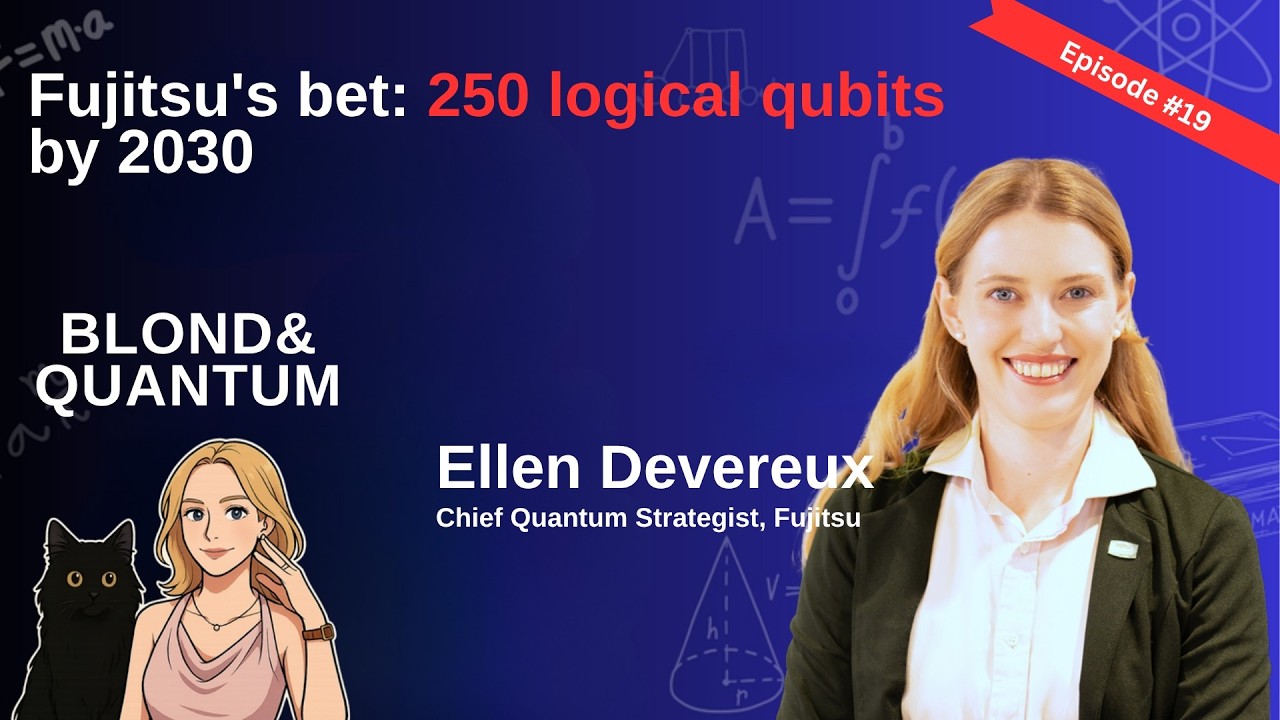
Fujitsu's Bet: 250 Logical Qubits by 2030 | Ellen Devereux | Ep. 19
Keywords
Summary
270 words
Critical Evaluation
Value of the Information & Strength of the Argument
The value of the episode lies mainly in its practical framing for business and technology leaders. Devereux gives a coherent account of why quantum adoption should be understood through two separate roadmaps: hardware scaling and the maturation of useful applications. That distinction is useful because it discourages simple qubit-count comparisons and directs attention to logical qubits, error correction, connectivity, and application readiness. The discussion of the Digital Annealer is also valuable as a concrete example of how quantum-inspired optimization can be sold and used before fault-tolerant quantum computing exists. The space-debris mission-planning example, the financial-services discussion, and the drug-discovery references give the audience a sense of where near-term value is being sought. The argumentation is generally clear and internally consistent, but it relies heavily on expert assertion and company framing rather than on demonstrated results. Claims about 250 logical qubits by 2030, the need for multiple qubit modalities, and the commercial value of quantum-inspired methods are presented as strategic judgments, not as independently tested findings. The episode is strongest when it explains trade-offs and weakest when it moves from technical description to forecasts about market timing and business impact.
Scientific Rigor, Source Quality, Title Accuracy
Scientific rigor is moderate. The episode is an expert interview rather than a peer-reviewed study, and the guest speaks from a corporate strategy role at Fujitsu. Several claims are plausible and broadly aligned with public discussion in quantum computing, including the difference between physical and logical qubits, the difficulty of scaling dilution refrigerators, and the use of photonic links for modular architectures. However, the episode provides no formal references, no benchmark data, and no detailed methodology for the Fujitsu executive survey. Named partners and products, such as Astroscale, Qubitra, Qimera, and Yakumo, are mentioned without supporting documentation in the transcript. The description links are mainly corporate and promotional rather than scientific. The title is accurate and not sensationalized: the episode really is about Fujitsu’s 250-logical-qubit target and the strategic bets behind it.
336 words
Title / Content Match
The title accurately reflects the episode's central claim: Fujitsu's target of 250 logical qubits by 2030 and the strategic implications of that roadmap. The discussion stays focused on that target, the hardware and application roadmaps, and how business leaders should interpret them.
Quality & Reliability
6/10
The episode is a long-form interview with a senior quantum strategist at Fujitsu, so it offers useful insider framing and concrete strategic vocabulary. Its reliability is limited by the vendor perspective, the absence of peer-reviewed references or independent benchmarks, and the use of an internal executive survey whose methodology is not detailed. Most technical claims are plausible and broadly consistent with public quantum-computing discourse, but they are not independently verified in the episode.
Chapters
- Intro
- Welcome: Dr. Ellen Devereux, Fujitsu
- The Digital Annealer, explained
- Space debris and quantum-inspired optimization
- From consultant to a PhD in quantum algorithms
- What a Chief Quantum Strategist does
- Two roadmaps: hardware and useful applications
- Why superconducting and diamond spin qubits
- Quantum next to HPC and AI
- Is quantum-inspired a distraction?
- Sovereignty and European clients
- Fujitsu's executive survey
- Logical qubits, MegaQuOps and better metrics
- Where should a business leader start?
- The Quantum Value Assessment: time and cost
- Where quantum projects stall
- Public sector and defense
- Qubitra and financial services
- Drug discovery and Qimera
- 2030 and the next ten years
- Better answers for whom?
Cited Sources
- Fujitsu — Corporate website linked in the description; source for Fujitsu's quantum-computing and quantum-inspired activities discussed throughout the episode.
- Astroscale — Named in the transcript as the space-debris removal company partnered with on mission-planning optimization.
- Qubitra — Mentioned in the chapter list and discussion as a Fujitsu-related financial-services quantum initiative.
- Qimera — Mentioned in the chapter list and discussion in connection with drug discovery and quantum-inspired optimization.
- Blond & Quantum newsletter — Podcast newsletter linked in the description; not a scientific source but part of the episode's published references.
Concurring Sources
- Quantum computing — General background consistent with the episode's explanation of qubits, quantum algorithms, and the difference between physical and logical qubits.
- Quantum error correction — Supports the episode's emphasis on logical qubits and the need for error correction to make quantum computation reliable.
- Superconducting quantum computing — Provides technical background for the superconducting-qubit platform and the cryogenic constraints mentioned by Devereux.
- Quantum annealing — Relevant to the Digital Annealer and the broader family of quantum-inspired optimization approaches discussed in the episode.
External References
Contribution & Novelties
The episode’s main original contribution is an insider account of how Fujitsu frames its quantum strategy: not as a single hardware race but as two parallel roadmaps for hardware and useful applications. It explains why Fujitsu pursues both superconducting qubits and tin-vacancy diamond spin qubits, linking the choice to the physical limits of dilution refrigerators and the need for photonic interconnects. It also presents quantum-inspired optimization as both a near-term commercial product and a way to build organizational readiness for quantum computing. The discussion of metrics, especially the limitations of physical qubit counts and the ambiguity of MegaQuOp-style measures, is a useful corrective to simplistic marketing comparisons.
Further reading:
- Quantum error correction — Background on logical qubits and the error-correction overhead that separates physical from logical qubit counts.
- Superconducting quantum computing — Context for the superconducting modality and dilution-refrigerator constraints discussed in the episode.
- Quantum annealing — Relevant to the Digital Annealer and quantum-inspired optimization framing.
- Shor’s algorithm — The algorithm referenced in relation to encryption and government interest in quantum computing.
- Post-quantum cryptography — Useful context for the distinction Devereux draws between quantum-computing strategy and post-quantum security planning.
189 words
Radar Profile
The profile is broad rather than deep: information quantity is high and technical specificity is moderate, reflecting a strategic interview rather than a technical deep dive. Reliability is constrained by the vendor-interview format and the absence of independent performance data. The episode is strongest on roadmap framing and weakest on verifiable benchmarks.