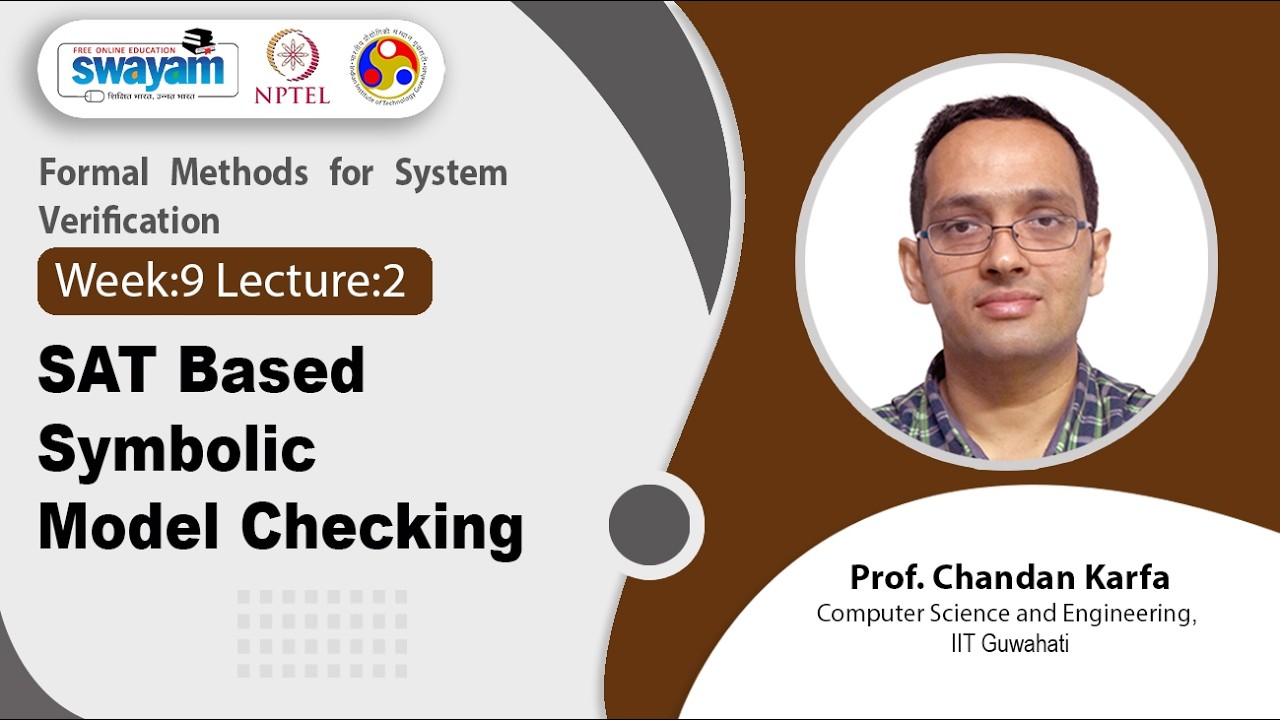
Lec 40: SAT based Symbolic Model Checking
Keywords
Summary
179 words
Critical Evaluation
Value of the Information & Strength of the Argument
The value of the information lies in its clear exposition of a practical alternative to BDD-based model checking, addressing scalability concerns. The argumentation is solid: it first identifies the weaknesses of BDDs, then introduces the bounded model checking formulation as a way to avoid encoding the entire transition system upfront. The use of a concrete circuit example (arbiter) grounds the theoretical constructs in a tangible problem, making the encoding process intuitive. The instructor methodically constructs the SAT formulas, explaining each component: initial state, transitions, and negation of the property. The step-by-step checking of length 2 and then length 3 illustrates the iterative nature and the reasoning behind each result. This pedagogical approach effectively conveys both the conceptual shift and the practical implementation details.
Scientific Rigor, Source Quality, Title Accuracy
The scientific rigor is high: the content is well-structured, definitions are precise, and the reasoning is clear. The lecture draws upon previously established concepts (BDD, SAT, temporal logic) and builds on them coherently. The sources are limited to the course materials (links in the description), but the lecture is self-contained, requiring no external references for the core material. The title accurately matches the content, which is entirely devoted to SAT-based symbolic model checking. The teaching is consistent with standard formal verification literature, and the example is effectively used to illustrate the concepts. There is no obvious bias or unsupported claim.
238 words
Title / Content Match
The title accurately reflects the content: the entire lecture is dedicated to SAT-based symbolic model checking, including motivation, methodology, and a detailed example.
Quality & Reliability
9/10
The lecture is delivered by an IIT professor, presents rigorous technical content with clear explanations of SAT-based symbolic model checking, building on established theoretical foundations. The argumentation is well-structured and demonstrated with a concrete example, ensuring high reliability.
Key Moments
Markers derived by PSI from the transcript: the creator did not define chapters.
- Introduction to the lecture on SAT-based symbolic model checking.
- Discussion of limitations of BDD-based model checking, motivating the SAT-based approach.
- Core idea: encoding model checking as a SAT problem, introducing bounded model checking.
- Introduction of the arbiter example and its encoding into Boolean formulas.
- Construction of state variables and transition relations for the SAT formula.
- Checking the property for path lengths 2 and 3, obtaining unsatisfiability and explaining why.
Cited Sources
- Course Preview: Formal Methods for System Verification — Course page providing overall context and syllabus.
- Playlist: Formal Methods for System Verification — Full playlist of lectures, including this one.
Contribution & Novelties
This lecture provides a pedagogical bridge from classical BDD-based symbolic model checking to SAT-based techniques, emphasizing bounded model checking as a practical approach. It clarifies the encoding of transition systems and temporal properties into Boolean formulas, demonstrating with a detailed example. The novelty lies in its instructional clarity, making the concept accessible to students while maintaining technical depth.
Pour aller plus loin :
- Bounded model checking — Directly related to the finite-path searching method discussed.
- SAT solver — The core tool used for satisfiability checking.
- Binary decision diagram — The alternative symbolic representation that motivates the SAT-based approach.
- Linear temporal logic — The temporal logic used for specifying properties in model checking.
112 words
Radar Profile
The radar shows consistently high scores across information quantity, quality, technical level, and reliability, indicating a well-rounded lecture that is both informative and trustworthy. The balance suggests a strong educational resource for advanced students.